
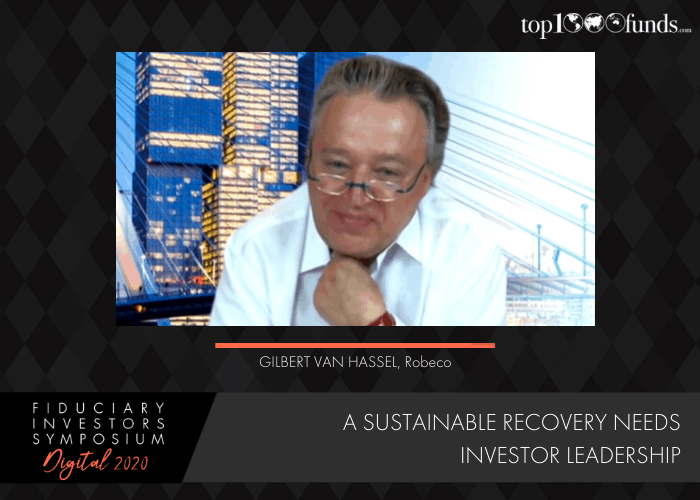

[vc_empty_space height=”10px”][vc_media_type_category]Global asset manager Robeco has found proactive stewardship triggers important changes in corporate behaviour. Chief executive Gilbert van Hassel urges FIS 2020 Digital delegates to do the same.
The appointment of climate expert Samuel Leupold onto the board of energy multinational Enel Group after a campaign led by Robeco and Climate Action 100+ (the investor initiative targeting the world’s dirtiest companies) shows the power of investor collaboration, said Gilbert van Hassel, chief executive, Robeco, speaking at FIS 2020 Digital. Discussing how to ensure a sustainable recovery in the wake of the pandemic, he called for action among governments and major asset owners to push for sustainability, saying “now is the time.”
“We hope Enel will make major steps towards the non-fossil fuel delivery of products to clients,” he said, reflecting on the long-term impact of investor collaboration on the energy company. Something that he said has also triggered change at oil giant Shell where investors like the United Kingdom’s Church of England Pension Board have influenced corporate sustainability policies.
“Making sure we actively vote and actively engage with corporates can change behaviour. We just need to persist and make sure we do it together,” he said.
A sustainable recovery and sustainable economy require leadership and capital, said van Hassel. Investors need to look at long-term trends and focus on a “healthy planet” that ends species extinction and warming trends.
“If we continue on this path, we will have more storms, disease and vulnerability,” he said. van Hassel also said it was essential that wealth was shared.
“People are protesting about inequality,” he said referencing a lack of opportunity to study and access healthcare particularly.
He argued that the recently common argument that “this time things will be different” has no basis: human behaviour doesn’t always change. Indeed, he observed how the recent re-opening of Brussels airport showed undiminished demand for air travel. However, van Hassel is also encouraged by the sacrifices people have made and the “willingness to do things differently” in lockdown. During the crisis social distancing was respected and biodiversity in Amsterdam’s’ canals increased.
“I hope this could be the spark the world needs to start working together to get into a sustainable economy,” he said.
Robeco, which manages around $200 billion, has had 95 per cent of its 1000 staff working from home since mid-March, but is now starting to bring employees back into its offices. He said there are many more rules on bringing people back to corporate premises.
“Working from home is going to be constant for a while,” he said, but added that working from home brings challenges like maintaining a company culture, cohesion and the loss of the social side of office life.
He said Robeco’s assets were conservatively positioned and the manager was able to generate cash relatively easily during the crisis. Getting the operational side of lockdown right was more of a challenge, however.
van Hassel said when sustainability is integrated into investment decision making and processes, it is no longer possible to greenwash. He said sustainability has become “mainstream” and many organisations are trying to “catch up.” Those that understand that sustainability ensures better risk-adjusted returns, and fully integrate ESG into their analysis alongside adopting regulations and taxonomies, are “no longer greenwashing.”
He said governments which have focused on short-term health issues and the need to support companies now need to focus on rebuilding in a sustainable way. Here he urged governments to galvanize around the SDGs.
“The Paris agreement and the SDGs are a road towards a more stable, inclusive society,” he said, noting how the SDGs ensure long term growth, less volatility and a better quality of life. van Hassel concluded that if governments had the “audacity” and “willingness” to introduce a global carbon price it would “be a huge help” and one of the quickest ways to solve pollution.
“Polluters are not seeing the consequences, but we, society, pay the price,” he concluded.







Leave a Comment
You must be logged in to post a comment.
Login