
Social conditions and the economy

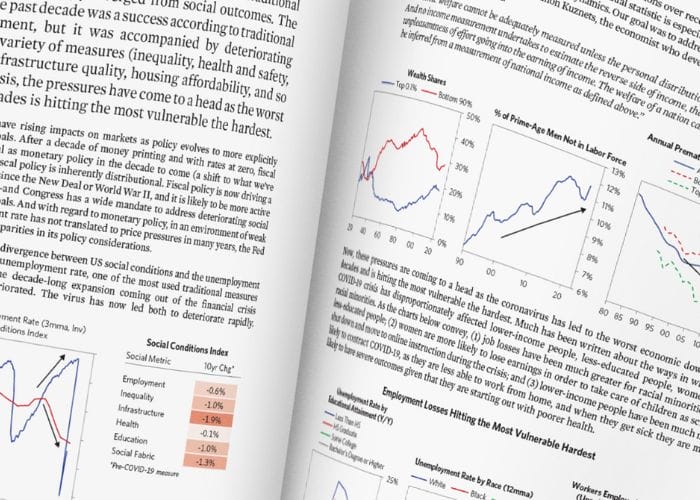
The ultimate goal of economic policy is simple and timeless—to ensure prosperity and maximize living standards. Broad macroeconomic measures such as GDP growth, the unemployment rate, and inflation had for decades been a good proxy of rising prosperity, so they have dominated economic policy making and are enshrined in most central bank mandates. But even before the COVID-19 crisis, it had become clear that traditional economic measures have increasingly diverged from social outcomes. The economic expansion of the past decade was a success according to traditional measures of full employment, but it was accompanied by deteriorating social conditions across a variety of measures (inequality, health and safety, educational attainment, infrastructure quality, housing affordability, and so on). With the COVID-19 crisis, the pressures have come to a head as the worst economic downturn in decades is hitting the most vulnerable the hardest.

Click here to read the full paper.

Sponsored Content

Leave a Comment

Climate the No.1 priority for 2021

Climate the No.1 priority for 2021

Climate is by far the number one sustainability priority for investors in 2021 according to a poll of asset owners from more than 32 countries which came together for the Top1000funds.com online Sustainability event in March.

Sort content by

Overcoming deepening inequality: CalPERS

How can investors work together to combat inequality? In this podcast episode Amanda White speaks to the president of CalPERS, Henry Jones, about his own experience and the fund's journey in tackling diversity and inclusion, in particular issues of racism.

The path to a sustainable economy

This episode explores the key pillars of a sustainable recovery including the three important long term trends that need to be addressed climate change, loss of biodiversity and inequality. It explores the key role for the finance industry which includes building new models that are not only about maximising monetary profits but also transition theory, and the value of ecological and social capital.

The need for urgent action on climate

Nigel Topping who was appointed by the UK Government as the High Level Climate Action Champion for United Nations climate talks, COP26 joins Fiona Reynolds, chief executive of the PRI, in conversation with Amanda White, editor of Top1000funds.com This episode focuses on climate change and how, amongst and despite, the short-term focus of this COVID-19 crisis, we can mobilise government, business and investors into action around this important issue of climate change.

Investor collaboration on sustainability

How can investors be a catalyst for change and have an active voice in a sustainable recovery? This episode explores the role of investors and how they can collaborate for effective collective action. It includes the work of one of the leaders in sustainable investing and the biggest pension fund in Europe, APG. It invites investors to have an active voice in a sustainable recovery.

Minnesota to expand private markets

A strategic and long-term focus sees the Minnesota State Board of Investment CIO, Mansco Perry, adopt a patient and encouraging approach when it comes to climate change and diversity. The $104 billion fund is also looking to expand its allocation to private markets, and double its internal team.

Investors’ role in a carbon-neutral 2050

Everyone's talking about it - a carbon-neutral economy by 2050 - but what are investors doing about it? Amanda White reports on the specific climate activities of some of the world's leading asset owners.

Previous