
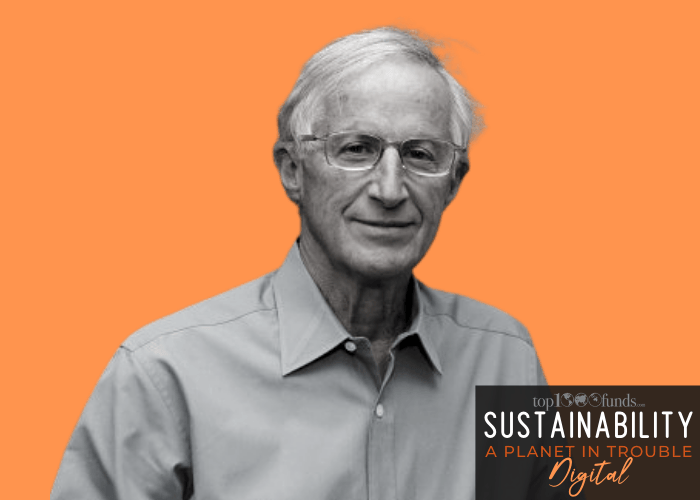

Nobel Prize winner Professor William Nordhaus, Sterling Professor of Economics and Professor of Forestry and Environmental Studies at Yale University, explains his theory of ‘No Regrets’ whereby companies can integrate ESG at a level that brings real benefits for society but has limited impact on the corporate.
Companies integrating ESG need to examine how they deal with the harmful externalities that they generate. By reducing the damaging spill overs of corporate activity like pollution, but without huge financial costs or damaging shareholder value lies at the heart of ESG integration, said Professor William Nordhaus, Sterling Professor of Economics and Professor of Forestry and Environmental Studies at Yale University.
Speaking at “Sustainability Digital: A Planet in Trouble” the recipient of the 2018 Nobel Memorial Prize in Economic Sciences outlined the arguments in his book “The Spirit of Green,” explaining that ESG holds so many concepts and ideas it is easy to become muddled. By looking at ESG through the lens of reducing externalities that benefit society without real corporate harm brings clarity.
Nordhaus used the analogy of turning down a thermostat to explain how corporates can introduce a policy of ‘No Regrets.’ The heating is still on, just a notch lower so that “we don’t’ feel the difference” but it has a “substantial difference” on externalities.
“We can make substantial contributions to reducing footprints in a win for society at small cost for firms.”
Nordhaus said that many firms achieve a win-win, where good management and governance brings benefits to both the firm and society. Challenges come for companies that act in the interests of society in a way that impacts the company negatively. However, a small reduction in a firm’s carbon footprint has a substantial impact on others. He said that “modest” ESG integration that reduces externalities increases shareholder value in a way that is also a “win-win” that does not mean a company will lose out. It has a benefit for society and comes at a low cost to the firm – and does not trigger a shareholder revolt.
Nordhaus said that investors should choose portfolio companies that apply this principle, selecting companies that reduce their carbon footprint at a low cost and designing portfolios that have lower impact. He said this approach would allow investors to reduce their portfolio imprint “with minimal loss” and he urged investors to “intervene with managers” to design portfolios for lower impact.
Carbon price?
Nordhaus, who outlined his argument for a carbon tax last year, told delegates that he believes a price on carbon is more likely under the Biden administration. However, he said it wouldn’t happen in the near future.
“It requires legislation and a majority in the House and Senate,” he said. He does believe US federal regulations are likely around auto emissions, however.
“I would be very surprised if this was not introduced,” he said.
He also urged governments to facilitate innovation in low carbon technology. The “radical” and “deep change” needed to reach net zero by the middle of the century requires a new landscape of innovation fuelled by a price structure where innovation pays off.
“Profit orientated firms need to have a price structure that reflects this priority,” he said, urging for a price structure that incentivizes private actors to conduct research. “The battery people know what to do; they just need an incentive,” he said.
In broad concluding comments, he said that corporations are increasingly viewed as members of society with economic and ethical obligations. He said ESG integration involves mostly voluntary actions, and said the idea that profits are the “central goal” for businesses is a “misleading compass” that needs correcting. He said containing the impact of climate change is possible if we go about it efficiently and at a low cost, focusing on corporate externalities. “We don’t’ have to go back to the Stone Age,” he said. “You don’t cure a pandemic by holding up in the house. You do it with a vaccine.”








Leave a Comment
You must be logged in to post a comment.
Login