


ESG-momentum matters when it comes to outperformance according to new research by Pictet Asset Management’s head of sustainability Eric Borremans who says investors should sharpen their ESG lens and use active ownership to trigger positive change.
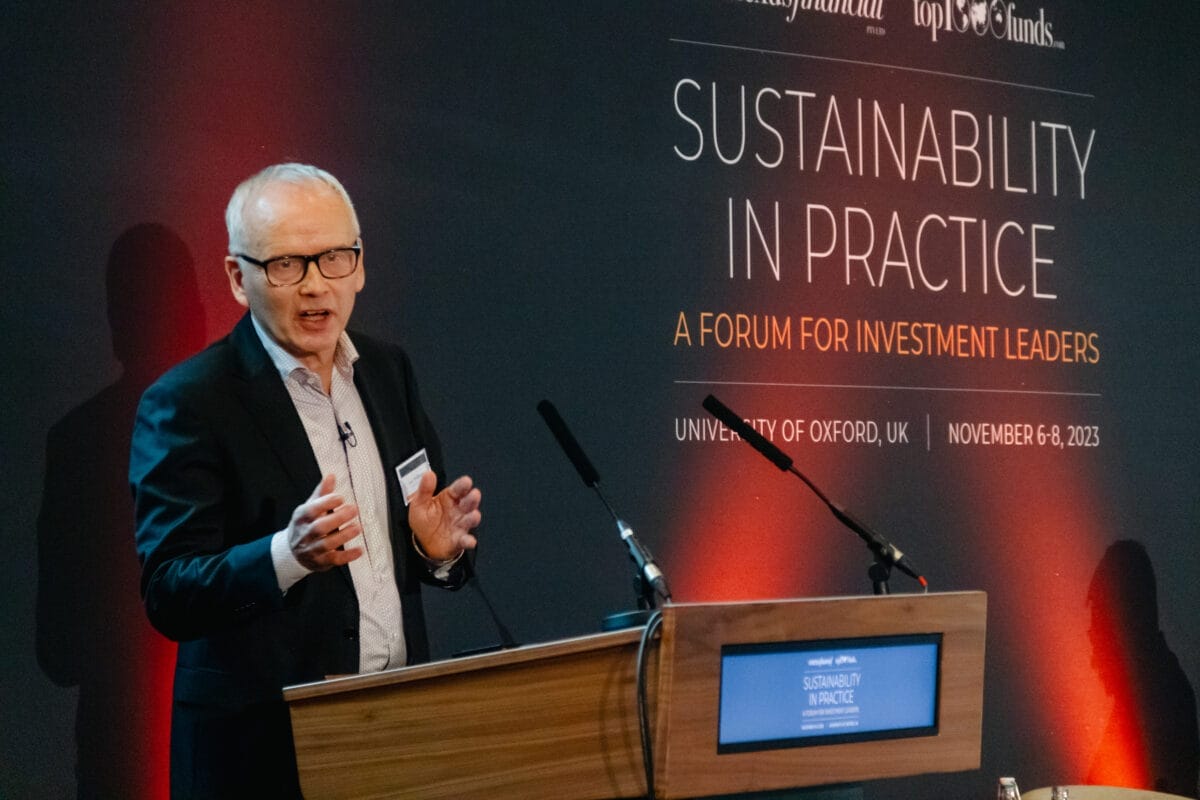
Speaking at Sustainability in Practice at Oxford University he highlighted the new research from the Switzerland-based investor that examines the performance attribution of conventional and ESG indices over long time horizons revealing the importance of governance and engagement.
Borremans said that risk-adjusted returns from ESG fixed income indices are in-line with wider market returns. “That’s good news as it means that investors can build portfolios with stronger ESG credentials without losing money.”
He added that the green economy has had ups and downs but the overall picture remains positive as the sector continues to benefit from supportive policy measures such as the IRA. “Since 2018, companies that derive more than half of their revenue from the green economy, as represented through the FTSE ET 100, have generated superior risk-adjusted returns,” he said.
Still, he noted that the hike in interest rates has had a negative impact on renewable energy projects, contributing to delays and cancellations in offshore wind while other challenges include the outside position of some companies in green indices.
Despite positive returns, Borremans said that investors still question the ESG ratings that underpin the construction of indices with many concerned about the extent to which ratings are a good lens to anticipate investment risks and opportunities.
In 2018 Pictet sharpened its own ESG lens, developing smarter ways to analyse companies that included focusing more on corporate governance. The firm’s analysis explored whether governance was “functional or dysfunctional,” analysed companies’ products and services; operations risk, ESG objectives and whether the footprint it left behind was generated at the expense of society and the environment.
“We asked if the company was facing liabilities because of mismanagement,” he said.
Pictet applied its key questions to thousands of companies and then aggregated the results together. A challenging process that had to unpick multiple issues. “For example, we thought that a weakness in one area could be compensated by strength in another but decided that each issue needed to be looked at in its own right to find outliers.”
The analysis also explored momentum, looking particularly at corporate progress over a 12-month period. It can take years for companies to meaningfully change their products, but governance and the change it can bring can happen quicker, he said. “We found more often than not that incremental changes were triggered by governance.”
Companies with a positive momentum outperformed (about 1 per cent per annum) the universe with lower levels of volatility. In contrast companies with negative momentum underperformed the index (around 1 per cent per annum) with higher volatility. “We came to two conclusions. ESG momentum matters and investors should monitor corporate governance as a key driver to momentum.”
Borremans said that the green economy has performed well despite the 2022 downturn and rising interest rates. “ESG momentum is a critical factor and something we should all be monitoring more closely supported by engagement and active ownership.”
He added that economies and regions will increasingly suffer from extreme weather impacting GDP growth, productivity, resilience and inflation and feeding into sovereign creditworthiness and corporate health.
He said that the growing climate crisis will require a more steady and active governance, especially in asset classes like high yield. High yield is approaching a “maturity wall” with billions of dollars of high yield needing refinancing going forward. Looking at corporate governance as a proxy provides a useful window into how successfully companies are managing this risks.
He also noted the importance of engagement, advising the audience that setting clear targets and incentivizing top management triggers corporate change. “Engagement is not always an easy ride, but it can pay off.”







Leave a Comment
You must be logged in to post a comment.
Login