
Products and services, not operations, key to assessing ESG

Global asset management firm Robeco has differentiated its ESG assessment methodology to give a more accurate picture of the impact investors have on sustainable development goals (SDGs), according to Rachel Whittaker, the firm’s head of sustainable investment research.

Speaking in a panel session with Del Hart, head of external managers at New Zealand Super – which has used Robeco’s methodology to significantly improve its ESG profile – Whittaker said the Robeco SDG framework contains two critical differences to other ESG ratings methodologies. 

The first is it focuses only on sustainability impact, and does not take into account any financial materiality. “We are purely looking at the impacts that companies have on people and planet,” Whittaker said.

The second difference is a focus on the company’s products and services as its primary impact mechanism. “We look at little bit at operations too, but have a very strong focus, we believe that what a company produces and sells has the biggest impact on sustainability,” Whittaker said.

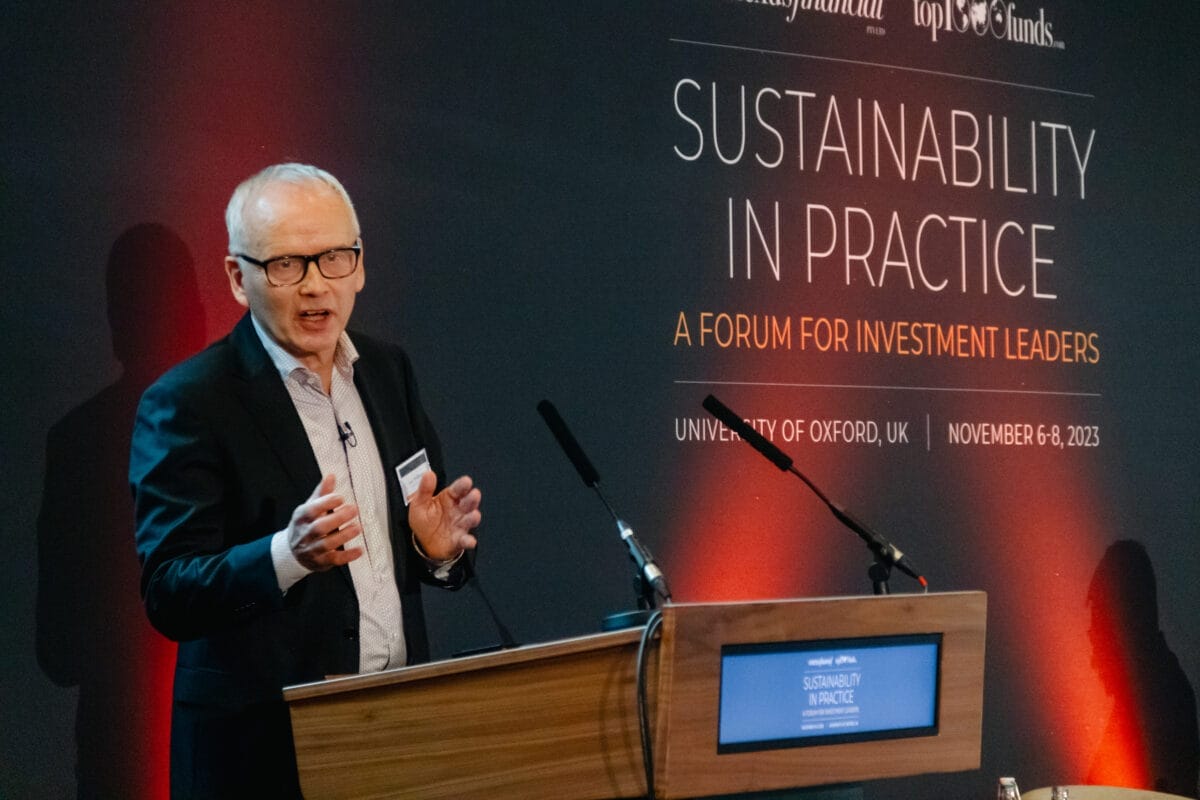
The panel discussion on the evolution and uses of SDGs was part of the Sustainability in Practice conference, organised by Top1000funds.com and held at Oxford University.

Robeco’s framework takes an “avoidance of harm approach,” rejecting the notion that a negative impact in one area can offset positive impacts in another area. 

Sponsored Content

“So, in the company’s operations, even if they are really well managed – maybe even reducing negative impacts or having some positive impacts in their operations – that wouldn’t offset a negative impact that we see coming from their products and services,” Whittaker said.

All assessed companies are given an SDG score between minus three and three, and this is made available open source for everyone, including the public and academics.

“That really grew out of seeing many, many more uses to our SDG framework than even we had initially anticipated,” Whittaker said.

Some organisations want to pick out specific SDGs on which to focus as well as the overall score, she said, giving the example of a client with associations with a labor union that wanted to focus more on social issues. 

But making the information widely available has some obstacles, as Robeco cannot share any data that it doesn’t own. Its website only displays overall scores and individual SDG scores, but doesn’t make the underlying data points available as these are sourced from other providers. 

Robeco is now digging deeper on a number of topics, improving its data and forming partnerships with academics. One partnership with a PhD student at the University of Zurich, for example, is looking at the link between SDG scores and controversial incidents.

New Zealand Super Fund , a NZ$64.4 billion sovereign wealth fund, has been integrating ESG into its investment process from its inception 20 years ago, although its approach has evolved considerably over the years. 

Robeco is one of the managers that  worked with NZ Super to incorporate Paris alignment into its multi-factor portfolios.  Hart, head of external managers at NZ Super, said the framework had removed the -3 and -2 companies from its factor mandates, and aligned more closely with SDGs. 

“So we are really improving the ESG profile by quite a significant extent [but] I think it’s very early days for us,” Hart said.

Leave a Comment

Meeting multiple objectives: The pension fund addressing mental health

Meeting multiple objectives: The pension fund addressing mental health

With the right governance models pension funds can play a role in broader societal issues, such as mental health in the workplace, while still delivering financial security for members. A unique “democratic governance structure” at the Danish Velliv Association allows it to manage multiple objectives, chief executive Lars Wallberg said.

Sort content by

Net zero targets drift out of reach but dynamic change is still possible

Net zero emission targets may cover most of the global economy, but the world is not going to deliver on its net zero promises, warned Oxford University’s Cameron Hepburn, speaking at Sustainability in Practice.

Abundant opportunities in dynamic, decentralised energy generation

The world is shifting from having very few centralised power stations feeding electricity into the grid, to a more dynamic market with abundant opportunities for investors, according to Alex Brierley, co-head, Octopus Energy Generation.

How to rewrite Modern Portfolio Theory to integrate climate risk

When it comes to climate risk, traditional scenario analysis leaves investors with more questions than answers and omits uncertainty around physical risk and the interaction between physical risk, inflation and tipping points. Investors need to abandon modern portfolio theory and find a new approach that focuses on short-term scenarios.

Impact investors, be wary of labeled bonds

Clarity around capital allocation and defined investment frameworks have made labeled bonds a lucrative opportunity for many impact investors. However, Oyin Oduya, impact measurement and management practice leader at the $1 trillion Wellington Management said the reality is not that straightforward.

Why ESG-momentum strategies with a focus on governance bring best returns

ESG-momentum matters when it comes to outperformance according to new research by Pictet Asset Management's head of sustainability Eric Borremans who says investors should sharpen their ESG lens and use active ownership to trigger positive change.

CPP shares the playbook for pushing corporates on scope 1, 2 emissions

A quarter of companies in CPP Investments' public equity allocation still don’t report Scope 1 and 2 emissions - one of the most fundamental indicators of whether a corporate board is engaging on the climate emergency.