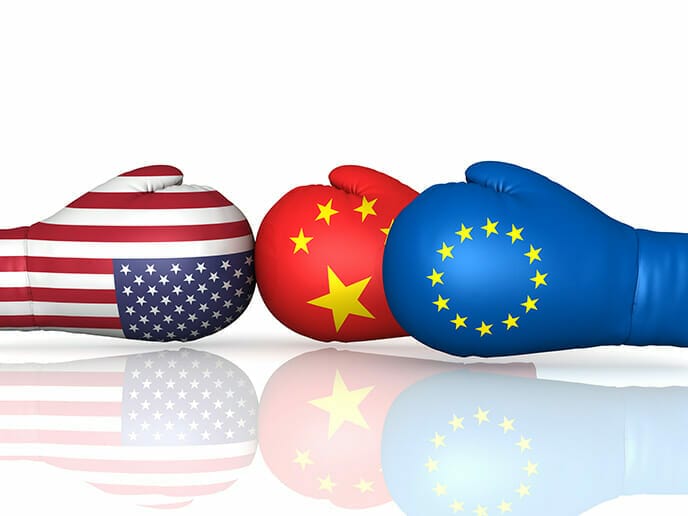

IFSWF marks rise of protectionism

Geopolitical issues, in particular the rise of protectionism, are a threat to the free flow of capital, a condition of investment extremely important to large global institutions, says Shahmar Movsumov, executive director of the $39 billion State Oil Fund of Azerbaijan.

In an interview at the International Forum of Sovereign Wealth Funds in Morocco, Movsumov, who was elected to the board of the IFSWF on Wednesday, said protectionism needed to be addressed.

At the forum, participants are celebrating 10 years since the creation of the Santiago Principles, which are credited with bringing transparency, accountability and a rule book on best practice to the sovereign wealth fund community, which represents about $10 trillion.

“When the principles were created 10 years ago, they were far-sighted and achieved a lot,” Movsumov said. “Today, there are new threats, protectionism is rising again…This might mean renewing the Santiago Principles, or maybe there are other ways we can impact that.

“The free flow of investment and capital is the most important thing for all of us, and protectionism is becoming a threat to that.”

The Oil Fund of Azerbaijan was one of the first member funds of the IFSWF to do a self-assessment of progress on the principles.

Sponsored Content

“This helped us see our gaps in relation to governance, accountability and disclosure and we made some minor adjustments,” Movsumov said. “For other SWFs, newcomers, it has been a rule book, an important set of best practices.

“They have also been important for the whole industry. [A decade] ago, SWFs were not well known players, and there were some misconceptions and concerns around their investments. This has disappeared. We are what we declare and thanks to the Santiago Principles and the IFSWF, we can show we are prudent, institutional investors without any hidden objectives.”The Oil Fund of Azerbaijan was established in 1999 with $270 million and has grown to about $39 billion.

Its policy portfolio is 60 per cent bonds, 25 per cent private and public equity, 10 per cent real estate and 5 per cent gold. The fund has dual purposes – the stabilisation of the economy and the needs of future generations. Due to the stabilisation objective, it currently has a lot of liquidity so, in reality, about 80 per cent of investments are in bonds, managed internally.

This year, the fund will contribute about $6.5 billion to the government’s budget and will receive about $10 billion from oil contracts. Azerbaijan is one of the fastest-growing economies in the world, due to its energy sector.

The executive director of the oil fund is appointed and dismissed by the president of the Republic of Azerbaijan.


For more on the Santiago Principles see:

SWFs could help global stability: forum

Abu Dhabi sovereign fund coughs up: first ever review published

Sovereign wealth funds look to risk[vc_images_carousel images=”25444,25443,25442,25441,25440,25439,25438,25437,25436,25435,25432″ img_size=”full” title=”Photos from IFSWF 2018″]

Leave a Comment

Impact investing’s case for scale

Impact investing’s case for scale

Impact investing has come a long way in the past two decades, going from a niche strategy to a $1.5 trillion industry, but there are still challenges for it to reach institutional scale due to the lack of products and insufficient evidence of outperformance in some parts of the market.

Sort content by

Steinem: No more labels, just humanity

Gloria Steinem tells institutional investors it is time to ditch the labels that describe our gender, class or ethnicity and urged the investment community to look at investments through the lens of gender, class and racial equality.

Material climate change already here

The impact of climate change is already material, said Woodwell Climate Research Center’s Philip Duffy who warns that thawing permafrost could mean the loss of control of ever being able to manage climate change. Elsewhere, he urged investors to use their voice to bring about change.

How to fix a broken labour market

In an impassioned call Sharan Burrow, general secretary of the ITUC which represents 200 million workers in 163 countries called on institutional investors to do more to protect workers rights.

Nordhaus and ‘No Regrets’

Nobel Prize winner Professor William Nordhaus, Sterling Professor of Economics and Professor of Forestry and Environmental Studies at Yale University, explains his theory of ‘No Regrets’ whereby companies can integrate ESG at a level that brings real benefits for society but has limited impact on the corporate.

APG and NYC talk Amazon push back

Two of the world’s most influential institutional investors are hitting a brick wall in their attempts to engage with Amazon’s board on workplace safety. Every time the Netherland's APG and the office of New York City Comptroller, fiduciary to New York city’s five pension funds, try to engage with the board at the tech giant in which they own a combined $6.5 billion they get push back from management.

The path to net zero

Investors from Brunel, Wespath and Robeco talk about the challenges of shaping their net zero portfolios including data, benchmarks and holding managers to account.

Previous



