
Winds of change blowing through private credit markets

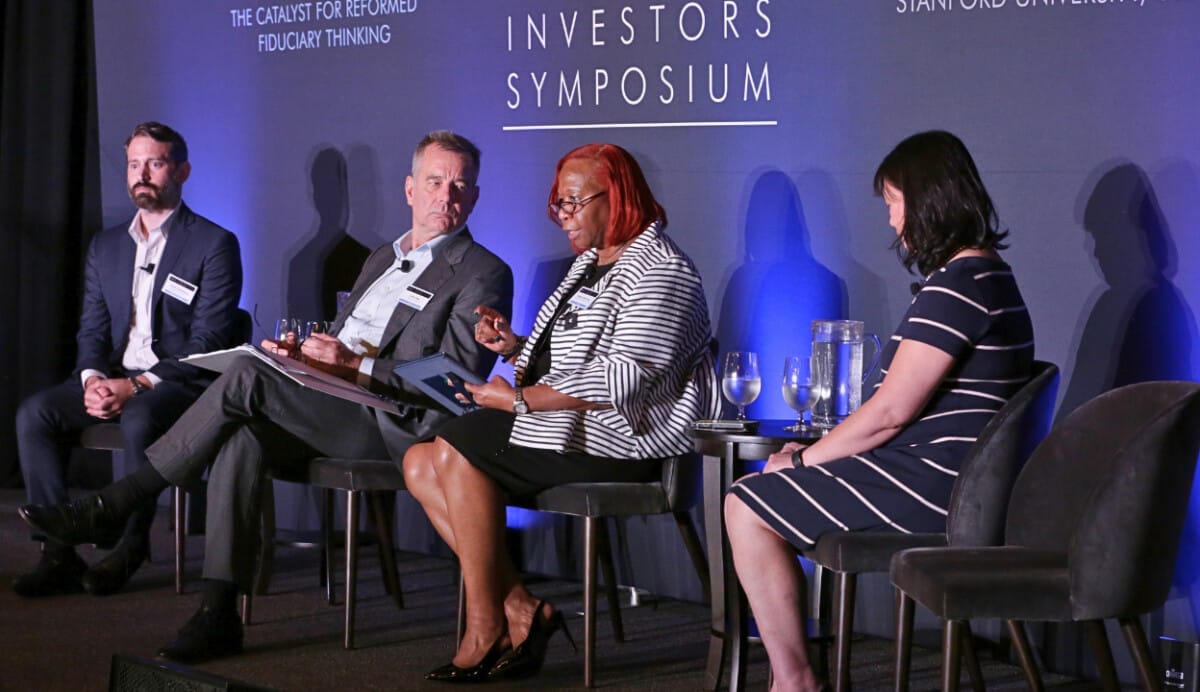
L-R: David Geenberg, Colin Tate (Conexus Financial), Angela Miller-May, Jennifer Shum. Image: Jack Smith.

The influx of capital and interest into the private credit market has spawned new managers and offerings, but asset owners are increasingly alert to the fact that not every one of them is built equal, and even tiny losses during the credit cycle can eat significantly into long-term returns.

During a panel at the Fiduciary Investors Symposium at Stanford University, HOOPP senior managing director of structured and private credit Jennifer Shum warned of the danger of “compound losses”.

“There’s a lot of managers out there that haven’t been through a full cycle. We have,” Shum said.

“The losses are going to be interesting, because right now, every single private [credit] manager that you talk to says, I don’t have any losses – it’s 0.5 or 0.8 basis points. Everyone has the same deck.

“If a manager has tiny little nicks over time during the credit cycle, those compound losses are going to get you.”

HOOPP has been investing in private credit for more than a decade and Shum said the most attractive aspect of the asset class is the current income. The presence of covenants also protects lenders and brings the board to the table when things don’t go according to plan.

Sponsored Content

“We are the debt investor, [so] we’re going to be able to have a conversation with the borrowers on the private equity side, so there’s really interesting downside protections on private credit versus private equity,” Shum said.

Illinois Municipal Retirement Fund (IMRF) chief investment officer Angela Miller-May said the $52 billion fund is similarly bullish on the asset class and has painstakingly gone through a manager selection process for that part of the portfolio.

It completed an asset liability study in 2022 and established a three-year implementation plan to reach a 4 per cent allocation to direct lending, asset backed lending, and opportunistic private credit, funded by reducing equities, Miller-May said.

“We evaluated various strategies across the credit spectrum to really look at managers that could complement each other, could diversify the portfolio, and have unique strategies with a competitive edge,” she said.

“We put out an RFP in April of 2023 we got over 200 applicants…we came down to 13 managers.”

Miller-May said the fund is expecting its position to change over the credit cycle, hence the number of managers it hired as the base of the portfolio. Now, the fund sees appealing income generation and risk-adjusted return prospects, and the role of private lenders as providing capital where it is scarce.

“Plus the exit environment that we’re experiencing in private equity, where private equity companies are seeking financing solutions as well to infuse capital or provide distributions to liquidity constrained investors,” she said.

“We think that increases the opportunity set for private credit.”

Looking ahead, though, HOOPP’s Shum said private credit has somewhat become “a victim of our own success” as with the capital injection, investors are seeing some “lighter covenants”.

David Geenberg, managing director and head of North American investment team at opportunistic credit manager Strategic Value Partners, said the winds of change are already blowing in the leveraged credit markets.

“We are already seeing an increased restructuring cycle,” he said.

“It started about a year and a half ago. You can see significantly elevated restructuring rates, where it is visible in syndicated leveraged markets and leveraged loans, and high yield.”

Depending on which data points investors are looking at, defaults rates for the LSTA US Leveraged Loan Index is between 4 and 6 per cent, Geenberg said. It was within that range last year, and SVP is expecting that to be the case next year.

“You’re going to see over three years, 10 to 12 per cent cumulative restructuring in these portfolios,” he said.

“In the US and Europe – just in corporates, private equity, leveraged loans, direct lending – there are ten trillion dollars. So we think you’re looking at a trillion dollars’ worth of assets that get touched however they’re touched by the cycle.

“We think that it has both been a profound opportunity for investors like ourselves, but it is also a profound risk. We’re not telling you it’s going to cause a giant economic cycle, but it is going to affect portfolios.”

Leave a Comment

The ‘most momentous’ in living memory: The 2024 US presidential election

The ‘most momentous’ in living memory: The 2024 US presidential election

Douglas Rivers, chief scientist at pollster YouGov, said data coming out of the current US presidential election confirms significant cultural and demographic shifts that are reshaping the political map. Rivers told the Fiduciary Investors Symposium that the once-popular “demographics is destiny” mantra predicting permanent centre-left majorities has lost meaning in the Trump era.

Sort content by

Synthetic biology can save us – if it gets the capital it needs

In years gone by, governments underwrote the development of new technologies before opening the doors to the private sector to exploit the applications. Today, the private sector is the primary source of R&D funding, and foundational research in technologies such as biotech are struggling to attract capital.

Focus on engagement to drive faltering climate transition

As the global fight against climate change shows signs of slowing down, some large asset owners are taking a more pragmatic approach to investment returns from the transition by focusing on more targeted engagement in order to drive more lasting impact, the Fiduciary Investors Symposium has heard.

How AI ‘allows you to be the investor that you grew up wanting to be’

Success in AI integration may vary for different investors, as some asset owners are reaping alpha benefits while others look for administrative excellence. The Fiduciary Investors Symposium heard how three major institutional asset owners define and measure AI success.

Real growth opportunities in evolving AI sector still to come

The biggest paradigm shifts in technology history - the internet and cloud computing - both had common characteristics: an initial cycle of investment in infrastructure before the applications were delivered to consumers. the Fiduciary Investors Symposium has heard that artificial intelligence is unlikely to be any different.

Unified view boosting appeal of total portfolio approach

The changing nature of volatility in financial markets and a more client-centric approach that allows allocations to be tailored is helping more institutions adopt a total portfolio approach (TPA) to investment management, the Fiduciary Investors Symposium at Stanford University has heard.

Policy framework, private capital key to financing energy transition

Public authorities need to develop regulatory frameworks that create incentives and provide policy support in order to attract long-term private capital for infrastructure needed for the ongoing energy transition, the Fiduciary investors Symposium at Stanford University has heard.