Changing geopolitical risks are getting harder to manage – but here’s how

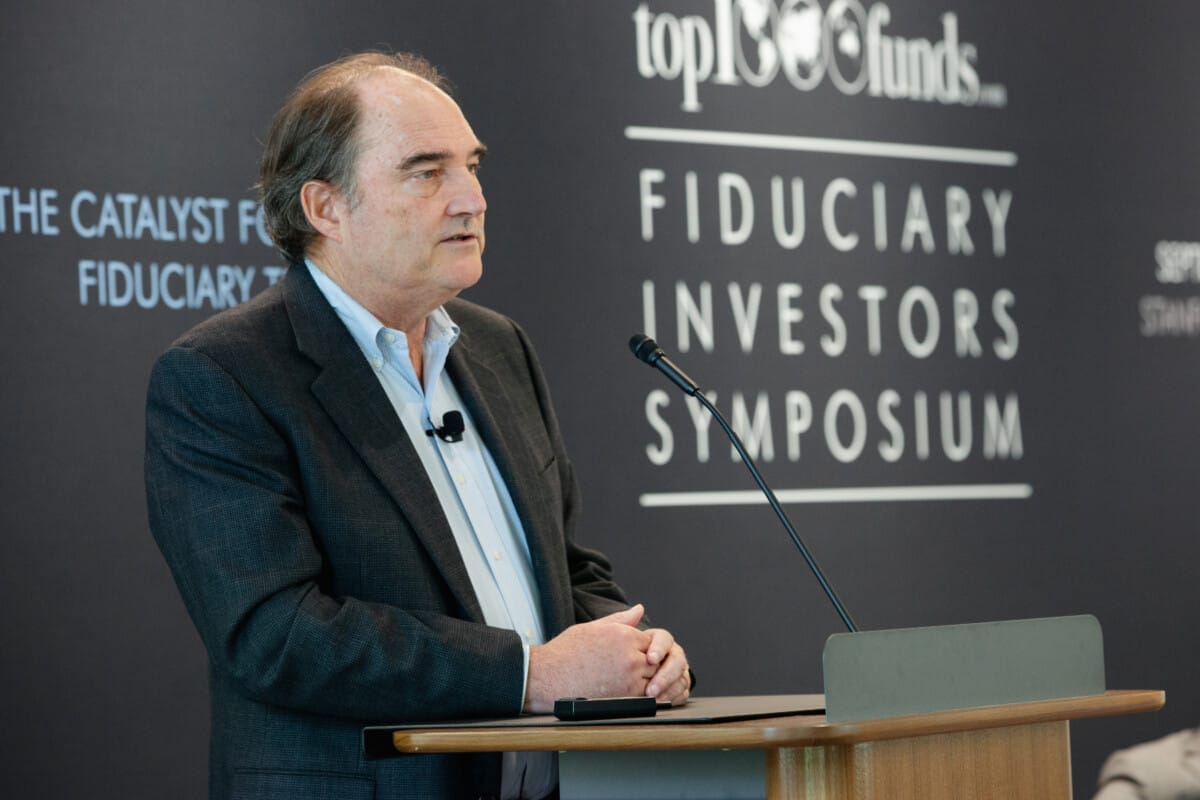
Stephen Kotkin. Image: Jack Smith.

The changing nature of geopolitical risks has made them harder to manage, even though the adversaries to an American-led world order have remained nearly the same over the decades, according to Stephen Kotkin, the Kleinheinz Senior Fellow at the Hoover Institution.

These risks can still be managed between the extremes of appeasement and provocation, and will require allies and friends to work with US, as well as fiscal power to undergird the challenge, the Top1000funds.com Fiduciary Investors Symposium at Stanford University heard.

“The world has changed a lot less than it seems,” Prof Kotkin, who is a specialist on geopolitical risk and authoritarianism, said. “So it’s manageable, it can be done; and if it’s not managed, then it’s unpriceable geopolitical risk.”

The geopolitical world, and America’s adversaries, are largely the same as in 1945 when the US-led order was created. It’s no longer Russia as the senior partner in the Eurasian bloc that’s opposed to US power now, instead it is China. On the other hand, Iran, which was part of the US-led order before the Islamic revolution in 1979, has now flipped.

Kotkin said the US bloc has remained vulnerable to conflict since 1945, in three places across the world – Crimea, Israel and the South China Sea.

At the time, the Soviet bloc formed “borders of victory” after winning World War II and taking over Eastern Europe, and a chunk of the Korean Peninsula. By contrast, the current conflicts centre around “borders of defeat”.

Sponsored Content

“They used to have it, they don’t have it, they want it back,” he said, referring to territorial conflicts in Ukraine and the South China Sea.

“It’s a lot harder to stabilise the other side when it wants the land back, unlike the Soviet case, where they had what they were after.”

Another key difference is that everything that happens everywhere is now potentially interconnected. While it took the world a while to master radio and TV technology, the power of the internet has been much harder to control.

“This interconnectivity, which is so empowering, is also massively destabilising, and we don’t know how to manage it. It’s relatively new,” Kotkin said.

Another key contrast to the old state of world affairs is the growing problem of “dual-use” technology, he added.

Back in the Soviet days, technology could either be classified as of use to the military industrial complex, or for consumer goods.

“Now, the rocket and the refrigerator, it’s the same. It’s all just a bunch of semiconductors and other dual-use technology,” Kotkin said, giving the example of a small private company that may simply come up with an innovation in computerisation, but which could be potentially considered as having military industrial applications.

These are the major differences in the world we live in now compared to 30 to 40 years ago. Otherwise, it’s the same problematic with the US led world order, like it or not, he said.

“In real life, it’s not justice and equality and sovereignty. It’s a US-led order with warts and all, or it’s the other guy’s order, and so solving that problem is really hard with these three big changes that have happened.”

Leave a Comment

The ‘most momentous’ in living memory: The 2024 US presidential election

The ‘most momentous’ in living memory: The 2024 US presidential election

Douglas Rivers, chief scientist at pollster YouGov, said data coming out of the current US presidential election confirms significant cultural and demographic shifts that are reshaping the political map. Rivers told the Fiduciary Investors Symposium that the once-popular “demographics is destiny” mantra predicting permanent centre-left majorities has lost meaning in the Trump era.

Sort content by

Synthetic biology can save us – if it gets the capital it needs

In years gone by, governments underwrote the development of new technologies before opening the doors to the private sector to exploit the applications. Today, the private sector is the primary source of R&D funding, and foundational research in technologies such as biotech are struggling to attract capital.

Focus on engagement to drive faltering climate transition

As the global fight against climate change shows signs of slowing down, some large asset owners are taking a more pragmatic approach to investment returns from the transition by focusing on more targeted engagement in order to drive more lasting impact, the Fiduciary Investors Symposium has heard.

How AI ‘allows you to be the investor that you grew up wanting to be’

Success in AI integration may vary for different investors, as some asset owners are reaping alpha benefits while others look for administrative excellence. The Fiduciary Investors Symposium heard how three major institutional asset owners define and measure AI success.

Real growth opportunities in evolving AI sector still to come

The biggest paradigm shifts in technology history - the internet and cloud computing - both had common characteristics: an initial cycle of investment in infrastructure before the applications were delivered to consumers. the Fiduciary Investors Symposium has heard that artificial intelligence is unlikely to be any different.

Unified view boosting appeal of total portfolio approach

The changing nature of volatility in financial markets and a more client-centric approach that allows allocations to be tailored is helping more institutions adopt a total portfolio approach (TPA) to investment management, the Fiduciary Investors Symposium at Stanford University has heard.

Policy framework, private capital key to financing energy transition

Public authorities need to develop regulatory frameworks that create incentives and provide policy support in order to attract long-term private capital for infrastructure needed for the ongoing energy transition, the Fiduciary investors Symposium at Stanford University has heard.