
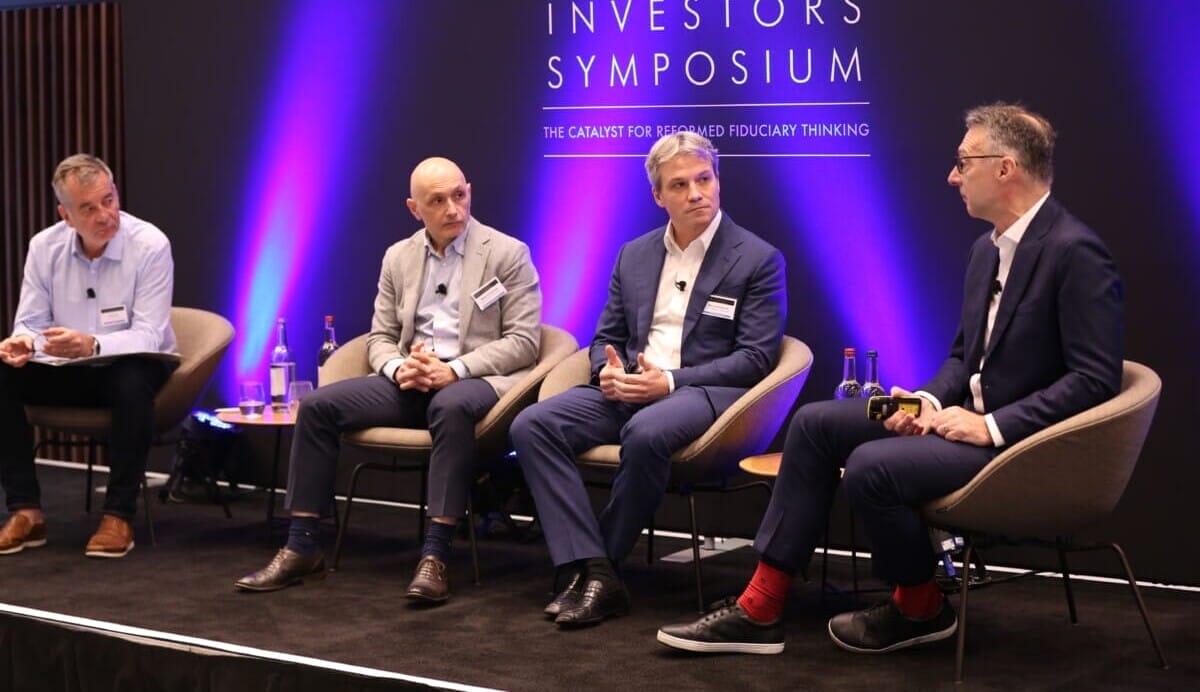

Ensuring a sustainable income in retirement is an enduringly knotty problem and one that continues to preoccupy national pension systems and their asset manager partners the world over. At the Fiduciary Investors Symposium Oxford, panellists explored how different countries are innovating to ensure their pension systems’ sustainability.
Like NEST, the UK’s biggest defined contribution (DC) master trust, which plans to enter the bulk annuity market as part of a new, post-retirement solution and is about to partner with an insurance provider to provide longevity protection for older retirees.
“We’re in the final stages with two insurance companies that will co-design a deferred annuity product,” said Mark Fawcett, chief executive officer of NEST Invest, who articulated the challenge many savers face in balancing the financial needs of retirement.
“It’s just really hard to make sure that you don’t run out of money before you die or leave a big pile of money on the table when you could have had a better lifestyle in retirement,” he said.
The annuity will pay out a level income from 85 for the rest of a person’s life, “whether they live to 86 or 106,” said Fawcett. NEST’s strategy is a default option, but requires member engagement because the annuity is not fully redeemable if they change their mind.
Majdi Chammas, head of procurement and product strategy at the Swedish Pension Fund Agency, explained the role the agency plays in selecting, managing, and monitoring the investment funds offered to Swedish savers under the Premium Pension. It is a part of the national pension system where individuals can choose how their savings are invested.
It has replaced an open fund marketplace, which once allowed hundreds of funds, with a curated, quality-controlled platform.
Specialised life insurance group Athora, part of US asset manager Apollo, recently bought UK insurer Pension Insurance Corporation (PIC) in its latest growth surge. The alternatives manager saw an opportunity to enter the retirement savings market in the US after the GFC and is now finding rich pickings in Europe too.
“We had the view that there was a demographic trend that would require significant demand for products that could give people guaranteed income and the innovation on products to allow people to plan better for retirement. We didn’t see an insurance company having the asset management capabilities to provide those products,” said Alex Humphreys, partner at Apollo Global Management.
He argued that buyout options support corporates de-risk, and help provide guaranteed income to pensioners and retirees through diversifying from the public markets and using, predominantly, investment-grade private credit to generate spread over the cost of funds.
“We’re the number one annuity provider in the US today,” he said. “At the heart of it, it’s still all about being a spread business, providing attractive products to policyholders and generating a spread through diversifying away from the public markets. There’s £1.2 trillion of defined benefit schemes in the UK today. About £50- £60 billion of those go to buyouts every year, so it’s a huge addressable market.”
Panellists reflected that during the accumulation stage, people should be less focused on liquidity and prepared to tie their money up longer term. Beneficiaries also need a diversity of asset classes that should include private markets like infrastructure and other assets that are tied to inflation and throw off income.
Sustainable pensions require savers tapping into the “full economy” – even more important today in thinning public markets. Innovative products that give people a breadth of access to a broader range of asset classes could include drawdown funds, semi-liquid funds, or more ETF-type strategies, for example, said Humphreys.
Successful pension systems also need to balance conflicting goals like a stable income for life and capital preservation with long-term growth, low costs, and the flexibility to allow members to change course.
Fawcett said that NEST is cash-flow positive because it takes in £6 billion in contributions every year. It has allowed the investor to create an internal market for its private market holdings, whereby when liquidity is required for older members, there are always new people coming up to take on the assets.
Panellists concluded with reflections on the challenge of communicating about pensions.
“Pensions aren’t that interesting to most people, right? They spend more time planning their holiday than thinking about that,” said Fawcett.







Leave a Comment
You must be logged in to post a comment.
Login