
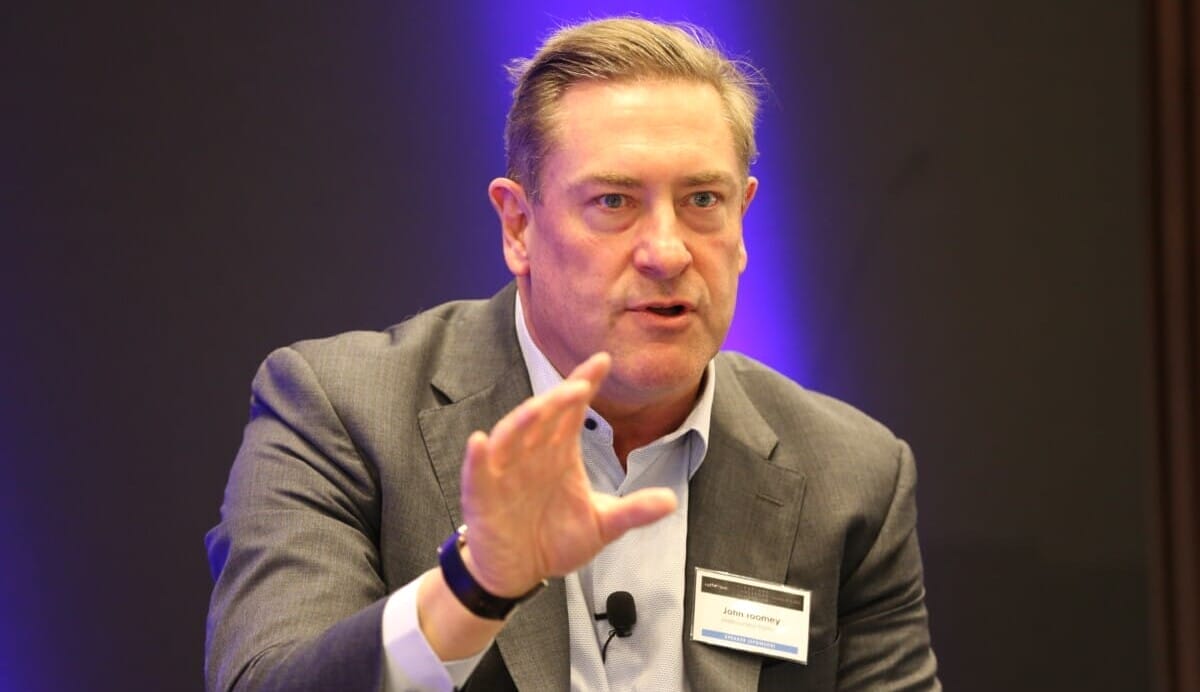

President Trump has ushered in a more transactional world that makes it challenging for European businesses seeking relationship-based partnerships, but news headlines don’t necessarily reflect US policy, and America continues to provide the most durable source of excess returns in private markets, thanks to thriving underlying ecosystems of capital, talent and risk-taking, according to HarbourVest Partners.
In a wide-ranging discussion at the Fiduciary Investors Symposium, John Toomey, chief executive officer of the Boston-based firm shared his key views of the current investment landscape, including his observation that US tariffs have been lower than originally feared.
“Tariffs were intended to encompass much larger percentages and a much wider swathe of goods, but even the more recent data from the US government shows that the receipts are a lot lower and the effective tariff rates are a lot lower,” he told the symposium at Oxford University.
HarbourVest has invested in Europe since 1984, putting capital to work across primaries, secondaries, co-investments, private credit, infrastructure and real assets, said Toomey.
Typically, capital flows first to country-specific funds which then grow to become pan-regional funds, and he noted that investors worldwide are becoming more expert, with deeper resources and more confidence in their ability to execute.
Still, some Eastern European countries remain challenging for private market investors because they are illiquid and thin so that even though the manager, industry opportunities and local returns are strong, investment options are crimped because investors can’t trade in and out. “What we have found is the market depth isn’t there,” he said.
Investment opportunities in Europe are also impacted by the lack of an ecosystem. Although Europe has developed tech champions like Revolut, Karna and Spotify, the market faces a shortage of seed capital flowing to start-ups plus sufficient returns from that capital to attract future capital.
In contrast, the US has a thriving ecosystem of plentiful capital, talent and people prepared to take risks, as well as an early customer base to prototype.
Building a culture that takes root overseas too
Toomey started in finance from “ground zero” when he joined HarbourVest in 1997 as an analyst, after deciding that a career in finance “sounded way more interesting” than being in a lab using his Harvard science degree.
He said that HarbourVest’s partnership model has nurtured teamwork, open ideas and inclusion in a culture that puts people first. “We’re in the human capital business. Of course, we are entrusted with capital, and we make investments and build portfolios and create returns that are important to the beneficiaries of those programmes. But at the end of the day, our team is responsible for this important work, so nurturing talent is a core part of our strategy.”
A significant proportion of his time is spent thinking about how to help people work together and become better organised, as well as developing talent and ensuring HarbourVest is a place where everyone’s voice is valued and heard.
A hiring sweep at the company has seen as many as 250 hires a year across 15 offices. Scaling the culture of the business and building expert leadership centred on core principles like always putting clients’ interests first, displaying a sense of urgency and operating with integrity at all times is more challenging away from head office.
Culture is also instilled by performance reviews now, including “the how,” he said.
Employees are now also asked to name a few things that they did that were outside their job description that helped a client or helped a peer “where they weren’t required to do it but instead went above and beyond their normal duties.
“We don’t want people creating a lot of success, but ultimately really doing that at the expense of our values,” Toomey said.







Leave a Comment
You must be logged in to post a comment.
Login