
Why MFS president is concerned about ‘long-term washing’

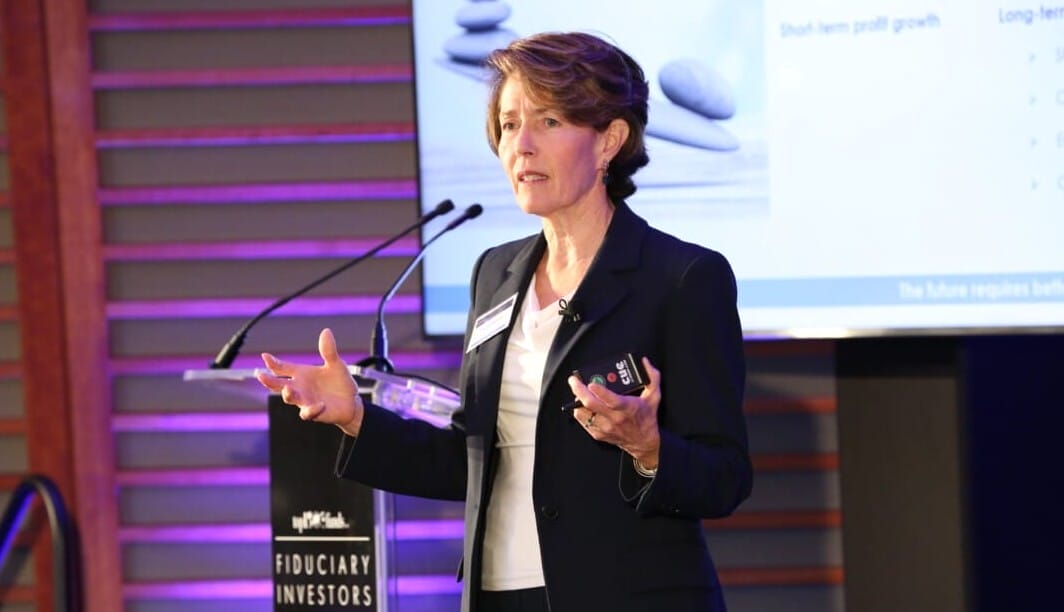
Carol Geremia. Photo: Jack Smith

Carol Geremia, president of the Boston-headquartered MFS Investment Management, said “long-term washing” has become one of her biggest worries, with everyone claiming to be a long-term investor while failing to align their investment practices with that goal.  

MFS Investment Management, which Geremia joined in 1984, is a 101-year-old asset manager with $600 billion in assets under management.  

Throughout her career, Geremia said she has witnessed institutional investors’ increasing ownership of companies in the US, from 35 per cent in 1975 to 95 per cent in 2022. However, the average holding period shrank from close to 5 years in 1980 to just 5.5 months in 2022.  

“I’m constantly confused – as we talk about being long-term as an industry – [about] how we can get better aligned with the conversation around the markers to the longer-term destination,” she told the Fiduciary Investors Symposium at Harvard University.  

“We talk about ESG and the fear of greenwashing. I say the biggest fear I’ve had for the past 15 years is long-term washing. 

“If you say you’re long term, prove it. I don’t know why we don’t use the average holding horizon of a stock inside the portfolio to have a better conversation with an active manager.” 

Sponsored Content

She pointed to research conducted by WTW’s Thinking Ahead Institute which says that in the 2020s, the measurement of success of any investment should be consistent value creation for stakeholders, with a focus on overarching sustainability and achieving long-term goals. However, Geremia said it still feels like many investors are stuck in the “messy middle” when they transitioned from the ‘alpha era’ between the 2000s and 2010s, where success only means alpha generation against a benchmark with low tracking error.  

This is coupled with the fact that investors tend to turn to easy-to-use metrics to judge their organisation’s success, focusing on things like past performance and traditional benchmarks, while more difficult-to-measure qualities, like effective decision-making and empathetic communisations, are ignored. But the latter qualities are more likely to help an investor achieve their long-term goals and add value to alpha generation, Geremia said citing a State Street report.  

“It makes it easier to hold people accountable when you can measure the easier quantitative things, but it actually pulls us so far away from long term value creation, not to mention responsible allocation of capital,” she said.  

How MFS is holding itself accountable to act like a long-term investor is through its goal to perform over the full market cycle. The definition of how long a market cycle is might be contentious, but Geremia said MFS believes it is close to 11 years, despite its survey of 540 institutional investors in 2024 showing that 87 per cent of respondents believe it’s seven years or under.  

Over half of the respondents also said their organisational tolerance for underperformance against a benchmark is three years or under.  

“That definition of a full market cycle from perception is actually declining – why is that?” she said.  

“I said to our investment team [that] if we can’t define a full market cycle, we’re going to have a problem, because that in itself is the growing misalignment of the system. 

“I’ll quote Roger Urwin from Willis Towers Watson. He said the only way to generate returns in the future is in a system that works. 

“I think we talk a lot about returns, a lot about alpha, but in the way we look at our system and how we’re operating, we need to poke some really big holes in.” 

Leave a Comment

Behind Norges’ search for pure alpha

Behind Norges’ search for pure alpha

Despite uncertainties, Norges Bank is tipping that the US stock market will continue to outperform Europe in the next two decades. The mammoth fund also explained how it carved out a $90 billion pure alpha portfolio from passive investments, overseen only by 8 portfolio managers.

Sort content by

Mental health issues in focus at Denmark’s Velliv

Denmark’s Velliv Association, the governance entity behind member-owned commercial pension fund Velliv, explained why a society where workers' mental health needs are looked after is better for pension funds and their liabilities. 

Alpha alone does not pay pensions – total returns do

Pension fund members in retirement want the sustainability of pension payments. OPTrust chief investment officer James Davis told the Top1000Funds Fiduciary Investors Symposium that a total portfolio approach is the best way to do that, and has been on a journey towards delivering it for the past 10 years.

Long-term investors can help break VC’s short-term trap

The short-term investment focus of venture capital investors and the withdrawal of government funding are opening the door to asset owners as providers of patient, long-term capital to fill an investment void, the Top1000funds.com Fiduciary Investors Symposium has heard.

TPA is in the eye of the beholder

Total portfolio approach is not a method, it’s a mindset, according to University of Toronto finance Professor Redouane Elkamhi. Also a senior advisor to HOOPP, Elkamhi said he would summarise TPA in one sentence: "How to be prepared for different market conditions."

Federal threats undermine Massachusetts’ edge, warns state treasurer

Massachusetts treasurer Deborah Goldberg warned that the state’s key strengths – including its higher education institutions and progressive social policies – are being targeted by the federal administration. She urged support from investors as federal funding for innovations and research wanes.

What it means if ‘DNA is not destiny’

Geneticist David Sinclair says aging is a disease and it is preventable and treatable. He told the Fiduciary Investors Symposium that research demonstrates we can slow down or even reverse the aging process. It sounds like good news, but the consequences for society and the investment community are profound.