
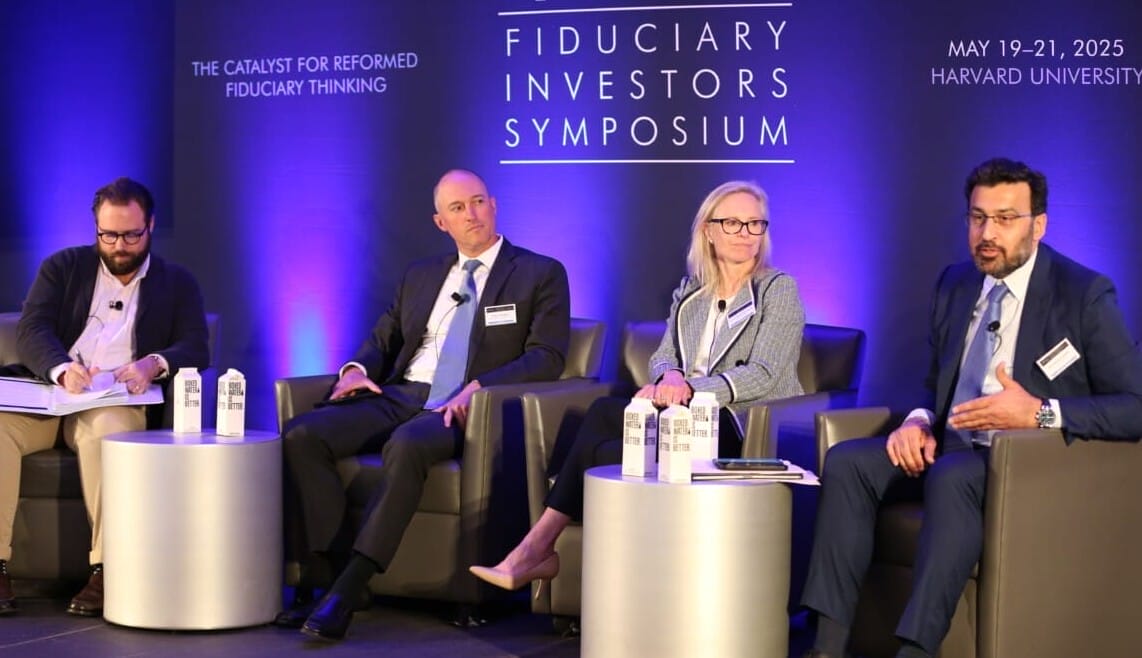

Asset owners have turned more optimistic about the role of active managers as market volatility and dispersion create fresh stock-picking opportunities.
The industry has been under stress for several years due to lukewarm performance which is commonly attributed to the rise and rise of large cap technology stocks and passive investing. However, investors at the Top1000funds.com Fiduciary Investors Symposium concluded that the root cause of that stress might be more complicated.
“The trouble that active managers have faced – I’m not sure passive is to blame,” said Trevor Graham, head of equities and deputy chief investment officer at TIFF, which offers outsourced CIO services to endowment and not-for-profit clients.
Active managers tend to be underweight the Magnificent 7, which was hurting their performance, in part because they feel the need to justify their fees by finding lesser-known companies of good value, Graham said.
“There’s a little bit of a behavioural bias here – I think there’s a reluctance on the part of a lot of active managers to walk into a meeting with a client say, ‘my biggest overweight is Apple’.”
But the number of eyeballs on these companies also means there is not much room for alpha.
“Anything in the Mag 7, it doesn’t matter what stock it is, there’s probably a hundred sell side analysts following that stock. There’s probably another several hundred buy side analysts looking at it too,” he said.
“I think a lot of them [active managers] rightly say, what’s the chance I’m going to have a divergent view here that’s right, and it’s going to lead to excess return?”
As an asset owner, Graham said TIFF does not have a view about whether the Magnificent 7 will continue to dominate market performance, and it tries to not become excessively overweight or underweight. It requests individual security level positions from managers and keeps the seven stocks within a tight range of the benchmark.
“[We’d rather] take the tracking error in other places where I think the odds of success are more in our favour,” he said.
The Magnificent 7 stocks have recovered after a tough first quarter in 2025 but are still underperforming the S&P 500, and Graham said the majority of its active manager roster are ahead of their benchmarks in the year so far.
“I really think for active to do better, one of the things that that needs to happen – and it’s a simple idea – is just that these roughly seven stocks don’t continue to outperform.”
Traders vs owners
But Aziz Hamzaogullari, founder and chief investment officer of growth equity strategy at Loomis Sayles, has a different view about the way active managers approach the Magnificent 7.
“The issue isn’t that there are a lot of people following these names. The issue is these managers cannot make up their mind if they want to own it or not,” he said.
Looking at the companies Loomis Sayles owns out of the Magnificent 7 and their past ownership, Hamzaogullari estimated that only 0.5 to 2 per cent of active managers held onto their holdings over the past two decades.
“That means that 98 to 99 per cent of managers have been trading these names, and your return profile is very, very different if you owned it continuously… versus if you were trying to trade.
“They just trade it because of short term pressure; of this pressure of outperforming every day – which is not going to happen, and every year – which is not going to happen,” he said, adding that most pension managers would consider replacing a fund manager if they have underperformed in the three years trailing.
Another cause of the underperformance is because active managers have simply become less active. The Active Share – a measurement of differences between a portfolio’s holdings and those of its benchmark – has been declining every decade in the past 50 years, Hamzaogullari said.
“In large cap space, if you look at the best of the best managers, historically in the last 20 years, their information ratio is around 0.3 per cent.
“So just basic math tells you, the lower your Active Share for the same amount of information ratio, you’re going to get less returns.”
Unlike TIFF, Makena Capital – which is also an OCIO provider – has been underweight the Magnificent 7 as a collective in the past five years. But its managing director and head of public equity Anne Marie Fleurbaaij emphasised the seven stocks are not a “monolith”, and that the fund is overweight in some of the names.
When selecting active managers, the fund is looking for five things: clear process, fundamental research, long-term investment horizon, concentration and balance, and shareholder engagement.
“There’s… 160 or so names beat the S&P 500 over the last five years to [this] Monday and 90 stocks beat the Mag 7,” she said.
“If you look at year to date, it’s 350 or so names that have beat the Mag 7 and 250 names – so more than half – that has beat the S&P 500.
“This tells me that there are opportunities and you don’t have to just buy the Mag 7 to beat the market.”







Leave a Comment
You must be logged in to post a comment.
Login