
Financial system robust but geopolitics poses threat: Bernanke

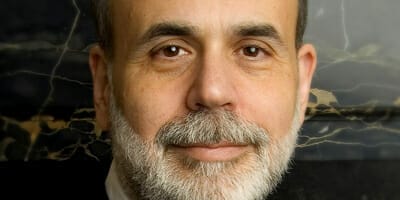
Former Governor of the US Federal Reserve, Ben Bernanke, says there are no foreseeable shocks to the financial system. In any case, he says, the system itself is so much more robust than it was before the crisis, that it could weather the storm. The only possible cause for concern is geopolitical risk.


Risk taking is a necessary part of the creation of new products and industries, and as long as there is risk-taking there will be various types of upset, says former US Federal Reserve chairman, Ben Bernanke.

The trick is, he says, is it so make sure that the system is sufficiently strong that if there is upset the system remains stable.

“Sub-prime mortgages were a very small asset class, but the reason the effect was so bad was because the system was so fragile and vulnerable, it was not sufficiently resilient,” he says, adding the policy decisions that followed the crisis, such as increasing bank capital, was aimed at increasing resilience.

“The garden variety crises can be tackled by fiscal and monetary tools if the financial system is robust,” he says.

Sponsored Content

“The financial system is more stable now and oversight is better. There is not much to indicate there’s major risk to the system. Growth is slow but the system is still growing and recovering. The one thing I’d put aside is geopolitical risks – which are the biggest risks. But wherever risk comes from the system is stronger so the chance of it de-stabilising is lower.”

Geopolitical specialist, professor of history at Princeton University, Stephen Kotkin, says geopolitical risk, which is ubiquitous, is always triggered unexpectedly, then developments seem utterly obvious post-facto.

“Climate events or cyberattacks might seem the most obvious, but geopolitical risk is fundamentally about incompetence and mismanagement by statesmen. Russia’s pariah status, combined with its formidable spoiler state capabilities, poses one such grand opportunity for mutual miscalculation. China’s continuing advance inside the US-dominated international system poses another. In both instances it can be developments concerning small states – the Baltics or Taiwan – that set off the big catastrophes,” he says.

“We might soon learn about the question of China’s resiliency – or lack thereof – in the aftermath of a crash, which would touch all aspects of the international financial system. The unresolved impossibility of the European Union continuing in its current form may be the least of our worries.”

Bernanke who was a contemporary of Kotkin’s at Princeton, holding various faculty roles from 1985 until 2005, including as the Class of 1926 Professor of Economics and Public Affairs, and the chair of the economics department, says China needs to transition to an economy driven by domestic demand.

He says slowing economic growth in China is inevitable and desirable.

“China can’t grow on the export-heavy industry and construction of the past. It needs to liberalise and the necessary transition means inevitable lower growth.”

But he also sees risks including Chinese banks “expanded credit”, and some “not very good loans”, which could create problems for the system.

Bernanke, who was speaking at the World Business Forum, said that he was “glad to say there is considerable evidence that the economy is in recovery.”

Unemployment in the US peaked at 10 per cent and is now 5.4 per cent and falling.

“Consumers in the US are in good shape. Confidence is back to normal levels, they have paid down debt and are getting their balance sheets in good shape. Consumers are more optimistic than they have been for some time. There has been a period of growth, people feel better and it’s self-fulfilling.”

While Bernanke defends the policy choices, and quantitative easing, he admits it would have been preferable to have both fiscal and monetary tools in action.

“I want to be very clear, it would have been much better if we had a better monetary and fiscal mix so we could have had recovery with high interest rates. But generally fiscal policy in the US is very contractionary so the Fed had to support the recovery and fight off the headwinds of fiscal contractions.”

But the last word is with Kotkin.

“We cannot predict the future, of course, but we can be sure that the world as we know it will not last. It never has.”


Stephen Koktin, whose recent book Stalin, vol. 1: Paradoxes of Power was a finalist for the Pulitzer Prize in biography or autobiography, will speak on geopolitical risks at the Fiduciary Investors Symposium, Chicago Booth School of Business from October 18-20.

Leave a Comment

Florida: Opportunities in a crisis

Florida: Opportunities in a crisis

The Florida State Board of Administration has made some strategic moves to take advantage of opportunities in the dislocation, including in private equity, distressed debt and active listed equities.. But CIO, Ash Williams, is concerned about the underlying real economy.

Sort content by

Inequality risk equal to climate change

Rebecca Henderson, the John and Natty McArthur University Professor at Harvard University who co-teaches Reimagining Capitalism at HBS, says inequality is equal to climate risk in its potential impact. She told delegates at the Fiduciary Investors Symposium at Harvard University when a system no longer generates freedom and prosperity it must be changed. Change is possible because we have the resources and technology to do it. A first move is decent jobs for people at the “bottom”.

America, China and Donald Trump

As trade wars between the US and China dominate financial markets, Princeton historian Stephen Kotkin has assured pension funds that the world order that has been in place since World War II remains intact.

Understanding US/China relations

Understanding the fractious relationship between US and China is more important– and simultaneously more confronting – than it has been in the past, according to Stephen Kotkin, professor of history and international affairs at Princeton University. While the China investment challenge has always been to capture the aspirational middleclass, the high-profile historian says “the big money that’s going to be made in China is going to be made from the dislocation”.

What can the past teach us?

Institutional investors' investment strategy should be serving the China middle class and the dislocation from within Asia, according to Stephen Kotkin,Professor of History and International Affairs at Princeton University speaking at the Fiduciary Investors Symposium at Cambridge University. He explored what the geopolitical conflicts of the past can teach us about the future. He looked at some of the key points in history, how China, the European Union and the US have survived, and what it means for the future.

A ‘Sputnik Moment’ with China?

Whither United States-China? Stephen Kotkin, Professor in History and International Affairs at Princeton University and adviser to conexust1f.flywheelstaging.com, discusses the changing nature of the complex relationship between the US and China and the struggle underway as these two large economies find their positions in the economic and technological hierarchy. So what should investors watch for?

Taiwan epicentre of geopolitical risk

The China-US trade war is the latest development in a tense relationship that threatens to bubble over into war over Taiwan, “incinerating” portfolios, Stephen Kotkin said.

Previous