
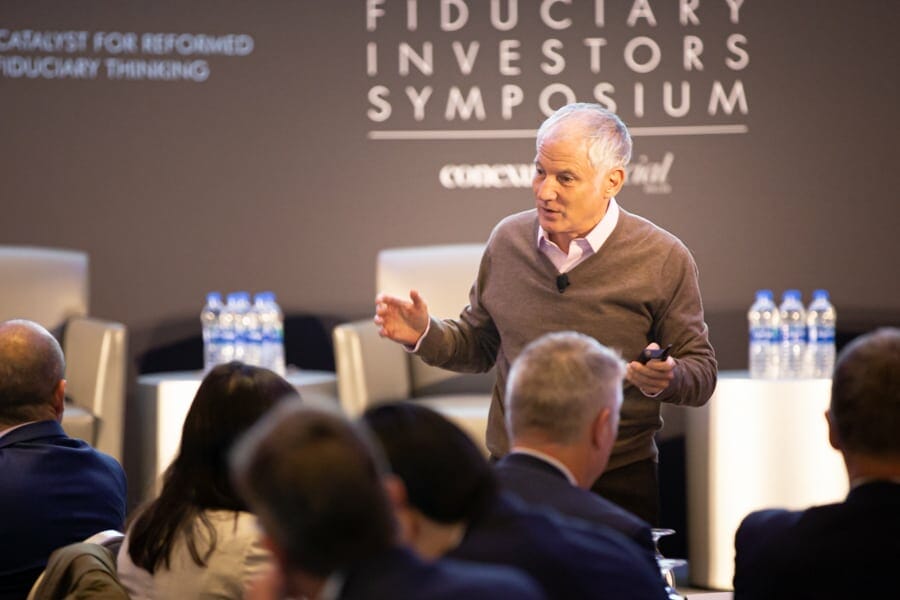

As trade wars between the US and China dominate financial markets, Princeton historian Stephen Kotkin has assured pension funds that the world order that has been in place since World War II remains intact.
“The notion that the US is on the decline is complete bunk,” said Kotkin, speaking at the Fiduciary Investors Symposium at Harvard University this week. “It’s one of the most idiotic things that you hear relentlessly.”
The professor of history and international affairs at Princeton University said that despite the chaos in the White House under US President Donald Trump, there was no other country that came close to matching America’s military, economy, currency or its number of allies. He also said that China’s economy is not the “giant” that everyone thinks it is, despite its growth.
“If you add up the US economy with its allies, its overwhelming,” the academic said. China “knows this fact, they know that the US is still in the driving seat. China is not this insurmountable threat, it is instead something that needs to be dealt with,” he added.
His comments came amid media reports that Trump’s administration is weighing whether to restrict pension fund investment into China. Michael Trotsky, chief investment officer at the $75 billion Boston-based Mass PRIM later told delegates at the Harvard Symposium, that no institutional investor would support a restriction.
Kotkin said that the US institutions designed to keep the government in check were a lot stronger than people think, as evidenced by the launch of the impeachment investigation into Trump last month. He added that there is a loss of confidence among American elites because globalisation had failed to unite the world as they had predicted did not translate to a “systemic crisis” nor “equate to a US decline.”
As for the future of liberalism, Kotkin said the rule of law, separation of powers and open dynamic markets without monopolies still works in practice but it needed to be kept in check and cultivated.
“There is no system which is superior,” the professor said. “It can be corroded from the inside if not properly tended … but the instruments are still available for us to fix things. It’s not about getting rid of Trump, it’s about where did he come from in the first place.”
He also warned that the sentiment amongst voters that installed Trump to the White House and saw Britons vote for Brexit remain in place today, despite the lies that were peddled by politicians on both sides of the Atlantic.
“The politics are fake but the sentiments are real and that is a very important point,” he said. “They are all still there. You can argue that they are deluded, but there were 65 million people who voted for Trump and they are all American citizens.”
So what about climate change which is a constant source of controversy within the Trump administration? Kotkin told delegates that there was no government who will be able to achieve the vision that the people have for them. He said whether a country joins the Paris Accords on greenhouse emissions, or leaves as Trump has done, it will have little impact on the behaviour of companies.
“You can’t solve those problems without the private sector,” he told the pension fund delegates, when asked about ESG investing. “Your capital is invested in private enterprise.”







Leave a Comment
You must be logged in to post a comment.
Login