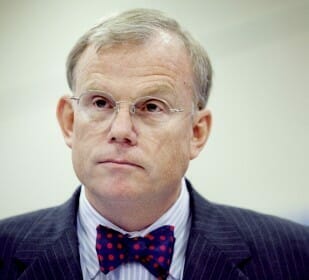
FSBA pounces on high valuations

The $204 billion Florida State Board of Administration is selling private equity and real-estate assets it believes are overpriced, chief investment officer Ash Williams says.

FSBA is steadily weeding out the mature allocations in its $10.9 billion private equity portfolio that still have to complete final realisations, and selling them in the secondary market.

In a process that in aggregate has accounted for about $3 billion to $4 billion over the last two years, Williams has bundled together weaker funds, sold them off and redeployed capital to higher-yielding areas, in a “disciplined pruning of the portfolio”.

He’s applied the same principles to FSBA’s $14 billion real-estate portfolio, which accounts for just under 9 per cent of assets under management. Here, he’s sold off highly sought after but dated apartment blocks and office space, freeing up capital to buy real estate that should have a higher value and return for the next 20 years.

“If an asset is a better fit for another investor’s portfolio, that will be reflected in its value to them and allow us to redeploy those dollars on assets better suited for our portfolio,”Williams says.

In private equity, higher-yielding assets are coming via new opportunities in Asia, where FSBA works with Asia Alternatives – an Asia-dedicated private equity fund of funds. It has led Williams to one fund investment that includes a portfolio company targeting India’s burgeoning second-hand car market.

Sponsored Content

The company’s founder has developed a sophisticated mobile app that combines car valuations, access to finance and insurance, and matching of buyers and sellers, in a strategy that Williams describes with his characteristic colour and detail.

“It’s the kind of thing that could be a unicorn,” he says. “It shows what an entrepreneur in an emerging economy can achieve with technology and a first-rate education.”

Williams’ team manages about 40 per cent of assets in-house. About half of the real-estate portfolio is run in-house.


For more on this story, see Florida SBA trusts long-term plan”.

Leave a Comment

Long term lens shields Colorado from private credit jitters

Long term lens shields Colorado from private credit jitters

As concerns in private credit mount, Colorado PERA CIO and COO Amy McGarrity says the pension fund isn’t seeing any strains in its growing allocation to the asset class, arguing that long-term investors are shielded from the risks because they can lock up their capital to weather market cycles.

Sort content by

LACERA: Why rebalancing is asset allocation’s best friend

Rebalancing back to asset class strategic ranges after a market rise or fall is one of the most vital seams of strategy at the $70.1 billion LACERA. It ensures the investment team remain consistent with investment policy statements, don’t try and time the market and avoid behavioural biases according to CIO Jonathan Grabel who calls is “the best long-term strategy we have”.

IMCO World View: Decoupling, tech and private markets drive future trends

Many of the certainties investors have taken for granted over the past several decades appear to be fading. In its World View research, Canada's IMCO reflects on the years ahead

Switzerland’s Publica hit by equity, fixed income correlation

Hit by last year's unusual correlation between equities and bonds, and in a bid to avoid higher long-term inflation, Switzerland's €45.6 billion Publica kick-starts a new strategic asset allocation that will reduce the bond allocation and result in a search for new managers.

Why private debt is pivotal to Queensland Investment Corporation

Queensland Investment Corporation's (QIC) CIO of State Investments, Allison Hill, explains why private debt is a crucial part of the portfolio.

Active, in-house and sustainability: The driving factors at AP3

AP3’s ability to actively benefit from volatile markets is rooted in a reform process undertaken by CIO Pablo Bernengo, replacing decade-old, separate alpha and beta allocations with a traditional asset class structures but avoiding silos. Active risk and sustainability go hand in hand, he says, and is a 2023 focus.

Investment industry needs to rethink strategy: Future Fund CEO

Persistently challenging market conditions driven by stagflation, uncertainty and volatility, the response to climate change and populism increasingly shaping government decisions, mean 60:40 needs a re-think according to Raphael Arndt, chief executive of the A$240 billion Future Fund.

Previous




