
OECD calls for policy solution to long term investing barriers

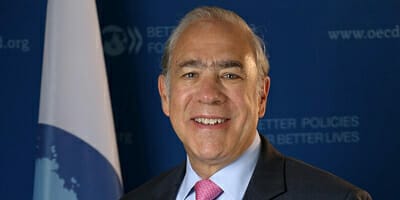
Governance of institutional investors and the lengthening investment chain causing  bigger distances between assets’ beneficial owners and those involved in executing investment strategies was one of three practical issues raised by the OECD general secretary as a barrier to more investment in long-term investing financing.

Speaking at the OECD Project on Institutional Investors and Long-term Investment roundtable, Gurria gave an update from the recent Brisbane G20 Leaders Summit as well as the future agenda for institutional investors and long-term investment in view of the future Turkish presidency of the G20.

In his speech, he said the G20/OECD High-Level Policy Principles on Long-Term Investment Financing by Institutional Investors provided a solid starting point for tackling the issues but there needed to be policy solutions to remove the obstacles to long term investing.

An extract of his speech is below:

“Following the guidance of G20 Leaders in Brisbane, we now need “to walk the extra-mile” and move “from solutions to actions”.

To this end, let me briefly address a few practical issues:
First, we need to address the issue of the governance of institutional investors. The lengthening ‘investment chain’, with bigger distances between assets’ beneficial owners and those involved in executing investment strategies, necessitates well-aligned incentives for every link in the chain.

Sponsored Content

We must remember that most of the money that circulates in this investment chain ultimately belongs to ordinary working people. Money they save for retirement or perhaps their children’s education. Similarly, those executing the investments also need to have the right skills and expertise to be able to expand their investment universe to alternative asset classes, in particular those that can support infrastructure investment and green projects.

Second, we need to address the question of financial regulation and its impact on the ability of institutional investors to provide financing for growth.

There is a need to balance stability and transparency against the need to ensure that institutional investors can act as proper financing channels for investment. For example, strict solvency rules, and related ‘mark to market’ accounting, may inadvertently put a brake on productive investment. More generally, governments need to ensure that the “conditions for investment” reduce legal and regulatory uncertainty.

Third, there is a clear need for more in-depth discussion on what are the most relevant and efficient financial instruments for long-term investment. We need to look at project financing needs across the entire life-cycle of investments to identify the optimal “division of labour” between different providers of finance.

“Pooling” mechanisms to get large and small institutions to participate in debt and equity financing can also play an important role. To facilitate these discussions, the OECD is developing a taxonomy of techniques, instruments and vehicles that policymakers can use to leverage private sector financing in infrastructure.

Ultimately, these three issues are just a sub-set of the much broader question as to what type of financial system we wish to construct. In advanced, emerging and developing economies alike, there is a need to enhance the role of fair and transparent capital markets. We need to consider concrete steps like the development of local currency bond markets; the issuance of project bonds; and the development of appropriate hedging instruments.

On these and many other issues, we are working together with the incoming Turkish presidency of the G20 on how best to advance the LTI agenda to promote stronger, fairer, greener growth.”


For the full speech click here

Leave a Comment

Sort content by

Pensionomics,
a money-go-round

As debate rages in the US about the generous retirement benefits and high cost of state and local defined benefit (DB) schemes, new research sheds light on the role these funds play in stimulating the economy and creating jobs. Pensionomics 2012: Measuring the Economic Impact of DB Pension Expenditures looks at the effect of DB

Total cost shakedown at CalPERS

Up to 8.9 basis points will be slashed from the total cost of managing the CalPERS’ investment portfolio in the next three years, under a new investment resource strategy which could also see internal administration costs increase by $6.5 million next year, and internal staff accountable for internal versus external management allocations. The internal investment

ESG almost an afterthought

Only 26 of 4300 companies surveyed by Governance Metrics International (GMI) have a specific clause that measures executive compensation against a sustainability metric, and institutional investors play a pivotal role in transforming this behaviour. Kimberly Gladman, director of research and risk analytics at the governance research company GMI, says investors should set the expectations that

Broader engagement at UNPRI

The United Nations Principles of Responsible Investment (UNPRI) will expand its focus beyond the micro focus of ESG implementation for its signatories to include thought-leadership research and public and policy debate, writes Amanda White. James Gifford, executive director at UNPRI, said the new strategy came out of its board meeting last week in Australia and

Are hedge fund investors getting what they paid for?

Alternative hedge fund beta allows investors to access the returns generated by hedge funds without the pressures of finding alpha, says Fama family professor of finance at the University of Chicago Booth School of Business, Tobias Moskowitz. Moskowitz says there are three components to hedge fund returns: unique alpha, traditional market beta, and “something else”,

Fund collaboration first step to joint investment

European pension fund service providers PGGM and PKA have agreed on an innovative knowledge exchange that eventually aims to look for joint investment opportunities as well as improving the way the funds conduct risk management and the benchmarking of investments, costs and socially responsible investing.mrec4inarticleinline Sponsored Content scnative1 scnative2 scnative3

Previous




