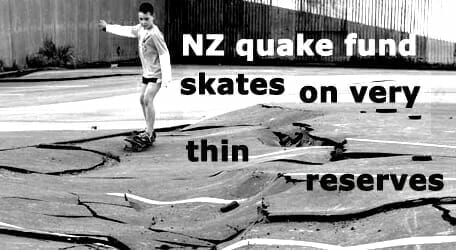

NZ quake fund skates on very thin reserves

New Zealand’s earthquake disaster relief fund could be completely drained following the fatal 6.3 quake that flattened large swathes of central Christchurch on February 22.

The Earthquake Commission (EQC) was already releasing about NZ$1.5 billion ($1.1 billion) of the $4.4 billion disaster fund to pay for claims generated by the 7.1 quake that caused widespread destruction in Christchurch last September.

The latest New Zealand government accounts to the end of January this year show the EQC had budgeted for insurance claims amounting to just over $1.78 billion from the September event.

While the fund itself must meet the first $1.1 billion in claims it had reinsurance in place up to a further $1.85 billion.

The EQC covers residential homeowners up to a value of $74,000 per claim. Owners who had been paid out after the September quake would be able to claim again if their homes sustained fresh damage following the latest catastrophe.

According to latest government estimates, about 10,000 Christchurch homes would have to be demolished while a further 100,000 required some level of repair as a result of the February earthquake.

Sponsored Content

If the latest round of claims exceeded $2.95 billion ($1.1 billion from the fund plus $1.85 billion from reinsurers), the EQC would have to dip into its remaining capital, which would amount to about $2.22 billion of New Zealand fixed-interest investments.

Last year Phil Jacques, EQC chief financial officer, told Top1000Funds’ sister publication, I&T News, the fund would first sell-down its $1.26 billion global equities portfolio to meet claims.

While EQC would not comment, it is understood the global equities sell-down had almost been completed. AXA’s annual accounts to the end of December last year, for example, reveal the EQC redeemed its $237.3 million global equities mandate with AllianceBernstein to cover costs incurred by the September earthquake.

The EQC also had global equity mandates with State Street Global Advisors, Tweedy Browne, T. Rowe Price and Capital International.

The remaining 70 per cent of the EQC portfolio was chiefly invested in a range of New Zealand government securities, including about 20 per cent in inflation-linked bonds.

Russell acts as investment adviser to the EQC fund.

EQC collects about $66.6 million in levies each year but New Zealand Prime Minister, John Key, said that figure could triple next year to replenish the disaster fund.

One response to “NZ quake fund skates on very thin reserves”

  1. Investor need to understand the risk of investing in infrastructure fund.

Leave a Comment

Sort content by

European distressed debt: investors divided by volatility

Last month conexust1f.flywheelstaging.com hosted a thinktank with a group of influential Australian investors to discuss the opportunities in European distressed debt. Participants included the Australian Government’s $80 billion sovereign wealth Future Fund, the $68 billion QIC, and leading asset consultants, with guest speaker sir David Cooksey, former board member of the Bank of England, chairman

Governance, Gonski style

Since becoming chair of the $80-billion Future Fund in March, David Gonski has set an agenda to act like a public company chair. An element of that vision is to very clearly delegate to management. “The general manager has been elevated to a managing director and the six-monthly announcements will be his,” he says. Another

Risk parity manages risk regret

The risk parity approach to portfolio construction might not deliver results in a “bull stockmarket,” but remained a “robust and rigorous” methodology which also “managed risk regret over time.” These are the views of Wai Lee, chief investment officer of quantitive investment at New York-based fund manager Neuberger Berman, who was recently named winner of

African countries come to the sovereign wealth fund party

Many of the countries with the largest oil reserves also boast the largest sovereign wealth funds (SWFs). And yet African producers, like newcomer Ghana, Angola, and Nigeria which has been pumping oil since the 1950s, haven’t saved much of their oil revenue. Now, in an effort to replicate the long-term growth of funds like Norway’s

Regulatory risk in Europe a factor for infrastructure investment

The head of infrastructure at Australia’s $80 billion Future Fund has cited regulatory risk in Europe and the United Kingdom as reasons to be wary about infrastructure investment in the region. Raphael Arndt, the Future Fund’s head of infrastructure and timberlands, told a Sydney conference this week that he was particularly concerned with the situation

Europe’s credit rating crunch

It has been a bad month for credit-rating agency executives who thought they were winning the legal and regulatory arguments about how they conduct their business. In Australia, the Federal Court ruled on November 5 in favour of 12 local councils in New South Wales which claimed that Standard and Poor’s had misled them into

Previous




