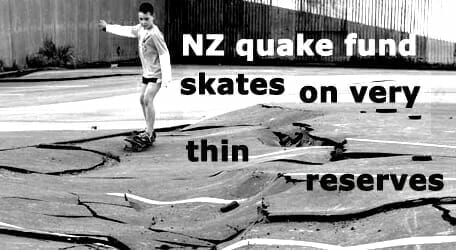

NZ quake fund skates on very thin reserves

New Zealand’s earthquake disaster relief fund could be completely drained following the fatal 6.3 quake that flattened large swathes of central Christchurch on February 22.

The Earthquake Commission (EQC) was already releasing about NZ$1.5 billion ($1.1 billion) of the $4.4 billion disaster fund to pay for claims generated by the 7.1 quake that caused widespread destruction in Christchurch last September.

The latest New Zealand government accounts to the end of January this year show the EQC had budgeted for insurance claims amounting to just over $1.78 billion from the September event.

While the fund itself must meet the first $1.1 billion in claims it had reinsurance in place up to a further $1.85 billion.

The EQC covers residential homeowners up to a value of $74,000 per claim. Owners who had been paid out after the September quake would be able to claim again if their homes sustained fresh damage following the latest catastrophe.

According to latest government estimates, about 10,000 Christchurch homes would have to be demolished while a further 100,000 required some level of repair as a result of the February earthquake.

Sponsored Content

If the latest round of claims exceeded $2.95 billion ($1.1 billion from the fund plus $1.85 billion from reinsurers), the EQC would have to dip into its remaining capital, which would amount to about $2.22 billion of New Zealand fixed-interest investments.

Last year Phil Jacques, EQC chief financial officer, told Top1000Funds’ sister publication, I&T News, the fund would first sell-down its $1.26 billion global equities portfolio to meet claims.

While EQC would not comment, it is understood the global equities sell-down had almost been completed. AXA’s annual accounts to the end of December last year, for example, reveal the EQC redeemed its $237.3 million global equities mandate with AllianceBernstein to cover costs incurred by the September earthquake.

The EQC also had global equity mandates with State Street Global Advisors, Tweedy Browne, T. Rowe Price and Capital International.

The remaining 70 per cent of the EQC portfolio was chiefly invested in a range of New Zealand government securities, including about 20 per cent in inflation-linked bonds.

Russell acts as investment adviser to the EQC fund.

EQC collects about $66.6 million in levies each year but New Zealand Prime Minister, John Key, said that figure could triple next year to replenish the disaster fund.

One response to “NZ quake fund skates on very thin reserves”

  1. Investor need to understand the risk of investing in infrastructure fund.

Leave a Comment

Sort content by

Investors must collaborate to innovate

Institutional investors are sheltered by competition, which in some instances can be beneficial, but it also means they are shielded from competitive forces that drive innovation. A new paper by Gordon Clark and Ashby Monk, looks at why the current model of either insourcing or outsourcing investment management doesn’t allow for innovation, and the models

Mercer’s plan for integrating ESG

How to implement ESG into portfolio construction and implementation is an ongoing challenge for asset owners. Mercer has come up with a number of strategies including the best way to use ESG ratings, active ownership, and tailored strategies that play to sustainability themes, including its own unlisted investment solution. Amanda White spoke to Jane Ambachtsheer,

PRI governance review to look at differential rights

The PRI has received many queries following the move by six Danish funds to abdicate as signatories over governance concerns. The association is holding a governance review that among other things will discuss the prospect of differential rights among signatories.   When six Danish funds, with a combined $300 billion, decided to leave the PRI

A trustee guide to factor investing

This research by academics at Tilburg University and the VU University Amsterdam, looks at the hurdles of implementing factor investing. It translates those into a checklist for implementing factor investing. The research, conducted for Robeco, finds that three approaches to factor investing are emerging and conducts case studies to examine how these approaches are implemented

Blackrock looks favourably on equities

Blackrock has a favourable view on equities, relative to bonds, but within fixed income it advocates an unconstrained approach. Amanda White spoke to chief investment strategist, Russ Koesterich.   Equities look cheap relative to bonds or cash, says chief investment strategist for Blackrock and iShares chief global investment strategist, Russ Koesterich, with the manager recommending

Howard Marks on alpha and making money

“It used to be easier to make money,” Oaktree Capital Management founder and chairman, Howard Marks muses as he discusses meeting the demands and goals of his clients in 2014. Marks is an avid communicator, and has been writing memos to clients for 24 years. The result is his book “The Most Important Thing”, which

Previous




