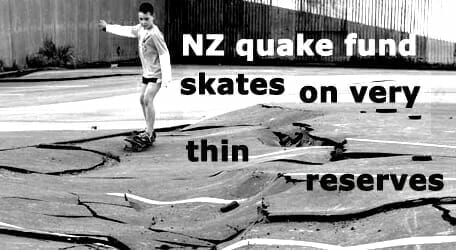

NZ quake fund skates on very thin reserves

New Zealand’s earthquake disaster relief fund could be completely drained following the fatal 6.3 quake that flattened large swathes of central Christchurch on February 22.

The Earthquake Commission (EQC) was already releasing about NZ$1.5 billion ($1.1 billion) of the $4.4 billion disaster fund to pay for claims generated by the 7.1 quake that caused widespread destruction in Christchurch last September.

The latest New Zealand government accounts to the end of January this year show the EQC had budgeted for insurance claims amounting to just over $1.78 billion from the September event.

While the fund itself must meet the first $1.1 billion in claims it had reinsurance in place up to a further $1.85 billion.

The EQC covers residential homeowners up to a value of $74,000 per claim. Owners who had been paid out after the September quake would be able to claim again if their homes sustained fresh damage following the latest catastrophe.

According to latest government estimates, about 10,000 Christchurch homes would have to be demolished while a further 100,000 required some level of repair as a result of the February earthquake.

Sponsored Content

If the latest round of claims exceeded $2.95 billion ($1.1 billion from the fund plus $1.85 billion from reinsurers), the EQC would have to dip into its remaining capital, which would amount to about $2.22 billion of New Zealand fixed-interest investments.

Last year Phil Jacques, EQC chief financial officer, told Top1000Funds’ sister publication, I&T News, the fund would first sell-down its $1.26 billion global equities portfolio to meet claims.

While EQC would not comment, it is understood the global equities sell-down had almost been completed. AXA’s annual accounts to the end of December last year, for example, reveal the EQC redeemed its $237.3 million global equities mandate with AllianceBernstein to cover costs incurred by the September earthquake.

The EQC also had global equity mandates with State Street Global Advisors, Tweedy Browne, T. Rowe Price and Capital International.

The remaining 70 per cent of the EQC portfolio was chiefly invested in a range of New Zealand government securities, including about 20 per cent in inflation-linked bonds.

Russell acts as investment adviser to the EQC fund.

EQC collects about $66.6 million in levies each year but New Zealand Prime Minister, John Key, said that figure could triple next year to replenish the disaster fund.

One response to “NZ quake fund skates on very thin reserves”

  1. Investor need to understand the risk of investing in infrastructure fund.

Leave a Comment

Sort content by

The cost of bad asset allocation

A study of 300 US pension funds by CEM Benchmarking reinforces the importance of asset allocation, highlighting the performance of asset classes, as well as new evidence on correlations between asset classes. Alex Beath, author of the study, discusses the implications for asset allocation with Amanda White. A CEM Benchmarking study “Asset Allocation and Fund

The OECD’s plan for long-term investment

G20 financial ministers and central bank governors welcomed the findings of the G20/OECD roundtable on institutional investors and long-term investment last month, which included clear plans to incentivise institutional investors to undertake more long-term investments. The roundtable, “From solutions to actions: implementing measures to encourage institutional long-term investment financing”, held in Singapore recognised that long-term

Why long-horizon investors should adopt factor-based asset allocation

Long-horizon investors can withstand macro-economic volatility and so should tilt towards strategies that are exposed to that, including value, small cap and momentum. Oleg Ruban, vice president in the applied research team at MSCI says this validates factor-investing and factor-based asset allocation for these investors.   Appropriate asset allocation requires explicit attention be paid to

The case for long-termism

Keith Ambachtsheer’s lead article in the Fall 2014 edition of the Rotman International Journal of Pension Management, takes readers through an historical and logical journey that supports the case for long-termism. Importantly he validates this with four high-profile investor case studies which demonstrate that a long-term view benefits society but also the investors, willing to

Investors alter allocations because of climate risks

A number of large institutional investors, including AP1, the Environment Agency and AustralianSuper, made changes to their strategic asset allocation as a result of Mercer’s 2011 study on climate risks, and now the consultant is working with a new raft of investors to assess forward-looking climate change scenarios against their current allocations. Meanwhile one of

Real estate sector continues to lead on sustainability: GRESB

This year’s Global Real Estate Sustainability Benchmark (GRESB) reveals that sustainability reporting has improved in coverage and quality of data, with the average overall score increasing due to increasing implementation and measurement. The average score is now 47 (out of 100) which is up nine points this year. The benchmark collects data from 637 listed

Previous




