
Income the key dimension

Risk should be defined as the inability to meet retirement income goals, so investors and their managers should forget alpha and other “distractions”, according to co-chief executive of Dimensional, David Booth.

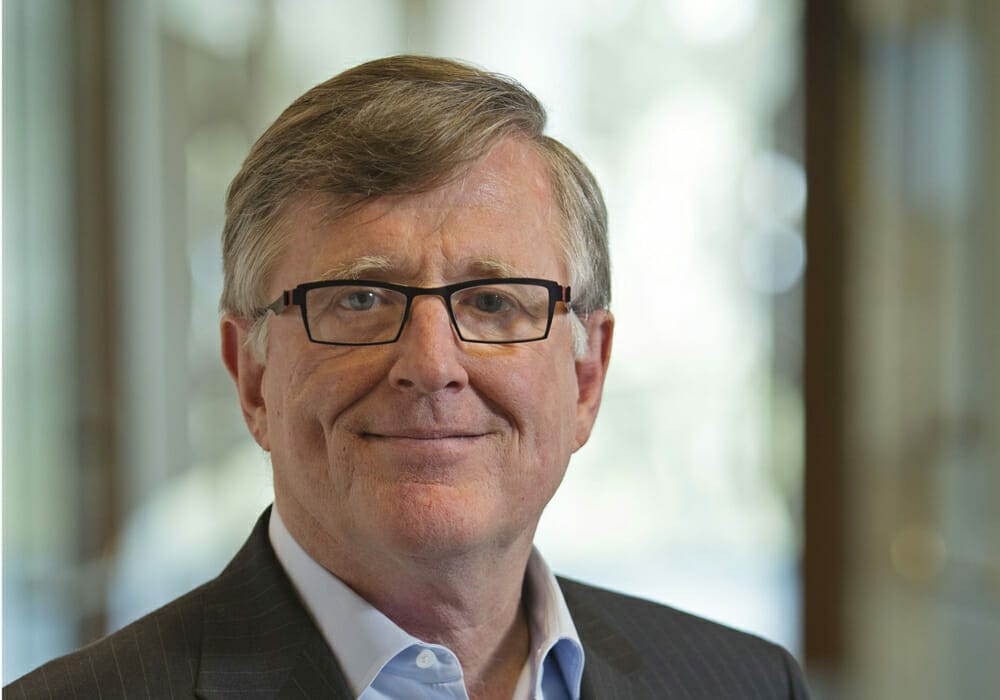
Retirement income should be the key focus of every investment manager, according to David Booth, founder and co-chief executive of Dimensional Fund Advisors.

According to Booth the entire investment industry should be focused on risk being defined as the inability to meet retirement income goals.

“Concepts of, for example, alpha are distracting; you want to focus on the goal,” he says.

“It has to be the big conversation in investment management, trying to improve people’s lives. Retirement has got to be front and centre.”

Dimensional puts this philosophy into action and has a conversation with all employees twice a year about retirement.

Sponsored Content

“As an employer, we talk about lifecycle financial needs and the importance of life insurance. It is so mismanaged. We don’t want it to be a case of no shoes on the cobbler’s kids, so we asked ourselves ‘what are we doing for our own employees?’.”

Key to understanding retirement, and how the industry can serve investors, is distinguishing between wealth and income, with the focus shifting to income.

As an example, he says the rates on the so-called least risky investment, like short-term fixed income, have been shown to have widely variable rates in the three decades since Booth started Dimensional – from 15 per cent to 15 basis points.

“In terms of retirement income, bank bills look risky,” he says. “Your risk is your consumption bundle.”

Dimensional has been an advisor to the recently launched S&P Shift to Retirement Income and Decumulation (STRIDE) index series, which is a multi-asset class solution designed to transition from growth assets to a hedged stream of inflation-adjusted retirement income based on target retirement dates.

Dimensional worked with S&P Dow Jones Indices to develop the glide path, inflation hedging and duration hedging techniques used in the indices.

In the paper, Introducing the Stride Index Series, Booth’s example of volatility in short-term nominal bonds is explained further.

It shows the difference in return volatility by expressing the results in wealth units versus income units, and does this by comparing short-term nominal treasuries and treasury inflation-protected securities (TIPS) bonds.

Measured in wealth units, short-term nominal bonds show low volatility, and the real-bonds TIPS portfolio is more volatile.

But by looking at the returns in income units, by looking at the change in the cost of $1 annual cash flow for 25 years, the reverse is true.

It’s switching the focus from wealth accumulation terms to income terms that is key.

“This is the first time we’ve said this is how you should do asset allocation. Given the notion of a goal, then asset allocation becomes relative,” he says.

And Booth says in order to evaluate how good a job a participant is doing, they needed a benchmark.

Each S&P STRIDE index consists of an allocation to a group of indices covering global equity, global fixed income and US Treasury inflation-protected securities (TIPS).

Allocations are determined by five-year increments of target date years to cover a full life cycle of accumulation, defined as working years, and decumulation, defined as retirement years.

“The goal for many people saving for retirement is to maintain a standard of living in retirement. For these individuals, one relevant risk to manage is the uncertainty of how much retirement income their balances can afford. This uncertainty is driven by changes in interest rates and inflation,” Booth says.

“The S&P STRIDE index series represents a significant step forward in the design of target-date indices, because they manage relevant risks facing participants saving for retirement. I believe these indices provide plan sponsors, consultants, and financial advisors with a better benchmark to understand how well prepared plan participants are to maintain their desired standard of living in retirement.”

The thinking behind this has been driven by Nobel Prize winner, and resident scientist at Dimensional, Robert Merton.

He says the focus should be on goals-based investing, and consistent with Booth’s comments, the right goal for most people is an inflation-protected income at retirement, not wealth accumulation.

It’s something Merton talks about with a passion that has supported a 45-year career researching risk and lifecycle investing.

In his opinion, the retirement management industry should change its language, and techniques, to focus on income, and to look at earnings for spending and lifestyle.

And that’s exactly what Dimensional is doing.

“Other firms have different objectives,” says Booth.

“We are never going to be the biggest manager, but I hope we can be one of the most important.”

Dimensional, which has a number of academic advisors including both Eugene Fama and Kenneth French, is open to innovation and the application of finance ideas.

“Financial science can be used in ways we haven’t even thought of yet. We want to be open to that,” he says. “The performance measurement industry has only been around for 15 years and is on a continuum of improvement. The idea of longevity insurance, and applying insurance to mortality, is an important idea.

“I’ve built a career out of trying to get people to think realistically about what can be achieved. $1 in the stock market gets the average stock-market return minus costs; it’s simple math,” he says.

“Wealthy people can afford to get advice, but how do you make these ideas and technology accessible?”


For more information see

Research introducing the S&P stride index series

Leave a Comment

Sort content by

Governance, Gonski style

Since becoming chair of the $80-billion Future Fund in March, David Gonski has set an agenda to act like a public company chair. An element of that vision is to very clearly delegate to management. “The general manager has been elevated to a managing director and the six-monthly announcements will be his,” he says. Another

Risk parity manages risk regret

The risk parity approach to portfolio construction might not deliver results in a “bull stockmarket,” but remained a “robust and rigorous” methodology which also “managed risk regret over time.” These are the views of Wai Lee, chief investment officer of quantitive investment at New York-based fund manager Neuberger Berman, who was recently named winner of

African countries come to the sovereign wealth fund party

Many of the countries with the largest oil reserves also boast the largest sovereign wealth funds (SWFs). And yet African producers, like newcomer Ghana, Angola, and Nigeria which has been pumping oil since the 1950s, haven’t saved much of their oil revenue. Now, in an effort to replicate the long-term growth of funds like Norway’s

Regulatory risk in Europe a factor for infrastructure investment

The head of infrastructure at Australia’s $80 billion Future Fund has cited regulatory risk in Europe and the United Kingdom as reasons to be wary about infrastructure investment in the region. Raphael Arndt, the Future Fund’s head of infrastructure and timberlands, told a Sydney conference this week that he was particularly concerned with the situation

Europe’s credit rating crunch

It has been a bad month for credit-rating agency executives who thought they were winning the legal and regulatory arguments about how they conduct their business. In Australia, the Federal Court ruled on November 5 in favour of 12 local councils in New South Wales which claimed that Standard and Poor’s had misled them into

Dutch reform to tread lightly on investment mix

When the Netherlands pension reforms were announced in 2011, many experts argued they were likely to substantially increase the risk appetites at the funds guarding the country’s $1-trillion pension assets. Recent developments to the reform proposals make the overall impact far from clear, however, suggesting there will be no bonanza for Dutch investment managers. The

Previous




