
How the Future Fund found agility

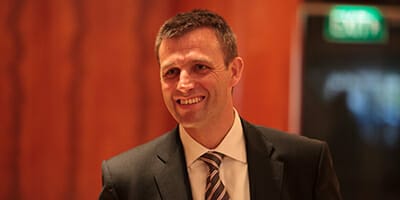
Using a fund of funds enabled the Future Fund to build a large exposure to hedge funds quickly during the global financial crisis, chief investment officer of the Future Fund, David Neal says.

The Future Fund, which uses a combination of fund of funds and direct hedge fund investments, decided it did not have the breadth of skill and research to entirely invest directly.

“Could we realistically, or want to, try to build a team with enough talent and size to cover the industry? It’s not consistent with our notion to keep the investment team small enough to sit around a table and talk about all of the opportunities and strategies to build our portfolio,” Neal says.

“We thought with fund of funds, and the extra edge of someone who’s actually doing it, was worth exploring. As we started, we found other benefits of fund of funds, for example, in the crisis we were able to move quickly. We had one investment-management agreement with one organisation, which has relationships, and we can throw money at them quickly and could build a large exposure quickly. There was an execution service that came from it that would have taken a long time.”

Environment-specific risk

Neal says the Future Fund, which has almost 20 per cent exposure to hedge funds, is looking to expand its exposure and invest in commodities, catastrophe bonds and macro managers.

Sponsored Content

The fund has generated 4.9 per cent since inception, well below its mandate of consumer-price index plus 4.5 to 5.5 per cent

“We are clearly behind, but we don’t think there is much more we could have done. It is very dangerous to play catch-up. If you load up more risk, you’ll blow it,” Neal says. “You have to take the right amount of risk given the environment.”

Investors must manage the risk profile to the prevailing landscape, Neal says, but he believes there will be opportunity to take more risk in the next decade.

Meritocracy for assets

The Future Fund has a “dynamic” allocation process, but it is not relative to a benchmark. Rather, all investment opportunities are assessed on their merit.

“Long-term characteristics can change quickly, the GFC showed that,” he says. “It is not about active tilting but managing risk/return and adjusting accordingly.”

Because of this dynamic nature, the funds are shifted from one opportunity to another.

“There are managers we are happy with who we take money from because the opportunity changes,” Neal says.

The Future Fund considers every investment opportunity on a hedged basis, so each investment can be compared on a like-for-like basis. The fund then decides how much currency to hold.

At the moment it has 12.5 per cent in emerging-market currencies and 18 per cent in developed-market currencies

“Currency is the risk I worry about the most – or it is the cause and solution of the risk I worry about the most – liquidity.”

Neal sits on the Hedge Fund Standards Board and encourages investors to sign the standards’ investor chapter.

“The more investors that sign, the more that managers are interested.”

Asset Owner:Future Fund

Leave a Comment

Sort content by

The changing nature of fixed income

As the fixed income asset class undergoes rapid change and the opportunity set expands, unconstrained bond funds have become popular. But as this article examines, with that expanded opportunity set comes new considerations including a wider risk/return spectrum among managers.   Trends in the global investment universe tend to come around every six months or

McKinsey’s tips on sustainability integration

More companies are recognising sustainability as a core business issue, but according to McKinsey and Company they are still failing to capture its full value, in particular struggling with incorporating it into organisational processes such as performance management. A McKinsey global survey, garnering responses from 3,344 executives from the full range of regions, company size

Long term investing and infrastructure

There has been some ambiguity about what being a long-term investor means. For Australia’s Future Fund it means focusing on a few key aspects of our investments: understanding value, the ability to make and implement portfolio decisions and manager alignment. In this speech at the ASFA Global Investment Forum on infrastructure and long-term investment, Raphael

Where does the next generation of fund managers come from?

According to Malcolm Gladwell’s Outliers, at least 10,000 hours of practice is needed to be a success at your chosen profession. This means that a fund manager will hit their strides around age 40. But the London Business School is giving its students a leg up in that quest to find success. They have real-life

The meaning of fiduciary duty

The UK Law Commission has delivered its final report on how the law of fiduciary duties applies to investment intermediaries and an evaluation of whether the law works in the interests of the ultimate beneficiaries. The project was commissioned by the Department for Business, Innovation and Skills (BIS) and the Department for Work and Pensions

New leadership prompts strategy review at ICPM

A decade since the formation of the Rotman International Centre for Pension Management is a good time to review the organisation’s raison d’etre. Amanda White spoke to ICPM chair, Barbara Zvan, chief investment risk officer of Ontario Teachers’ Pension Plan, and the outgoing and incoming executive directors, Keith Ambachtsheer and Rob Bauer.   “There is

Previous




