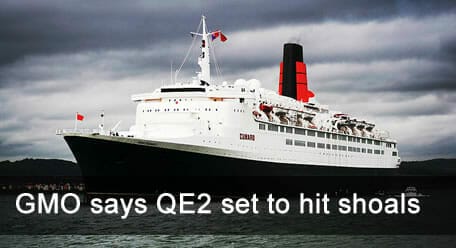

GMO says QE2 set to hit shoals

On the eve of an anticipated second round of quantitative easing – QE2 – a number of commentators, including GMO’s Jeremy Grantham, have criticised Fed’s policy as a large net negative to the production of a healthy, stable economy.

According to Grantham, chief investment strategist and co-founder of GMO, in almost every respect, adhering to a policy of low rates, employing quantitative easing, deliberately stimulating asset prices, ignoring the consequences of bubbles breaking, and displaying a complete refusal to learn from experience has left Fed policy as a large net negative to the production of a healthy, stable economy with strong employment.

He believes that there is likely to be no benefit to artificially low rates, and more so, quantitative easing is likely to turn out to be an even more desperate move than the typical low rate policy. Importantly, by increasing inflation fears, this easing has sent the dollar down and commodity prices up, he says in his quarterly letter.

Weakening the dollar and being seen as certain to do that increases the chances of currency friction, which could spiral out of control.

“If I were a benevolent dictator, I would strip the Fed of its obligation to worry about the economy and ask it to limit its meddling to attempting to manage inflation.

Sponsored Content

“Better yet, I would limit its activities to making sure that the economy had a suitable amount of liquidity to function normally.

“Further, I would force it to swear off manipulating asset prices through artificially low rates and asymmetric promises of help in tough times – the Greenspan/Bernanke put.

It would be a better, simpler, and less dangerous world, although one much less exciting for us students of bubbles. Only by hammering away at its giant past mistakes as well as its dangerous current policy can we hope to generate enough awareness by 2014: Bernanke’s next scheduled reappointment hearing.”

In recommendations, Grantham says investors should:

Emphasise US quality companies, which are still cheap in an overpriced world

Moderately overweight emerging market equities

Moderately underweight the balance of global equities

Heavily underweight lower quality US companies

Carry extra cash reserves for a volatile market with insecure fundamentals

For the very long term (20 years) overweight resources, particularly if they have a sharp decline (this is Grantham’s personal view rather than that of GMO, which on this topic is agnostic).

Leave a Comment

Sort content by

“Periodic table” for investment shows case for diversification

The latest “periodic table” of investment returns – which ranks the performance of key equity and credit indices over two decades – from Callan Associates reinforces a lasting rule for long-term investors: diversification works. mrec4inarticleinline Sponsored Content scnative1 scnative2 scnative3

US funds lag in risk management

US public sector funds spend less than half the time and resources on risk management than the average of their global peers according to a survey of 58 funds by Canadian-based CEM Benchmarking. mrec4inarticleinline Sponsored Content scnative1 scnative2 scnative3

Private equity is ‘train crash’: expert

The collapse of a private equity manager lacks the impact of a hedge fund failure: it’s like a “slow-motion train wreck,” says Chris Hunter, managing director of Cambridge Associates in London. Now that fundraising among private equity managers is down, leveraged finance is scarce and the market for exits is weak, mega-buyout funds are busy

Going green boosts property returns

Green properties are better financial performers, says of Maastricht University, who recently helped build a global environmental real estate index. But most property managers are either unaware of this dynamic or prefer to talk about sustainability rather than take action. However, some exceptions provide a ‘green’ benchmark for institutional investors in property. Simon Mumme reports. mrec4inarticleinline

New private equity head for New York Teachers

The New York State Teachers’ Retirement System has restructured its internal investment team creating a new role of head of private equity, to create five direct investment reports to the executive director, and has already made a number of additional investments in that asset class. mrec4inarticleinline Sponsored Content scnative1 scnative2 scnative3

Investors take credit in Say on Pay reform

Investor action through letters and company dialogue has resulted in more than 40 companies in the US, including Goldman Sachs, State Street, BNY Mellon and Conoco, agreeing to implement Say on Pay reform, according to Timothy Smith, senior vice president, Walden Asset Management who recently coordinated a letter signed by investors including CalPERS chief investment

Previous




