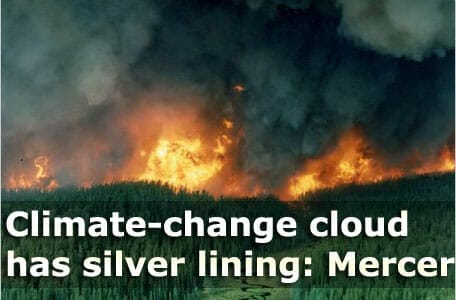

Climate-change cloud has silver lining: Mercer

Climate change could slash as much as 10 per cent off portfolios in the next 20 years, according to Mercer’s much-anticipated climate change report, the result of an 18-month collaboration with 14 institutional investors from around the globe.

With support from the International Finance Corporation and the Carbon Trust, the report, ‘Climate Change Scenarios – implications for strategic asset allocation’, had three broad objectives:

1.      To investigate and analyse the potential investment risk from climate change

2.      Look at the key performance drivers for markets

3.      Identify scenarios around climate change that help in understanding and framing climate change as a strategic investment priority.

Sponsored Content

“It is about setting the framework so institutional investors can transform to a low carbon economy,” Danyelle Guyatt, head of global research in Mercer’s responsible investment team, said.

The report looks at the impact of climate change on investments, concluding it could contribute as much as 10 per cent to portfolio risks.

Guyatt said Mercer would research managers with the best ideas across ideas and regions, and urged investors to introduce climate risk into reviews and strategic asset allocation.

Mercer’s chief investment officer, Andrew Kirton, said investors should look to allocate more to infrastructure, real estate, private equity, agriculture land, timberland, and sustainable assets.

The 14 global institutional investors, representing more than $2 trillion in AUM, are: AP1, APG, AustralianSuper, British Columbia Investment Management Corporation, British Telecom Pension Scheme, CalPERS, CalSTRS, Environment Agency Pension Scheme, Government of Singapore Investment Corporation, Maryland State Retirement and Pension System, Norwegian Government Pension Fund, Ontario Municipal Employees Retirement System, PGGM and VicSuper.

Leave a Comment

Sort content by

Who pays for climate fund still up in the air

The formal approval of the Green Climate Fund (GCF) was a critical outcome of the UN climate change conference in Durban, according to Deutsche Bank Climate Change Advisors, but the lack of funding for the GCF remains a concern.mrec4inarticleinline Sponsored Content scnative1 scnative2 scnative3

Investment risks rank highest for CalPERS

Investment controls and systems remain the highest risk at CalPERS according to its year-end enterprise risk dashboard.

Macro risks remain dominant: Cambridge

Macro-economic risks remain the biggest investment concern this year, while certain distressed assets will present the best opportunities, according to managing director of Cambridge Associates, Sandra Urie. “The dislocation in European markets has already created investment opportunities across different credit markets, and we believe these may expand as the pace of European bank deleveraging accelerates,”

2011 global and industry highlights

Republican congress woman Gabrielle Giffords was among 17 shot in an assassination attempt, six killed. The Dow Jones Industrial Average broke through 12,000, the first time the index was above this mark since 2008. The index had its best January performance since 1997. Investors’ appetite for corporate bonds continued unabated with banks and companies borrowing

The year that was, a CIO’s perspective

The downgrade of the US took the entire industry by surprise, in a year that confirmed the complexity and unpredictability of markets, CalSTRS chief investment officer, Christopher Ailman, says.mrec4inarticleinline Sponsored Content scnative1 scnative2 scnative3

Hermes downbeat on 2012 outlook

There isn’t a lot of Christmas cheer when it comes to economic forecasts at Hermes, with the fund manager’s chief economist Neil Williams predicting the current gloom besetting the world economy will not lift in 2012, and may even get worse.mrec4inarticleinline Sponsored Content scnative1 scnative2 scnative3

Previous




