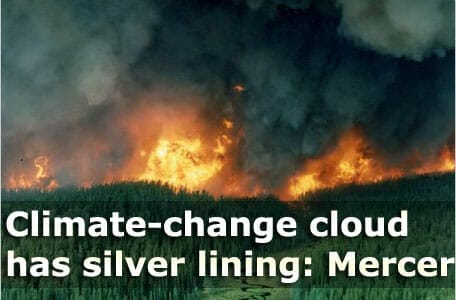
Climate-change cloud has silver lining: Mercer

Climate change could slash as much as 10 per cent off portfolios in the next 20 years, according to Mercer’s much-anticipated climate change report, the result of an 18-month collaboration with 14 institutional investors from around the globe.

With support from the International Finance Corporation and the Carbon Trust, the report, ‘Climate Change Scenarios – implications for strategic asset allocation’, had three broad objectives:

1.      To investigate and analyse the potential investment risk from climate change

2.      Look at the key performance drivers for markets

3.      Identify scenarios around climate change that help in understanding and framing climate change as a strategic investment priority.

Sponsored Content

“It is about setting the framework so institutional investors can transform to a low carbon economy,” Danyelle Guyatt, head of global research in Mercer’s responsible investment team, said.

The report looks at the impact of climate change on investments, concluding it could contribute as much as 10 per cent to portfolio risks.

Guyatt said Mercer would research managers with the best ideas across ideas and regions, and urged investors to introduce climate risk into reviews and strategic asset allocation.

Mercer’s chief investment officer, Andrew Kirton, said investors should look to allocate more to infrastructure, real estate, private equity, agriculture land, timberland, and sustainable assets.

The 14 global institutional investors, representing more than $2 trillion in AUM, are: AP1, APG, AustralianSuper, British Columbia Investment Management Corporation, British Telecom Pension Scheme, CalPERS, CalSTRS, Environment Agency Pension Scheme, Government of Singapore Investment Corporation, Maryland State Retirement and Pension System, Norwegian Government Pension Fund, Ontario Municipal Employees Retirement System, PGGM and VicSuper.


Leave a Comment

Sort content by

Epic change predicted for investment industry

The investment management industry must address the high fees it charges in relation to the realistic returns it can achieve in the current environment, attendees at the CFA Institute’s annual conference were told this week. As part of celebrations of the 50-year history of the CFA Charter, a panel of eminent institute members discussed the

Listed companies are failing on sustainability

US companies are failing to meet a 10-year roadmap to sustainability and some sectors globally are ‘inherently unsustainable’ requiring a drastic refocus, according to two separate reports released this week by leading sustainability research firms Ceres and EIRIS. A report on the progress that some of the world’s biggest companies are making towards achieving sustainability

OECD, ITUC call for more green investment

Amid calls from global leaders for pension funds to invest more in the green economy, institutional green investments still languish at less than 1 per cent of portfolios. A recent OECD report looks at some of the barriers facing investors wanting to invest more in the sector, with regulatory uncertainty and a lack of suitable

Money for water

The global scarcity of water continues to make headlines, but a water-themed investment approach is only just starting to make waves with large institutional investors. Estimates of the assets in equity funds in this niche corner of the investment world vary from about $3 billion to $6 billion in funds under management – a veritable

GMO’s Grantham bets against irrational markets

Supposedly long-term investors typically have the patience to wait about three years to see if an investment strategy will pay-off with managers needing to manage to their own and their client’s career risk tolerance, investment icon and Grantham, Mayo and van Otterloo (GMO) founder Jeremy Grantham says. In his quarterly letter to investors, Grantham says

Mercer: think laterally on bonds

The angst in Europe has calmed down, relatively speaking, but according to Mercer, it will be a long haul, with deleveraging there and in the US taking many years. Investors need to act accordingly. Part of the problem is that conventionally safe assets, such as US Treasuries, are expensive. “That will take years to work

Previous



