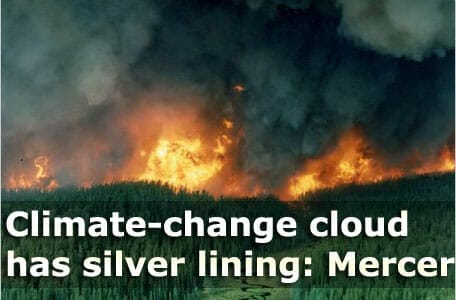
Climate-change cloud has silver lining: Mercer

Climate change could slash as much as 10 per cent off portfolios in the next 20 years, according to Mercer’s much-anticipated climate change report, the result of an 18-month collaboration with 14 institutional investors from around the globe.

With support from the International Finance Corporation and the Carbon Trust, the report, ‘Climate Change Scenarios – implications for strategic asset allocation’, had three broad objectives:

1.      To investigate and analyse the potential investment risk from climate change

2.      Look at the key performance drivers for markets

3.      Identify scenarios around climate change that help in understanding and framing climate change as a strategic investment priority.

Sponsored Content

“It is about setting the framework so institutional investors can transform to a low carbon economy,” Danyelle Guyatt, head of global research in Mercer’s responsible investment team, said.

The report looks at the impact of climate change on investments, concluding it could contribute as much as 10 per cent to portfolio risks.

Guyatt said Mercer would research managers with the best ideas across ideas and regions, and urged investors to introduce climate risk into reviews and strategic asset allocation.

Mercer’s chief investment officer, Andrew Kirton, said investors should look to allocate more to infrastructure, real estate, private equity, agriculture land, timberland, and sustainable assets.

The 14 global institutional investors, representing more than $2 trillion in AUM, are: AP1, APG, AustralianSuper, British Columbia Investment Management Corporation, British Telecom Pension Scheme, CalPERS, CalSTRS, Environment Agency Pension Scheme, Government of Singapore Investment Corporation, Maryland State Retirement and Pension System, Norwegian Government Pension Fund, Ontario Municipal Employees Retirement System, PGGM and VicSuper.


Leave a Comment

Sort content by

The Netherlands’ UWV battles to regain funding

The funding crisis that hit pension funds across the world may be easing – in common with the five-year long economic crisis – but restoring healthy funding levels remains a vital priority for many investors. The Netherlands’ €4.9-billion ($6.6-billion) UWV pension fund is one of that number. A funding ratio of 98.7 per cent at

The diminishing role of agents

I’ve always been frustrated by interviewing consultants and the lack of conviction they have about their decisions. “What would your ideal model portfolio look like?” I constantly ask. “It depends on the client” is the predictable and consistent answer. That may be valid, even true, but it speaks to a wider problem. Consultants are hired

Push the reset button at PRI in Person

At the United Nations-backed Principles for Responsible Investment conference Cape Town on October 1, general secretary of the International Trade Union Confederation Sharan Burrow delivered a speech entitled Push the Reset Button – a Line Between Speculation and Investment. She discussed the stability of the global economy, the necessity for investors to shift to long-term

OECD leads global infrastructure push

The OECD seeks to lengthen the time horizons of investors and get institutional money flowing from across the world into infrastructure gaps.

Sustainable investment goes to school

The Robert F Kennedy Centre for Justice and Human Rights and Columbia University’s Earth Institute will run a series of high-level courses on sustainable investment focused on environmental, social and governance approaches as well as human and labour rights this autumn. The Compass Sustainable Investing Certificate program, designed for long-term investors, will have a solutions-driven

Giving time to investment governance

Roger Urwin, global head of content at Towers Watson and governance specialist, says most organisations don’t spend enough time on it, but transformational change is all about giving time to investment governance. Culture and leadership, for example is so self-evidently important in people organisations and yet it is understated in asset owners, he says. “The soft

Previous



