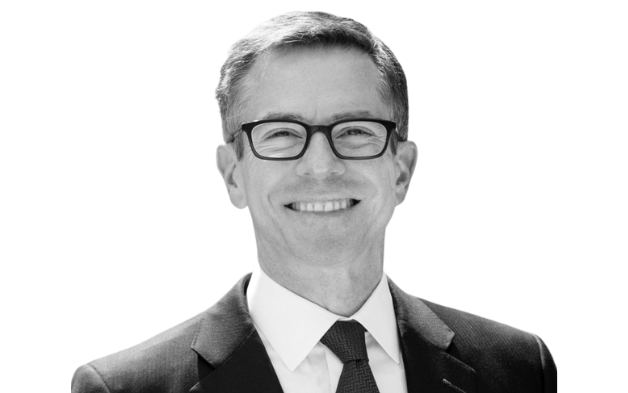

A lot of regulation incoming for crypto, predicts former Fed governor

Former Federal Reserve governor Randall Kroszner argues crypto assets are mislabelled as “currencies”, and said digital currencies like China’s digital Renminbi could one day challenge the primacy of the US dollar, in a wide-ranging conversation.

Blockchain technology is “extraordinarily interesting and has a lot of potential,” but Bitcoin and other crypto coins should not be considered currencies as they are rarely used as mediums of exchange, according to former Federal Reserve governor Randall Kroszner.

Kroszner also labelled cryptocurrency Tether a “Ponzi scheme,” predicted “a lot of regulation” to enter the space in coming years, and said China’s digital Renminbi could potentially be a longer term challenge to the primacy of the US dollar, in a wide-ranging conversation at Conexus Financials Fiduciary Investors Symposium held between May 23-25 at the Chicago Booth School of Business.

Speaking with American historian, academic and author Stephen Kotkin, Kroszner said a more accurate description of crypto coins is “crypto assets,” as they are mostly used as a store of value.

“Elon Musk was taking Bitcoin for a short period of time to buy a Tesla, my guess is he sold, like, five or six Teslas on Bitcoin,” Kroszner said. “So it’s not really being used as a medium of exchange.”

“It’s a store of value, a very volatile one,” Kroszner said. “And so I prefer to think of it more, at least so far, in terms of crypto assets.

Sponsored Content

Kroszner is the Deputy Dean for Executive Programs at the University of Chicago Booth School of Business and Norman R. Robins Professor of Economics. He was Governor of the Federal Reserve System from 2006 to 2009, and represented the Federal Reserve Board on the Financial Stability Forum–now the Financial Stability Board–as well as on the Basel Committee on Banking Supervision.

Kroszner said stablecoins such as TerraUSD had tried but failed to be as close as possible to money by promising comparable value to currencies like the US Dollar.

“Just because someone promises something to be stable, doesn’t necessarily mean that it’s stable,” Kroszner said.

With billions of dollars flowing out of stablecoin Tether, the company had refused to publish an audited financial statement of their backing “for reasons that escape me,” Kroszner said.

“I mean, it’s not like an audited financial statement is something new or wild in the financial services world, thats sort of fairly standard,” Kroszner said. “If you don’t do that, people are going to continue to question. People are going to keep wondering, can I have an attack on Tether that will work?

“And we have seen a lot of money coming out of Tether over the last few weeks, but interestingly, you know the people, it’s a Ponzi scheme. And so, once the money starts to flow out, they’ll never be able to do it.”

Tether is holding out a little below US$1 for each coin despite the outflow of money, and this is “where a lot of regulation is going to come in,” Kroszner said.

Blockchain technology has a lot of potential, but we are still in the very early stages of understanding what this potential is, along with its applications, he said.

“They’re still far from being used as currencies, but I think these interesting experiments are worthwhile to be undertaken,” Kroszner said. “But they’re not for the faint of heart. And so anyone who’s putting a significant fraction of their personal wealth into this is taking, I think, an excessive risk.”

Kotkin asked Kroszner about the prospects for digital currency, including a Federal Reserve digital currency. The Fed is clearly “thinking about it,” Kroszner said, but is taking a wait-and-see attitude to allow the private sector more time to innovate and experiment.

But China’s digital Renminbi is one of the most interesting experiments, he said, with a longer-term prospect of challenging the primacy of the US Dollar.

“The dollar really has no challengers,” Kroszner said. “The dollar is still the go-to currency when something goes wrong.

“But with the digital Renminbi, that’s where you potentially could see a longer term, not a short term, but a longer-term challenge to the dollar,” he said. “The challenge for China is that they’ve got major capital controls. No-one is going to rely on a currency with their major capital controls.

“But could a digital Renminbi allow them, if they’re monitoring and have the technology to look at each individual transaction and follow each of those transactions, would that allow them to do some sort of selective opening of the capital markets? I don’t know whether that’s technologically feasible, but my guess is they have that in mind.”

Leave a Comment

Sort content by

Alecta doubles down on governance, risk management and culture

Sweden’s largest pension fund, the $126 billion Alecta, has spent much of the last year continuing to work on improving governance, risk management, competence and culture in the wake of a $2 billion loss in 2023 attributable to investments in US regional banks, including Silicon Valley Bank, turning sour.

Japan’s trifecta of challenges

After 18 years working with Japan’s leading pension funds and asset managers Chris Battaglia, president of the Global Fiduciary Symposium in Japan, is well placed to observe the pressures on the country’s retirement system and observes its evolution. mrec4inarticleinline Sponsored Content scnative1 scnative2 scnative3

日本が直面する3つの課題

グローバル・フィデューシャリー・シンポジウム代表を務めるクリス・バッタリア氏は、日本の大手年金基金や資産運用会社と18年間仕事をする中で、日本の退職金制度の課題、その進化を観察してきた。 mrec4inarticleinline Sponsored Content scnative1 scnative2 scnative3

Portfolios of the future

This session drew on themes of the conference and discuss with asset owners what the portfolios of the future will look like, particularly examining how investors plan to build robust portfolios to meet changing investment regimes.

Fiona Reynolds joins Conexus as CEO

Conexus Financial, publisher of Top1000funds.com, further cements its position as a global influencer with the appointment of Fiona Reynolds as chief executive.

Debunking distressed debt

The sharp market falls triggered by the pandemic brought the longest recovery ever in modern finance to an abrupt end. But despite the turmoil unleashed by COVID, it has not wrung out the market excesses of the last 13-year cycle. It means another wave of corporate failures could appear on the horizon in a shorter timeframe than expected, and offer more opportunities for distressed debt investors, according to Victor Khosla founder of SVP Global.




