
Emerging market funds need to diversify

Rush hour people movement during Lathmaar Holi Barsana

The extremely low levels of foreign investments in pension funds in emerging countries is cause for concern, according to the World Bank, which is calling for more diversification of portfolios.

A new paper by the World Bank, Pension funds capital markets and the power of diversification, outlines the need for pension funds, in emerging markets in particular, to invest more of their assets internationally in order to achieve higher returns with potentially lower volatility.

The paper calls for a deliberate creation of innovative domestic investment vehicles combined with more reasonable overseas investment limits, based on the size of the pension fund assets relative to macroeconomic and market factors.

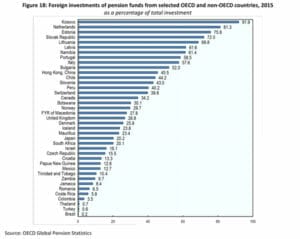
Some countries, including Brazil, Turkey, Thailand, Colombia, Costa Rica and Romania, have less than 7 per cent of their pension assets in foreign investments.

Brazil has less than 0.2 per cent investing offshore, according to the OECD global pension statistics. This compares to the Netherlands, which has 81 per cent of its pension assets invested outside the country.

Some emerging market countries have restrictions on the amount of foreign investments, notably some African countries and India which have a limit of zero.

Sponsored Content

“There is often much resistance to allowing pension fund assets to invest overseas as governments and authorities wish to see domestic savings used for domestic purposes,” the paper says. “Macroeconomic factors clearly play an important role – including foreign exchange regime, capital flows and policy and availability of foreign currency held by a country’s central bank … however, deciding on the amount and allocation of these international investments should be done in a systematic fashion.”

In particular it says that the amount of foreign investment allowed should be linked to the size of a pension fund’s assets compared to the size and turnover of domestic capital markets or flows, and currency movements.

The paper looks at Chile as an example of a country that has more systematically increased its overseas investment limits, raising them as the pension fund assets have grown and become too large for the domestic market.

The regulatory authorities in Peru have also gradually increased their limits on several asset classes.

The paper also points out that improving governance and management is an important precondition for diversifying these portfolios.



Asset Owner:World Bank

Leave a Comment

GIC, Temasek eye trillions of growth in climate adaptation market

GIC, Temasek eye trillions of growth in climate adaptation market

Singapore’s two largest asset owners, GIC and Temasek, see attractive opportunities in climate adaptation solutions – a relatively underfunded area compared to decarbonisation. The former has already made selective adaptation investments and said the opportunity set across public and private debt and equity could increase to $9 trillion by 2050.

Sort content by

When should you choose an alternative to passive investing?

New research by Russell Investments’ co-chair of global investing, Don Ezra and senior lecturer at the Australian National University, Geoff Warren,  presents a framework for deciding when to choose an alternative to passively investing in capitalisation-weighted indices within any particular asset class, and highlights how the debate over active versus passive investing needs to be

Neuberger Berman alternatives strategy outlook

This paper from the Neuberger Berman fund of hedge funds team analyses the near-term prospects of distressed investing and volatility arbitrage, offers observations on the importance of managing the beta profiles of long and short positions within long/short equity portfolios, and explores the effects of reduced competition on hedge fund managers. mrec4inarticleinline Sponsored Content scnative1

Collective investments for pension saving: lessons from Singapore’s CPF scheme

New research by the Pension Research Council at The Wharton School, University of Pennsylvania, examines whether workers seeking higher returns can expect to do better than the CPF-managed default, by moving their money into professionally-managed unit trusts. The evidence is mixed. mrec4inarticleinline Sponsored Content scnative1 scnative2 scnative3

Investing in climate change 2010

In this white paper by DB Climate Change Advisors, led by global head of climate change investment research Mark Fulton, the drivers of climate change for 2010 are examined in the context of strategic asset allocation. mrec4inarticleinline Sponsored Content scnative1 scnative2 scnative3

What a difference a year makes

  A joint study by LIMRA , the International Foundation for Retirement Education and the Society of Actuaries into the effects of the financial crisis on how retired individuals with investable assets make decisions about investing their assets and purchasing financial products has found they are more risk averse and less confident post the crisis.

Pension risk under extreme scenarios: capturing tail risk in pension schemes

This research examines the effect of tail risk, or extreme risk, on pension funds, concluding that all extreme scenarios have an immediate negative impact that can significantly jeopardise the smooth functioning of a pension scheme, probably as much as the other non-extreme risks. mrec4inarticleinline Sponsored Content scnative1 scnative2 scnative3

Previous




