


The performance reviews of CalPERS’ chief executive and the broader investment team could soon include measures of how well they collaborate with each other, as the largest US pension fund continues its shift to the total portfolio approach.
The $556 billion fund became the first US retirement plan to adopt TPA last year and the approach, once implemented, is expected to add 50 to 60 basis points of annual portfolio returns, according to chief investment officer Stephen Gilmore. The fund is now looking at compensation structures to rally the team behind that goal.
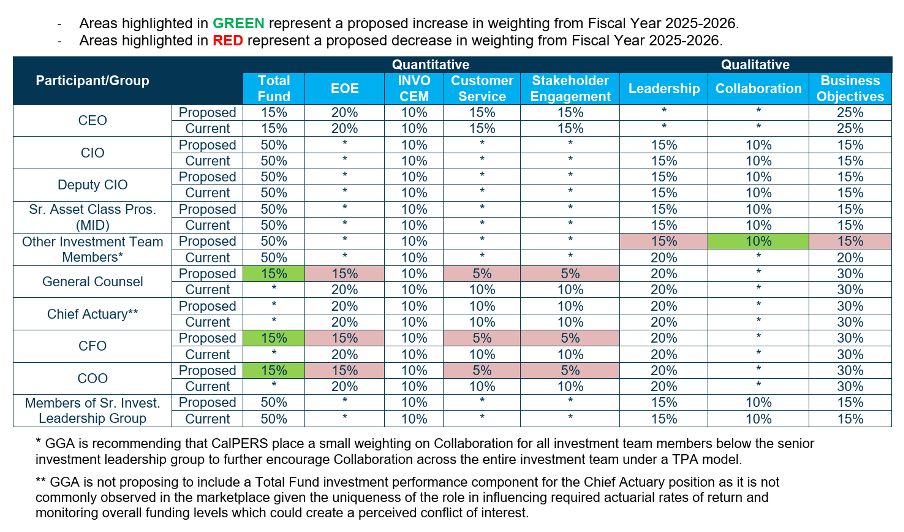
Currently, only the CIO, deputy CIOs and managing investment directors (asset class heads) at CalPERS are assessed based on how well they collaborate, which comprises 10 per cent of their performance metrics.
But during a board meeting this Monday, Global Governance Advisors, a compensation consultant for CalPERS, recommended that “collaboration” also be added as a performance target for the less senior investment members from fiscal year 2026-27, and potentially for the chief executive in the future.
“This is a culture shift. This is something all of CalPERS will have to look at and embrace,” said Global Governance Advisors partner Brad Kelly during a presentation to the board.
“When you’re looking at collaboration, it really has to start from the top. So it’s not just looking at investment collaboration from your investment professionals, but it’s also how your senior leadership team emulate those values, those practices.”
Collaboration sits at the core of the TPA philosophy, which is focused on total fund objectives rather than the performance of ‘siloed’ asset class teams, as in the traditional strategic asset allocation approach.
In practice, this may require asset class teams to cede capital to others to better optimise total fund risk and returns. That could be a difficult conversation for many investors, especially if higher-returning asset class teams are asked to give up capital, which is why long-term TPA practitioners say building a common language and understanding around TPA within the investment team is critical.
But at CalPERS, private equity is one asset class that still seems be an exception to the TPA system. At a PEI conference in February, CalPERS CEO Marcie Frost said the private equity team needs some “independence” from the TPA to have a “full budget” and deploy their skills appropriately.
Private equity is the biggest alternatives program at CalPERS, representing 16 per cent or $103 billion of total fund investments at the end of June 2025.
Global Governance Advisors also recommended that CalPERS identify some qualitative metrics to evaluate the degree of collaboration.
Australia’s Future Fund, for example, has developed a survey which identifies five colleagues an employee had the strongest collaboration with during the year. It “built descriptions of what collaboration and role modelling at different levels looks like”, and set different expectations for staff with various seniority, according to Global Governance Advisors’ presentation.
Other recommendations include introducing total fund results as a performance metric for the general counsel, chief financial officer and chief operating officer, albeit at a different weighting from CEO and CIO. This would mean the entire executive suite is incentivised to improve total fund outcomes, with the exception of the chief actuary due to potential conflict of interest identified.
CalPERS’ current incentive design is comprised of base salary, annual incentive capped at 150 per cent of target (which includes quantitative metrics such as fund return vs SAA benchmarks and enterprise operational effectiveness and qualitative metrics of leadership ratings), and a long-term incentive capped at 150 per cent of target (5-year annualised return vs required rate of return).
But the value-add performance hurdle needs to be updated to reflect the reference portfolio – which consists of 75 per cent equities and 25 per cent bonds – and incentivise alpha over it, Global Governance Advisors said.
There are various designs global TPA practitioners have adopted, the consultant noted. New Zealand Super where Gilmore was previously CIO, for example, doesn’t offer long-term incentives but only annual incentives, which consist of quantitative assessments (value add over reference portfolio and 90-day Treasury bill rate) and qualitative metrics (such as collaboration). The same weighting of total fund and individual performance also apply to all investment and executive staff.
Global Governance Advisors will finalise its compensation recommendations in June.
CalPERS’ CEO Frost received $1.55 million in total pay during the 2024-25 financial year, including $766,782 in annual incentive pay. CIO Stephen Gilmore took home $2.26 million during the same period, including $1.54 million in annual incentives, according to website disclosures.








Leave a Comment
You must be logged in to post a comment.
Login