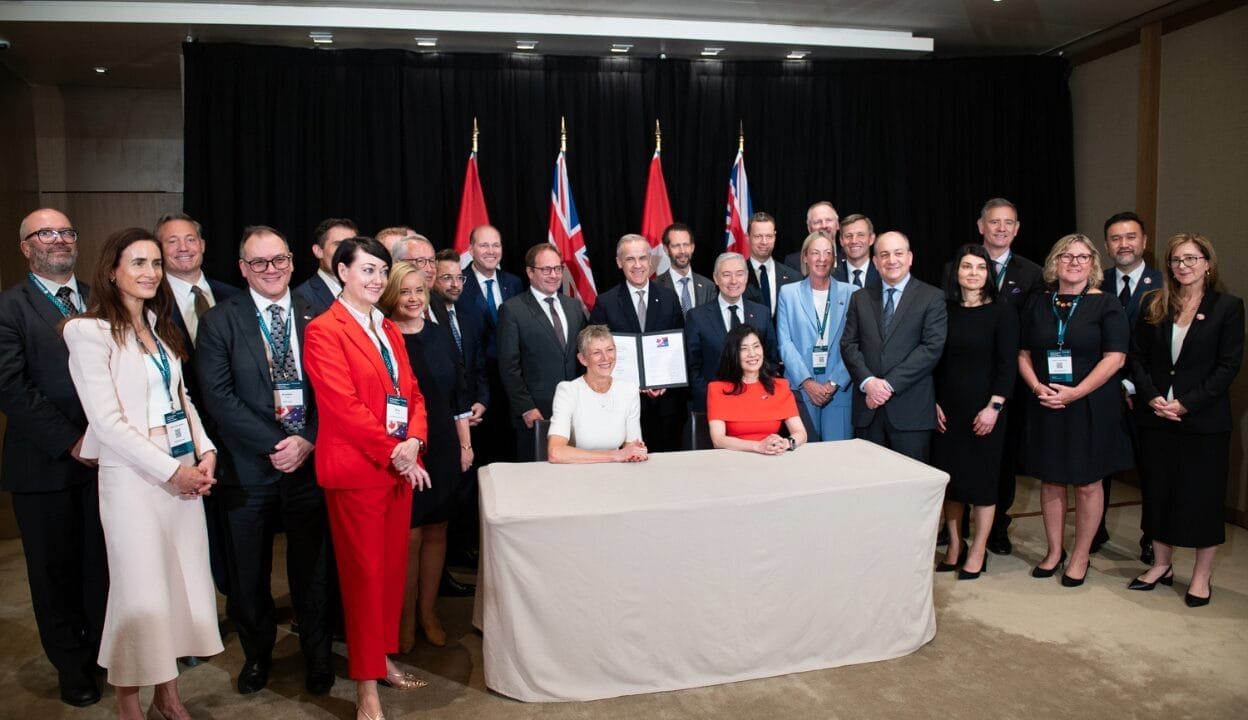

Infrastructure at the heart of Canada-Australia pension fund pact

A group of major Canadian pension funds, including the Maple 8, has entered a high-powered memorandum of understanding with top Australian superannuation funds to lobby for policy changes that would help fast-track investments in both countries.

The deal, brokered by industry super fund-owned asset manager IFM Investors and known as the Canadian-Australian Pension Funds Investment Initiative (CAP Invest Initiative), is a first-of-its-kind deal between two of the world’s largest pension markets which are expected to manage $13.9 trillion in fiduciary capital by 2040 collectively.

The announcement came as Canadian Prime Minister Mark Carney began his four-day diplomatic visit to Australia in Sydney this Tuesday with the aim of bolstering the connection between the two so-called ‘middle power’ countries.

He attended a breakfast event hosted by IFM Investors in Sydney on Wednesday morning alongside Canadian Finance Minister François-Philippe Champagne, Australian Minister for Financial Services Daniel Mulino, as well as a slew of Australian and Canadian pension fund executives who have signed the MoU.

While the agreement does not commit to a specific dollar amount to be deployed by the pension funds in both nations, with IFM Investors chair Cath Bowtell characterising it as a “MoU for partnership”, enabling infrastructure investments in both nations will be a significant focus of the deal.

“Our job through this partnership is to really look at the frictions that are prohibiting us from making those deployments, and see whether we can work with governments at the national and sub-national level to eliminate those frictions,” Bowtell said at a press conference in Sydney.

Sponsored Content

IFM has been speaking about the need to unlock private-public partnerships for some time, including at last year’s Top1000funds.com Fiduciary Investors Symposium at Stanford (See Public-private partnerships key to fixing US infrastructure).

Funds in both systems are major sources of capital for real assets around the world. Canadian pension funds are known for having significantly diversified private markets exposures enabled by the famous “Canadian model” which emphasises independent governance and large-scale, in-house investment management.

Australian pension funds have invested heavily in Australian infrastructure since the 1990s as the government privatised transport, utilities and telecommunications assets, making them an early mover in the asset class.

Australian and Canadian pension funds are among the largest allocators to infrastructure globally with the average fund in Australia allocating 6.8 per cent and those in Canada allocating 10.1 per cent, according to a Macquarie Asset Management report – well above investors in other countries.

“We seek to contribute our experience, knowledge and relationships to the mutual benefit of CAP Invest Initiative participants, as this initiative upholds constructive engagement that will help support stable, investable markets over the long run,” John Graham, president and chief executive of CPP Investments, said about the partnership.

Setting the policy agenda

As savings flow into Australia’s A$4.1 trillion ($2.8 trillion) defined contribution system, super funds are seeking opportunities in deeper overseas markets such as the US and the UK. This means they have both a collaborative and competitive relationship with their global peers which are often much larger in size, especially around sourcing and accessing deals.

AustralianSuper is the biggest fund in Australia with A$410 billion ($294 billion) in assets under management, and large offices in both New York and London. The fund is projected to grow to A$700 billion by 2030 and A$1 trillion not long after. It is expected that 70 per cent of new flows will be invested offshore. (See Behind AustralianSuper’s global expansion)

A delegation of super fund executives and lobbyists embarked on a soft power mission to Washington and New York last February, and are being hosted by Australian Ambassador to the US Kevin Rudd in Silicon Valley, New York and Washington next week, to foster greater relationships with US investment partners. US Treasury Secretary Scott Bessent remarked to the super funds that “the confidence you have in the growth is not what one might expect for Australia”.

IFM Investors is a crucial vehicle of super funds’ push for global influence due to its ownership structure and significant mandates with global asset owners. Most recently, NEST, the UK’s largest defined contribution fund, became a shareholder of IFM and committed to invest £5 billion through IFM Investors by 2030. (Inside Nest’s serendipitous deal for IFM stake.)

IFM Investors’ head of global external relations David Whiteley previously said Australian funds must take a collective approach to compete effectively with giant pension funds in North America, Europe, the Middle East and Asia for better access to global investment opportunities.

The infrastructure manager’s UK leaders include former Labour Member of Parliament and Shadow Minister of State for Pensions Gregg McClymont.

In 2024, IFM Investors made a move to influence policymaking in a foreign country, leading a consortium of pension funds in pressuring the UK government to unclog its stagnant pipeline of infrastructure deals, especially around energy transition.

Meanwhile, former president and CEO of CPP Investments and former chair of AIMCo, Mark Wiseman, is now the Canadian Ambassador to the US.

Canadian funds that signed up to the CAP Invest Initiative include AIMCo, BCI, La Caisse, CPP Investments, HOOPP, IMCO, OMERS, OTPP and PSP Investments. On the Australian side, the signatories are Australian Retirement Trust, AustralianSuper, Aware Super, CareSuper, Cbus Super, HESTA, Hostplus and Rest, as well as IFM Investors.

Leave a Comment

Future Fund: AI world order defined by US-China split will hurt capital owners

Future Fund: AI world order defined by US-China split will hurt capital owners

A geostrategic standoff between the US and China over AI would be “extremely damaging for capital owners” according to the Future Fund, Australia’s A$337 billion ($237 billion) sovereign wealth fund, which outlined four “secular scenarios” around AI and its investment implications.

Sort content by

CalPERS’ public and private equity reset shapes performance

CalPERS is continuing to reap the benefits of a sweeping overhaul of its public and private equity programs, with the two asset classes, which are the biggest components in the portfolio, powering a 14.8 per cent return for the $637 billion fund in the last reporting period.

Temasek lifts China exposure by $7.7b, commits to doubling AI bet

Singaporean sovereign wealth fund Temasek saw its exposure to China surge by $7.7 billion in the last reporting period as valuations rebounded in the world’s second-largest economy. It is also planning to more than double its exposure to the AI value chain within the next five years.

TPA: Built on essentials, shaped by levers

As asset owners grapple with the appropriateness of a total portfolio approach for their fund, new ICPM research has outlined building blocks to be considered in the process including some essential “enablers”, like governance structures, and optional “levers”, like incentive architecture. ICPM managing director Adrian Trollor unpacks the framework.

Ohio STRS warns of higher US recession risk; prioritises liquidity

The State Teachers Retirement System of Ohio has warned of a “material” increase in US recession risk compared to last year as the fund braces for a wider, “negatively skewed” distribution of outcomes in the next 12 months. It came as the mature plan, which is 81 per cent funded, is tilting to fixed income and new asset classes like liquid alternatives over equities.

Returns, resilience and reinvention: What private markets’ top brass are worried about

Senior executives from some of the world's largest private market managers gathered in Berlin this month with a collective understanding: managers who move slowly on AI face not just weaker returns but the risk of owning businesses that have been competitively displaced before they can exit.

Temasek likely to miss 2030 climate target dragged by aviation, energy investments

Temasek chief executive Dilhan Pillay says the sovereign investor is likely to miss its 2030 interim climate target, as exposures to the aviation and power generation sectors are crimping the investor’s ability to reduce portfolio target emissions. But the $339 billion fund is sticking to its net zero by 2050 goal, stressing the slower decarbonisation pace "reflects the realities of the broader global economy."



