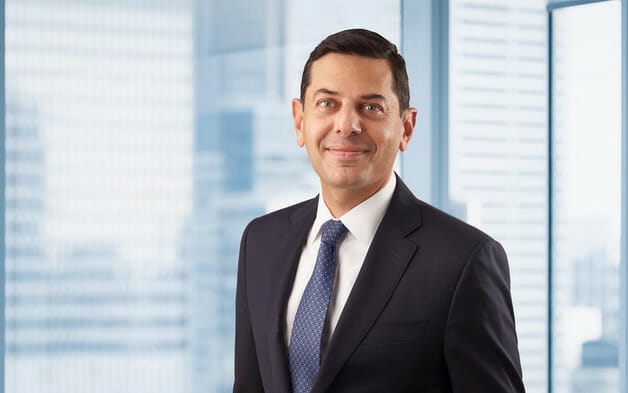

OTPP: Positioning the fund for the next decade

“It’s an interesting time to be an investor,” says chief investment officer of Ontario Teachers’ Pension Plan, Ziad Hindo in an interview with Top1000funds.com from Toronto.

He’s reflecting on the past 30 years where many countries and markets have benefited from globalisation and related tailwinds, the unwinding of which has led to a different environment going forward. How he positions the fund to take advantage of the opportunities of that new environment, while minimising the risks, is where he spends most of his time.

There are three neat themes contributing to the new investment environment: sustainability; policy uncertainty; and the end of (hyper) globalisation.

“Climate is not just an environmental issue it’s an existential issue for all of us,” he says pointing to the impact on economies, policies, energy security and the depletion of natural capital. “The combination of this is going to present challenges and risks and we think that these risks may be reaching a tipping point beyond what many people appreciate, with far reaching consequences for countries, societies, communities and investors.”

“We are looking at this in the context of how we are investing to protect the fund, but also the opportunity set for a decarbonised world and our role as an active investor to help the world decarbonise.”

Another characteristic of the new investment environment will be short-term economic policies creating continued uncertainty for long term investing. Added to this is what Hindo calls the end of the hyper globalisation, noting that globalisation over the past 30 years saw the entry of a massive labour force into the global economy and related beneficial disinflationary impacts, as well as optimization of the supply chain, trends that are now reversing.

Sponsored Content

“There are a lot of changes as the world moves away from hyper globalisation to probably a more fragmented political system. And embedded in that is increased geopolitical risk and the hegemony of the US being challenged, particularly by China. The world doesn’t know how to absorb that, so this will be a major focal point for investors, to navigate the complexity of transitioning to perhaps a very different world that what we were used to for the last 30 years,” he says.

“When you put those things all together – the environmental, political and social issues – with the digital disruption taking place they are all interacting together in ways that are very hard to predict.”

Because of this lack of linearity, and the increased probability of more shocks to come, investment organisations need to be resilient, he says.

“We are humble enough to know we can’t predict these shocks,” he says. “But we are confident we will be resilient, we have good talent, we trust each other, and we are agile enough to pivot and change when we have to allocate differently.”

Resilience and agility in the asset mix

Given these deep-seated changes in the economy and continued inflation volatility, he believes that agility and the ability to mix up the active/passive mix as well as dynamic asset allocation will be key. “Organisations need to be more resilient to deal with ambiguity and unpredictability and have a culture that is resilient to constant change,” he says.

“It also requires internal expertise to manage the total fund, mix the top-down and bottom-up, and act with conviction in dynamic asset allocation, and ultimately invest differently in a more agile way than most organisations are used to. And you need organizations that will put sustainability at the centre of everything they do – this doesn’t mean less return, I would say it delivers as much return as well as delivering the social licence to operate and attract talent.”

OTPP, which is 107 per cent funded, has generated a total-fund net return of 9.6 per cent since the plan’s founding in 1990. It has always been actively managed, with more than 80 per cent of assets in house.  OTPP’s governance structure, and the delegated authority, means it has an ability to be agile which Hindo believes positions it well for the current environment.

But he says the agility in the asset mix is not about short term or being tactical. “It’s hard to know for how long that environment will last,” he says.

As an example, he points to the changes in the fund’s fixed income allocation over the past few years, peaking at 46 per cent in March 2020. By the end of 2020 the allocation was down to 16 per cent.

“With rates rising in 2018 and 2019 fixed income looked attractive for the first-time post GFC and we had ramped it up significantly. When Covid hit rates fell significantly so we acted quickly to almost completely unwind the interest-rate sensitivity of the portfolio. That was a lot of capital to move around. We didn’t know for how long they would be low, but we acted with conviction.”

With aggressive hikes in interest rates by central banks, OTPP has just started to buy back fixed income and build the position again. “We had to be ready. It’s about how you manage the balance sheet, the derivatives exposure, budget risk and have the right governance to do that. All this provides you with an ability to be agile, so you are not scrambling for capital, approvals or balance sheet room.”

Leader in private assets, more to come

While OTPP has a private assets allocation of more than 50 per cent there is no set public to private asset target, rather the asset class ranges are viewed through a lens of liquidity.

“We are more focused on the building blocks of the seven asset classes we have, and how to mix and match them to design a portfolio to withstand shocks, without having the full benefit of knowing what the future will look like,” he says.

“Many outsiders think we are well-known for private assets, but actually how we mix and match the public and private, and active and passive together seamlessly has been one of our secret sauces.” It means that both private and public assets are levers and can provide diversification if there is dislocation in one market.

OTPP has a long and prestigious history investing in private equity, most recently expanding that to include venture capital and growth equity, building an internal team and strong portfolio in the past three years.

“Three years ago, venture capital was restricted to external managers and was a smaller component of our portfolio. But we saw that the disruptions that we were likely to see over the next decade from technology, would not just disrupt selective industries but the whole economy,” he says. “So, we created an internal team as a defence mechanism to understand the potential disruption in the sectors we were in and to understand where they were headed.”

In three years, the fund has built an internal team of 25 people in venture capital and growth equity, and an $8 billion portfolio with 24 holdings including SpaceX.

Private credit the missing piece

But while it has a skilled team and impressive portfolio in the context of most asset owners, Hindo believes there is a missing link in the private assets portfolio which will allow it to be a more “seamless full capital solutions provider” to portfolio companies.

“We need deeper capabilities in private credit. We have been good in public credit, but private credit has been a missing link in our private asset capabilities.

“We have been addressing that and we are in the process of putting together an internal private credit team in London. We mostly had exposure through external managers but there was opportunity to build internal capabilities. Bridging the gap allows us to be a full capital solution provider to the portfolio companies we invest in. Just like we moved quickly in venture and growth capital, we will do that with private credit.”

London seemed like a natural fit for the team, given the opportunities and expertise available, as well as the fund’s head of EMEA, Nick Jansa, having deep credit expertise. Geographically OTPP has teams in Toronto, London, San Francisco and New York with Asia covered with offices in both Singapore and Hong Kong.

A couple of years ago OTPP did a massive deep dive into India. OTPP had already invested in the market, noting the attractive investment fundamentals contributing to increased interest in the country by sovereign wealth funds and others.

To date it has completed four major investments, and will now open an office later this year. Hindo says it is in the process of starting up a much larger presence in the country. “We were struck by how quickly the SWFs had set up shops and got on with it.”

Sustainability and purpose

Hindo, who became CIO in June 2018, has been with the fund for 22 years. It’s a lived ethos that human capital is the biggest asset at OTPP, and employee incentives align with the long-term performance of the fund.

“There is a lot of passion to be here,” he says of the staff. “My mom was a university lecturer, and we all have a story to tell that links us to education. Genuinely and authentically people who work at OTPP have a purpose when they come to work.”

He says the investment program was set up to think about how to invest for a better future, and that resonates throughout the organisation. It started with the retirement of teachers and is now a broader purpose.

“Organisations must put sustainability at the centre of everything they do. Having that social licence to operate will mean you can attract talent,” he says.

OTPP’s climate strategy is multi-faceted with net zero at the heart of it.

In September last year it committed to the ambitious targets of reducing portfolio carbon emissions intensity by 45 per cent by 2025 and 67 per cent by 2030.

“When we designed the interim targets, we wanted to make them industry leading on purpose. That’s who we are,” he says. “We have never shied away from being leaders and doing things differently and taking calculated risks. We know our actions can influence peers.” Hindo says the targets are also aimed at demonstrating the urgency needed.

“A ton of carbon abated now is worth a lot more than one abated in 10-years’ time,” he says. “1.5 degrees is unattainable without active, focused efforts. The longer you delay the less likely it will be achieved. If we had waited and did every bit of planning needed, we’ll never get there. We did a lot of robust work and I’m very proud of how the asset class groups and responsible investment group came together. We are good investors, and we are passionate about this and will get there one way or another.”

OTPP developed the Virtual Energy and Renewables Team (VERT) made up of members of each of the asset class groups to look at sustainability holistically as a thematic for the fund, the first time it has taken that approach.

OTPP is heavily focused on investing in green assets with VERT looking at sustainable fuels, electrification, industry 4.0, sustainable resources and enabling solutions. “VERT allows all our investing capabilities to come together and discuss what they are seeing in things like hydrogen and renewables which are very fast moving.”

Some of its investments include offshore wind, battery storage, waste management, bioenergy, and a carbon credit platform. OTPP has also been an anchor investor in the Brookfield Global Transition Fund and in TPG Rise Climate fund. “We are leaving no rock unturned here,” Hindo says. “We are in a capital deployment mode, and we are also wanting to learn with some of the best investors out there.”

Hindo believes capital allocators have a keen role in the energy transition, especially encouraging investee companies to set targets – the fund is working with 100+ portfolio companies to also set ambitious targets for them. “Internally we are saying by 2030 we want 90 per cent of the emissions of our portfolio companies to be covered by a credible net zero plan,” he says. “The ball is rolling on this, and we are in active dialogue with companies and sharing information. This is a massive risk and a massive opportunity as the entire world economy figures out how to retool itself to net zero.”

Leave a Comment

Aware Super maps AI exposure as it sharpens whole-of-portfolio risk focus

Aware Super maps AI exposure as it sharpens whole-of-portfolio risk focus

Australia’s third-largest pension fund Aware Super is taking stock of its investment exposure to AI and the initial analysis suggests at least 15 per cent of the fund’s assets are exposed to the thematic. In a project deep dive, head of investment strategy Michael Winchester says finding the portfolio's true concentration around AI will require looking beyond simple dollar aggregation.

Sort content by

Finland’s Elo: Larger equity allocations promise new media scrutiny

As Finland's pension funds prepare to increase their equity allocations to unprecedented levels compared to global peers, they must also navigate a new and unfamiliar risk. Elo's chief investment officer Jonna Ryhänen explains the fund's investment approach going forward and how it will manage stakeholder and media scrutiny as they react to swinging volatility and returns.

PMT talks infra equity and how to balance stock concentration risk

Scenario testing has put inflation risk front and centre at PMT, the Netherlands’ third largest pension fund, and it's driving the investor to take stock of the inflation protection it gets from infrastructure. In an interview with Top1000funds.com, chief investment officer Hartwig Liersch unpacks the risk, as well as another initiative where it's balancing concentration risk in the equity allocation without hurting returns.

NZ Super cuts benchmark return expectation on US valuation concerns

A view that the US stock market is overvalued and equity risk premia will be lower over the long term has driven New Zealand Super to lower the return expectations for its reference portfolio following its recent five-yearly review of the benchmark. Co-chief investment officer Brad Dunstan also flags underweight commodity exposure as an area to address and explains why the fund remains sceptical of illiquidity premia despite seeing a growing case for private markets.

Sampension: Why there are many reasons to be optimistic

Now is not the time to reduce risk, argues Henrik Olejasz Larsen, chief investment officer of Sampension, Denmark’s $50 billion pension fund for public and private sector employees. In an interview with Top1000funds.com, he says corporate profits have not deteriorated, and although the market has been tested from multiple directions, the underlying optimism driving equities is strong enough to overrule the negative impact of geopolitical risk.

France’s Banque des Territoires looks for data centre opportunities

France’s Banque des Territoires, a subsidiary of Caisse des Dépôts, the country’s €323 billion state-owned financial institution, plans to invest more in data centres in France. The push is in line with government policy to build out AI infrastructure off the back of the country's access to cheap, green, nuclear energy that uniquely positions France to provide power to the AI industry while maintaining net zero credentials.

Why NYC pensions CIO hasn’t drunk the ‘TPA Kool-Aid’

Three decades of investing have given Monte Tarbox sharp eyes for recognising risk and opportunities, and he’s putting it to use as the new permanent chief investment officer of the $306 billion NYC Bureau of Asset Management. In an interview with Top1000funds.com, Tarbox outlines his vision for the fund, why he’s bullish on infrastructure but “nervous” on PE, and why he hasn’t drunk the TPA “Kool-Aid”.



