

Germany’s €7 billion MetallRente, founded in 2001 by employer’s organisation Gesamtmetall and the trade union IG Metall for workers in the metal and electrical industries, offers a variety of investment options for its beneficiaries. Almost all are restricted and conservative strategies like the direct insurance option MetallDirektversicherung and the traditional MetallPensionskasse, where annual returns typically languish between 3 and 4 per cent.
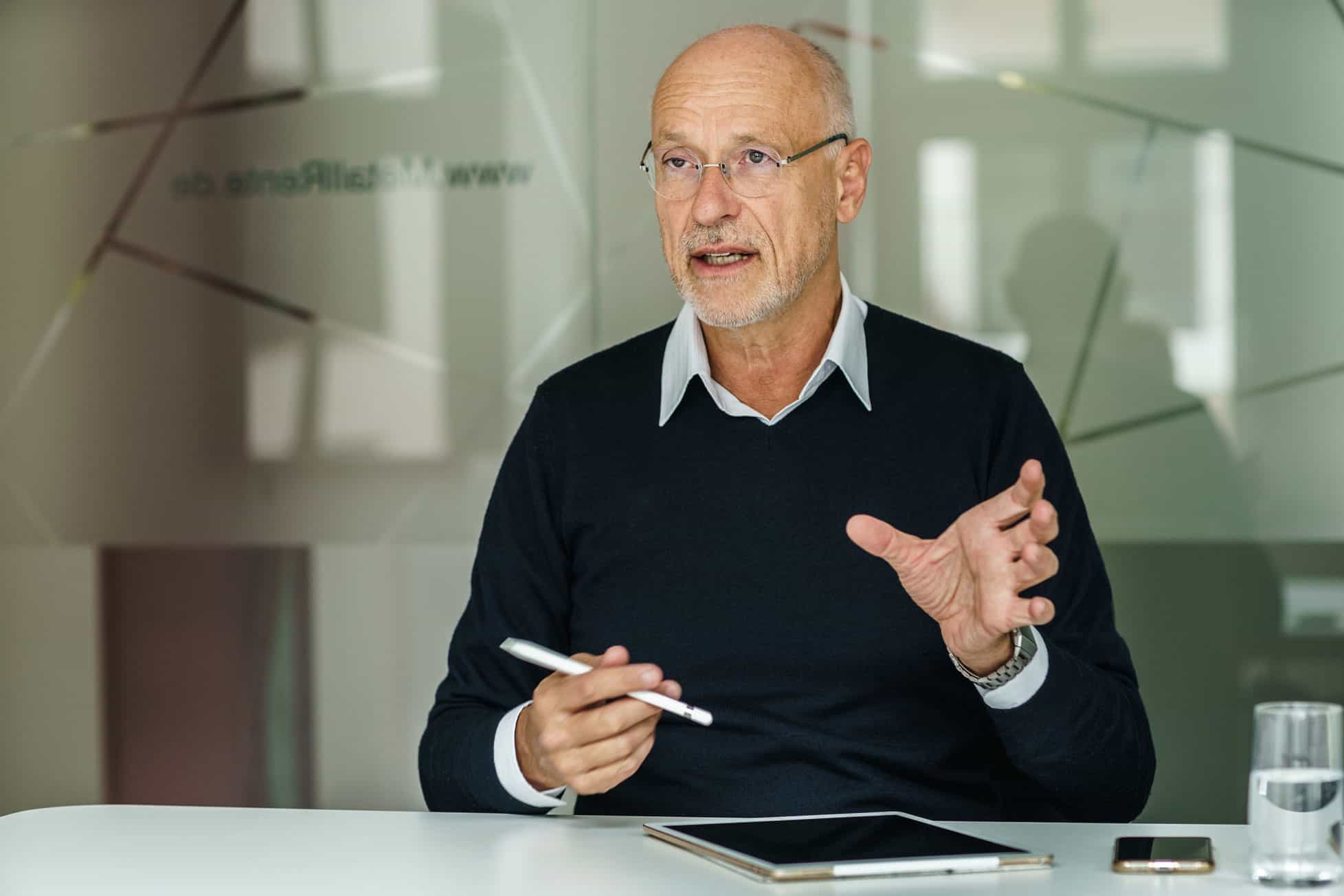
One vehicle however, MetallRente’s so-called Pensionsfonds allocation, invests in the capital markets offering beneficiaries chunky equity exposure over grindingly low interest rates, more flexible asset management and all the benefits of risk and reward. The Pensionfonds vehicle, begun in 2003 and still only accounting for €270 million of MetallRente’s total assets under management, may be the pension fund’s least popular investment vehicle amongst a conservative saver cohort but it is by far the most exciting part of the overall fund for its liquidity, dynamic equity exposure and strong ESG focus. It’s also where veteran pension expert Heribert Karch, managing director of MetallRente, is passionately focusing his efforts.
“We believe the pension fund is the vehicle of the future,” he says in an interview from MetallRente’s Berlin headquarters. “The German pension industry has been conservative for a long time characterised by a dominant belief that guarantees equate to safety. But this doesn’t achieve the returns we need to provide good pensions to our people,” he says referencing the Pensionsfonds’ annual 5.2 per cent return versus the lower returns of the insurance vehicles to illustrate his point.
“The MetallPensionsfonds is our most dynamic and fastest-growing product with increasing importance not only in our portfolio, but for many employers and employees in Germany in general.”
With over 80 per cent of the allocation in listed equity in developed and emerging markets (56 per cent and 22 per cent respectively) the Pensionsfonds portfolio has the largest equity exposure of any other German pension fund. The allocation is actively managed by external manager Allianz Global Investors with a focus on value investing and ESG.
“Active management provides a better framework for our risk management, because we have such a high share of equities,” explains Karch. “It means that market risks can be identified and acted upon very quickly, and that we can ensure the implementation of our values in the investment decision process.”
That ability to act quickly was evident after the collapse of Lehman Brothers in 2008 when the fund cut its equity allocation from 80 per cent to 11 per cent over a short period. But finding the right point in 2009 at which to re-enter the market was challenging, particularly because of the need to balance rules-driven risk management with discretionary decision making. It’s the kind of challenge that feeds into the fund’s ongoing debate around adopting a different approach.
Today, stakeholder-level discussions comprising the fund’s union and employer shareholders, MetallRente’s insurance partner Allianz and asset manager AGI, do question the benefits of the Pensionsfonds dynamic risk management versus a more stable asset allocation, says Karch. Discussions centre around the pros and cons of investing in a more diverse asset allocation with more buy and hold strategies which could lead to a lower equity exposure that allows the fund to remain inside the market during downturns.
“I can’t say if we will continue with our dynamic risk steering strategy with high equity exposure, or if we will adopt a strategy with a less risky asset exposure, but the discussion is ongoing,” says Karch.
Wider policy change in Germany is also fuelling the debate. Employers and unions are under growing pressure to introduce Germany’s new social partner model which seeks to encourage more pure DC schemes without guarantees. So far, no existing occupational schemes have introduced the DC model, but the debate is building interest in risk-return strategies like MetallRente’s Pensionsfond’s vehicle, says Karch.
“If, and it’s a big if, our shareholders agreed to adopt the social partner model there is the possibility we would readjust our investment strategy with a different balance between asset classes and more buy and hold strategies than we have at the moment.”
The social partner model would also allow Germany’s pension funds to create systems and products in a new and different way, ultimately leading to more assets under management and lower costs, enthuses Karch who is spending a great deal of his time researching a model to suit MetallRente’s management and labour sharehholders. But change is set against a challenging backdrop.
None more so than communication given Germany’s cautious investment culture.
“The introduction of a collective DC model is economically interesting, but from a communication point of view it is a challenge,” he says.
Many pension funds are reluctant to introduce yet another model to their retirement benefits offerings.
At MetallRente, take up of the Pensionsfonds strategy is growing but it remains tiny compared to savers’ preference for insurance-style savings programs. And because MetallPensionsfonds is the smallest of MetallRente’s vehicles it doesn’t have the size or clout to negotiate costs and fees like other European pension funds – although Karch insists this will change once the new law takes root and the Pensionsfonds AUM grows.
Any new strategy could also expose the fund to more reputational risk, something shareholders are particularly wary of and which has helped drive the fund’s ESG strategy to date.
“Our unions don’t want any ethical risk, lack of transparency or speculation around, for example, un-transparent commodity investment,” says Karch.
The challenges of ESG investment in allocations other than equity is one of the reasons behind the fund avoiding other asset classes, he explains.
“In our opinion the only really reliable way to meet ESG guidelines is via publicly listed companies. Applying ESG principles to other asset classes is still very difficult, but in stocks you can use fundamental research that gives a serious estimate to what extent the company has a sustainability approach.”
ESG strategy at the fund has developed in recent years from pure negative screening of stocks, to increasing allocations to best in class methods and integrating global laws like labour regulation. The Pensionsfonds allocation is also beefing up its reporting processes, and the detail and depth of information on its ESG priorities that it passes onto its members and external manager.
Today Karch is gradually scaling back his workload, evident in his decision to retire as chair of Germany’s occupational pensions association. But slowing down won’t stop his determination to bring a return-seeking investment culture to Germany.
“For young people there is no advantage to having an insurance product. I can’t advise our young people to go into these types of investment products,” he concludes.








Leave a Comment
You must be logged in to post a comment.
Login