
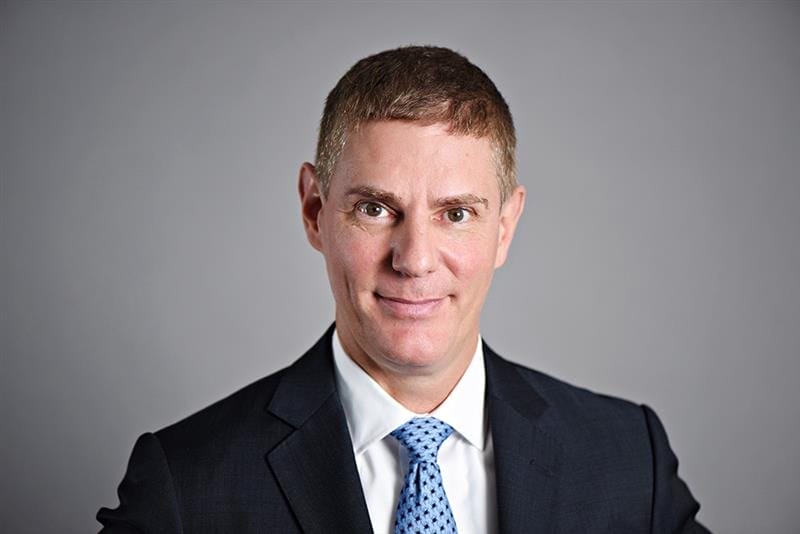

An increased focus on liquidity management through factors, a leaning towards public markets and robust risk management are all key to implementing HOOPP’s “maniacal focus on liquidity” that helps CIO Michael Wissell sleep at night. Amanda White spoke to the Toronto-based investment chief ahead of the Fiduciary Investors Symposium.
In comparison to its Canadian peers with huge weightings to private markets, the C$112 billion HOOPP leans slightly towards public markets, a preference consistent with its liability-driven approach and focus on member outcomes.
For instance, it has a 26 per cent allocation to public equities and 12 per cent to private equity and Wissell believes public companies are still bringing ingenuity that is worth investing in. (CPP Investments has 24 per cent public equities and 33 per cent private equities by way of comparison.)
“The innovation some of those public companies are bringing is great. It’s not either or, but public and private together that is compelling, they have different characteristics,” Wissell says. “Our relationship between private and public assets is a little bit more public oriented, which is predicated on our maniacal focus on liquidity.”
Historically HOOPP has been good at making returns in troubled markets, and Wissell is quick to point out that can only happen when there is cash available.
“We have ratios we look at and the quantum of cash available if we need it. How much is tied up and how much can you get at,” he says.
Liquidity management has developed using a series of factors to measure and manage the portfolio.
“I sleep well at night knowing tomorrow I can come up with an enormous amount of capital if I need to. We don’t think we need to, but we manage for events that can happen over time or in the near term,” he says. “We use a series of liquidity metrics, and then when something does go bump in the night you are a buyer. My crystal ball is not as clear as I’d prefer it to be, but you can build a diversified portfolio, hedge the risks you can and leave yourself liquid, because something will go bump.”
As an example, he says COVID presented enormous opportunities, and HOOPP was a buyer throughout all of 2020.
It’s Wissell’s opinion that “we do live in perilous times” but the fund is not leaning into any one thematic, rather it’s exploring themes, including AI and the impact on investments.
“AI for a large pool of capital is a tool for us to manage our corporate processes, management process, an area of investment and something our portfolio companies need to be aware of,” Wissell says. “There are a lot of touch points on that and makes it more complicated, it’s something we are spending a lot of time on.”
The investment process focuses in on understanding broad economic factors and examining its portfolio through certain factor exposures and the comfort around those, for example growth and inflation risk.
Once the risk parameters are set, for example around growth risk, the decision is made whether to get that exposure through in this case private credit or another investment that may have a better tradeoff.
“We try to build the best portfolio you can with the broad factors you are comfortable with,” Wissell says. “For example, how many nominal bonds can you own without inflation risk getting too high. This is where global diversification comes into play, and we tend to learn into the developed world economies. We have some emerging markets but that is an example of where we think we can make good returns but it’s a little bit trickier to know if you’re really getting paid for all the risks there.”
Fixed income allocation
Wissell says the team is continuing to manage the broader bond portfolio, which can be “tricky” in this inflationary environment.
“We need to be mindful of that and it’s why we have been actively adding to the real return bonds and can see that is going to pay dividends this year. It’s something I feel very strongly about,” he says. “When you can pick up 2-3 per cent real, for a plan like ours, on that portion of our investment assets it takes us a long way, because it is guaranteed return and liquid. With our remining liquidity it takes down the return pressure.”
Throughout the year HOOPP has been adding to its real return portfolio with the aim of getting the mix to 50:50 between nominal bonds and real return bonds.
“It’s a unique period of time where can manage inflation risk and lock in comparatively compelling rates for a really long time,” Wissell says.
HOOPP has invested in private credit for some years but only formalised it in the policy portfolio in 2023. It performed well for the fund last year with 9.33 per cent and Wissell says he continues to think the outlook for private credit is “constructive”.
“I’m in the camp that at this base interest rate and some of the spread tightening a bit, we will still get returns that meet our pension promise at reasonable risk,” he says. “Some of the structural changes mean it will remain compelling over the medium term. A 5 per cent allocation to that asst class, that’s a measured amount earning good returns.”
Decision making process
Wissell describes the portfolio construction as a “constant refreshing”.
“I like to think about it as if I was building the portfolio from scratch today how would we build it? And if that’s not the portfolio we have then make changes and bring people in. That’s’ how we stay fresh.”
HOOPP’s decision making process is best described as collaborative. Chief executive, Jeff Wendling, is the ex-investment chief of the fund and someone whose counsel Wissell finds important.
“On big decision he’s very much involved, he’s a phenomenal investor,” he says. “Some of the tweaks we are managing right now is with me, our asset class head experts, portfolio construction team, then on top of that there’s a risk team.
“It might seem like a lot of voices, but you want to avoid the unintended consequences. We take risk and are comfortable with markets going up and down, but don’t want to make an investment we didn’t really fully consider. This leaves you with a high degree of confidence and why HOOPP has done so well for so long.”
HOOPP has a 115 per cent funded status and a 10-year annualised return of 8.43 per cent.
Michael Wissell is one of the speakers at the Fiduciary Investors Symposium at the University of Toronto from May 29-31.








Leave a Comment
You must be logged in to post a comment.
Login