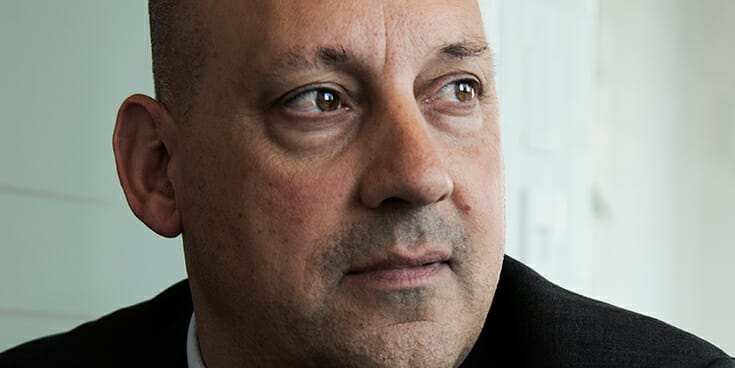

Cashflows and risk management drive PSP Investments

The possibility of a recession is “still pretty high”, according to PSP Investments’ chief investment officer, Eduard van Gelderen, with that prospect driving investigations into the most impacted asset classes if that eventuated.

“It’s a very delicate situation in the next three years, and we’re looking into the impact that would have on the portfolio,” he says. “We still believe the probably of a recession is still pretty high over the next two years.”

It’s one of a handful of projects the PSP investment team is looking at over the next 12 months as it comes off a stellar year despite the market upheaval.

Increasingly important to the way the portfolio is managed is the aim of minimising and mitigating the risk of a deficit in the plan, van Gelderen says.

Portfolio testing is centred around returns but also negative scenarios that could impact the portfolio and more specifically create a deficit, and subsequently how the portfolio could be positioned to mitigate that.

The fund manages currency hedging at a total fund level, hedging a group of five currencies that behave similarly to the Canadian dollar. Currency added 5.8 per cent to the total portfolio for the year making it the fourth biggest contributor behind infrastructure, private credit, and natural resources.

Sponsored Content

“The US dollar is important for us, especially when markets take a nose dive,” he says. “Our annual return of 4.4 per cent is pretty good given the circumstances and currency hedging contributed to that.”

The fund continues to focus on risk management and building portfolio resilience.

“With risk people think about market volatility, but we think about it differently,” he says.

The risk of a deficit, and funding risk, is important to the fund, which in turn gives the investment team very different indicators for the portfolio.

“We need to think about the government adding to contributions if there is a deficit, so we look at funding risk not market risk and this gives us very different signals,” he says. “We look at cashflows. As long as positions generate good solid cashflows, the market valuation is not that important to us. Cash generation is more important than the volatility.”

Van Gelderen says PSP’s portfolio is well positioned, and despite the volatility in capital markets, the cashflows generated from real assets are providing protection.

Infrastructure, which makes up 12 per cent of the C$247 billion portfolio, was the fund’s best performer in the financial year results just released.

“With the real assets we have a cashflow focus and look at whether the deals we do are generating an appropriate cashflow we are looking for. One of the reason the asset classes did so well last year in infrastructure and private credit is because the deals have solid cashflow generations. And in infrastructure there is an inflation path through in those deals. That is an important to us.”

In the past year the infrastructure investments generated C$4.6 billion of income, and an increase in assets of C$5.9 billion, with C$1.6 billion of that attributable to currency gains.

Core to the management of the portfolio is the risk tolerance of the Canadian government, PSP’s sponsor, and how each asset class and currencies play a role in managing that risk tolerance.

“Our mandate is not just about maximising returns, there is clearly a risk element to it.”

Focusing on the long term

PSP has outperformed its reference portfolio over the past decade with a 10-year net annualised return of 9.2 per cent versus the reference portfolio of 7.4 per cent. It’s also outperformed on a five-year (7.9 per cent versus 5.5 per cent) and one-year (4.4 per cent versus 0.2 per cent) time frame.

Looking forward van Gelderen is emphasising “more and more we are a long-term investor”.

“The long term is what we find important not the short term,” he says. “We try to stay away from market timing as much as possible. In reality it is never successful, investors are always late and make a lot of transaction costs.”

PSP reviews its policy portfolio every year, with changes driven by the dynamics of asset classes or a change in the risk tolerance of the sponsor.

Van Gelderen thinks the policy mix will remain stable this year and there won’t be any big changes but there are two issues under discussion: the impact of a recession on asset classes; and the impact of climate change on different asset classes over the long term.

The fund also has a dynamic asset allocation process that looks closer at the economic cycle.

“If inflation remains high and more sticky than we hope it will have a massive impact on the liability side of our portfolio. If it remains more sticky then we might move more towards our inflation hedging strategies, that is something we are currently looking into.”

In September last year PSP appointed a new chief executive, Deborah Orida. And in that time the team has made some changes to the team and organisation. From an investment sense there will be more emphasis on the difference between the alpha and beta generating activities, and portfolio completion driven by an internal trading team to create passive exposures.

The fund is split 50:50 between private and public assets with the private asset classes given great freedom to pick the best deals across regions and sectors.

“But by doing it that way they might not follow the country or sector asset allocation for the policy portfolio, so to hedge that gap we have the completion portfolios and tat will be something we emphasise a bit more,” van Gelderen says. “From a risk point of view we can see whether the total portfolio is moving in line with the view of the reference portfolio.”

Talking to Top1000funds.com in an interview following the fund’s “town hall” meeting van Gelderen emphasised the impact of new CEO, Orida.

“She is directing the organisation in a certain way and clearly on the agenda is the culture of PSP,” he says.  “She keeps emphasising our role at PSP and the importance of what we do. People working for the Canadian government do an important job for Canada and we need to support them to be able to retire. Our social licence to operate is front of mind for her and the culture she is creating. And this is important internally, there is a purpose for why we do our jobs.”

Leave a Comment

How CPP is evolving risk management for a faster, more interconnected world

How CPP is evolving risk management for a faster, more interconnected world

In an environment where multiple risks are emerging and their effects are compounding on the portfolio, CPP Investments' chief risk officer Priti Singh says the $572 billion fund is rethinking risk management from the ground up, shifting from reaction to preparation and embedding risk thinking earlier in investment decisions. She speaks to Amanda White about the fund's risk approach.

Sort content by

NOW: Pensions crosses borders

In the city of Hillerød outside Copenhagen in Denmark, a small group of Danes want to teach the United Kingdom’s pensions industry a thing or two. Where UK trustees tend to see fund choice as a blessing, Denmark’s DKK579-billion ($101.6-billion) public pension plan ATP has always viewed picking and choosing between different managers as more

Autumnal Danish fund shows spring growth

Innovation is associated more with bold new businesses than gently declining ones, but Denmark’s Lønmodtagernes Dyrtidsfond (LD) is embracing change as it enters its final years. The pension fund’s inevitable disappearance has nothing to do with any lack of competitiveness or poor investment returns – the 9.9-per-cent net return it generated in 2012 is testament

KLM funds ride out de-risking turbulence

Pension funds can face a lot of turbulence in the course of their investing journey and many funds thrown into shortfalls have found the need to de-risk their portfolios. There might be a few investment officers at those funds casting an enviable eye upwards to the pension fund of Dutch flag-carrying airline KLM. Toine van

Mid-life crisis at West Midlands Pension Fund

The area surrounding the British city of Wolverhampton, near Birmingham, is still called the Black Country although the polluting coal mines and steel mills that sprung up during England’s nineteenth-century explosion of wealth have long gone. Today there is little evidence that Wolverhampton was the cradle of an industrial revolution and the 300-odd public sector

Inhouse target: zero to
$40 billion in 4 years

If everything continues on schedule, the $60-billion AustralianSuper will begin testing its new internal investment-management systems this month, with a view to managing its first money in house in the third quarter of 2013. Within four years the fund expects to manage as much as $40 billion in house, funded primarily from cash flow, and

Belgium’s KBC fund
thrives on LDI

Edwin Meysmans, chief executive of the KBC Pension Fund, sounds extremely relaxed for a man who rises early to avoid Brussels’ clogged roads on the way to the office. Then again, that Meysmans shies away from the madness of commuting crowds should perhaps be no real surprise given that his fund focuses on avoiding being

Previous



