
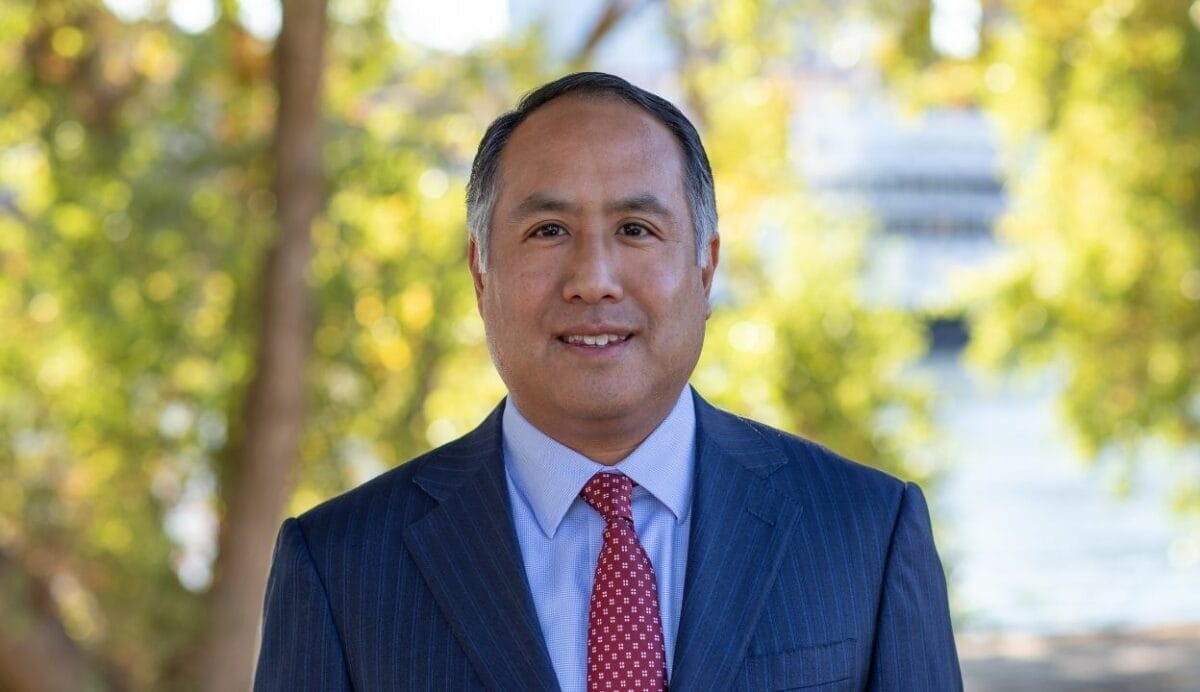

CalSTRS has plenty of cash as it positions for opportunities emerging out of the current economic volatility. In the longer term, the fund’s asset allocation will continue to move away from global equities into private markets as the dust settles and makes way for more US opportunities. Amanda White spoke to CIO Scott Chan about the fund’s plans.
An acceleration of some persistent themes coming into 2025, like deglobalisation and the increasing chance of recession, has positioned CalSTRS well for the volatility in markets.
As Scott Chan, the fund’s chief investment officer carried out its annual asset allocation exercise with June Kim, senior investment director of total fund management, the senior management team, directors, and staff, one of the concerns was balancing the long-term positioning of assets alongside potential repercussions of the current economic environment.
“One of the issues is that tariffs, and the theme of deglobalisation, is causing a lot of uncertainty and chaos,” he says. “If it means that trading partners will be shifting their reliance on trading with the US, there is a growing risk that capital might shift from the US. The future holds that risk in its hands, and we are trying to understand the magnitude and speed of a risk like that.”
Chan believes it is likely the US will experience higher inflation and lower GDP growth, and the upending of complex supply chains will mean company profit margins are likely to go down, not up.
“This puts into jeopardy some very high historical profit margins. The opportunity is how we might consider diversifying our public markets exposure as a lot of that is concentrated in the US,” he says. “We are working in a world with higher inflation, higher for longer interest rates, great policy uncertainty and geopolitical uncertainty. There is a lot for allocators to think about.”
But in “reading the tea leaves”, Chan’s view is that there will be more amazing opportunities for transformative capital to come into the US once the dust settles.
“There is a lot to unpack from the US perspective,” he says. “As we look to AI and whether there will be a manufacturing renaissance in the US, the themes of infrastructure, energy, and power come in. We see private markets as transformative capital, and there is a lot of transformation that is going to be needed.
“There’s always opportunities and risks, and you can turn risks into opportunities too. These are some of the thoughts emerging and in our annual asset allocation you can see how it is in line with that.”
The fund recently completed its annual asset allocation review internally across all investment divisions and while generally speaking, Chan says the environment is one where “staying the course” is important given the volatility, there is also a need to be more dynamic.
“We have a very diversified portfolio, and I don’t think diversification has paid off in the recent past because of the dominance of the US stock market. But we are quickly moving into an environment where diversification will pay off,” he says.
The fund is moving its “diversifying portfolio” from an underweight to target position, adding to fixed income, risk-mitigating strategies (including hedge funds), long-duration bonds, and cash.
“We are hoping in a turbulent market environment that portfolio would be up, or at a minimum outperforming the growth assets. We were underweight and over time we are bringing it to target and then moving into an overweight position. We have been on a path to move to target for 18 months and we accelerated that from January this year.”
Chan says in January the view was that the chance of recession or stagflation increased significantly and wasn’t priced into markets.
“So we became defensive in Jan/Feb, positioning the portfolio defensively. While market strategists began to raise the risk of the odds of a recession, the market was pricing almost zero back in that timeframe,” Chan says. “We have more and more conviction of the uncertainty and the probability of risk increasing. We didn’t have 100 per cent direction but as an allocator we have to look at the probability and expected return.”
For nearly two years, the fund has also been on a path to increase liquidity and that accelerated in January and February.
“We are looking at all the liquidity tools we have available, raising a bit more cash, and slowing down some of our transactions. We always want to have enough liquidity to take advantage of opportunities if the market declines a lot. We are in that position now,” he says, adding that “we have a lot of liquidity when the time comes, but we don’t think the time has come yet.”
In addition to cash, the fund has access to other tools, like the futures markets, counterparties, a formal leverage policy of 10 per cent, and widening of allocation bands, all giving the fund access to liquidity.
“They all provide us with the amount of liquidity we think we need to take advantage of a market crisis. We don’t want to put a figure on it but it’s very significant and I feel good about that in preparation for volatility and an uncertain environment.”
In line with its strategic thinking, CalSTRS is diversifying out of global equities, currently around 1.5 per cent underweight, and into private markets where it sees more ability to add value.
“We are building out infrastructure, the energy transition, certain areas of private credit like asset backed, all clear areas of private markets we think can provide very good returns at decent risk levels.”
Priorities
The end of June will mark the first year of Chan’s tenure as CIO, a year in which he has laid out organisational and investment priorities and appointed new senior team members.
A shared vision for the investment division, moving to a one fund approach and revamping how the fund uses technology are the top three priorities.
“As a new CIO I wanted us to look out five to 10 years at what we need to become, and what do we need to build now to fulfill on our mission well into the future,” he says.
CalSTRS has a 30-year average return of 8.1 per cent versus its target of 7 per cent, and as the second largest fund in the United States, doubles its assets under management about every 12 years.
“Every dozen years or so, if we are successful in achieving our returns – we create a whole new CalSTRS because we double our asset base and we need to prepare for increased size and complexity”, Chan says. The move towards a total fund approach, which has taken place over the past few years, including the appointment of June Kim last year to head of total portfolio management, has been fast-tracked as the need to allocate capital dynamically becomes more important. The fund’s collaborative model is deeply embedded and the cost savings and alpha point to its success.
“We want to look at what is the better value for the risk we are taking. There are more and more evolving opportunities and they evolve quickly, things like the energy transition, data centres, asset backed private credit. Some fall within an asset class and some in between. We need to be nimble and innovate in how we allocate,” Chan says.
A centralised view of the portfolio is also essential for reporting risk at the total fund level, and can be used to scale opportunities.
“I want to unlock the advantage of position sizing,” he says.








Leave a Comment
You must be logged in to post a comment.
Login