
Investors’ role in disability inclusion

Four US state treasurers are among 11 investors to sign a joint investor statement on corporate disability inclusion, and are urging others to get behind the cause.

The investors, worth $1 trillion, believe companies must to do more to include people with disabilities in the workforce and are urging their portfolio companies to adopt best practice.

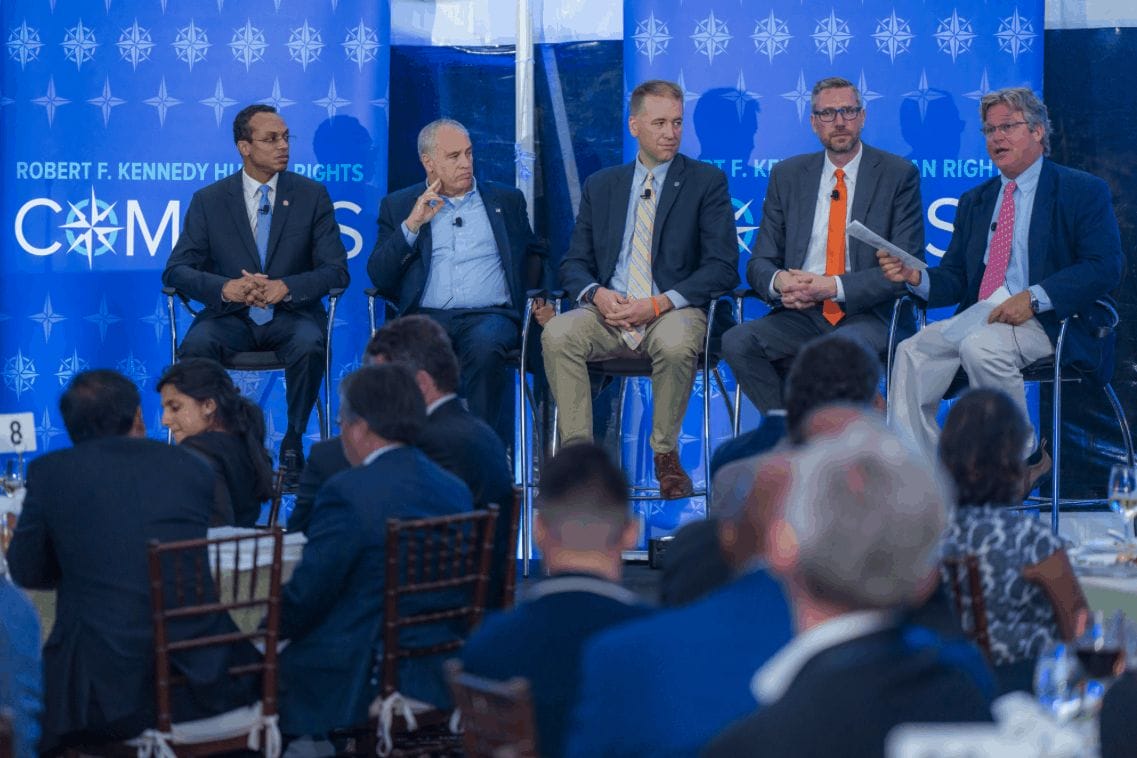
Hosting a conversation with the treasurers of Connecticut, New York, Illinois and Oregon, Ted Kennedy Jr, chair of the American Association of People with Disabilities, urged every investor at the RFK Human Rights Compass conference to sign the investor statement.

“If we are not looking for these opportunities we are not living up to our responsibilities,” the Treasurer of Oregon, Tobias Read, said. “If we are not seeking them out then we are not doing our jobs.”

The treasurers discussed how including people with disabilities is not just the right thing to do, but a business edge. A recent report by Accenture showed that companies that promote disability inclusion are four times more likely to outperform their peers.

The report identified 45 companies as standing out for their leadership in areas specific to disability employment and inclusion and found that they had on average 28 percent higher revenue, double the net income and 30 percent higher economic profit margins than their peers.

Sponsored Content

“Our analysis also revealed that US GDP could get a boost of up to $25 billion if more persons with disabilities joined the labour force,” the report said.

New York State Comptroller Thomas P. DiNapoli said the Accenture report provided the justification to urge the top 49 companies in his portfolio including Apple, McDonald’s, Nike and Twentieth Century Fox, to report on their inclusion of people with disabilities.

“We need to include the disabled in our definition of diversity,” he said. “We began this in January and as we’ve found in every other engagement, it may take time but we’re going to get there. It’s important we don’t do it alone.”

Of the 49 companies NY Common Fund reached out to, 11 replied.

“We then followed up with the remaining 38 and there is now a roadmap for them to meet our expectations of what it means to be an inclusive workplace regarding disability,” he said. “Investors need to do follow up. We can give them the formula for what we expect and how to do it.”

Connecticut State Treasurer, Shawn Wooden, also supported collective action on the issue.

“One of the most significant things is that we are moving more collectively to organise our capital to bend the needle,” he said.

“As institutional investors we need to lead by example. There needs to be collective action and persuasion in getting the view out.”

Michael Frerichs, Treasurer of Illinois, said it was important to ask questions but also to give some preferences, for example by giving extra points in RFPs to companies that display diversity and inclusion.

Oregon’s Read, also said there needed to be a process regardless of who was in office.

“We need to make sure this is not dependent on who sits in the treasurer’s chair,” he said. “We have changed our investment beliefs to say diversity is a material factor. Just by making that statement we have changed who comes to see us.”

The treasurers also said it was important to look in their own backyards.

“One action we can easily take is to look at our own team and what we are doing regarding disability inclusion. How explicit are we about diversity and does that include disability? We can update our own executive order regarding diversity and ask more questions about our own profile.”

Kennedy Jr also highlighted the Disability Equality Index as an effective benchmarking tool to score businesses on their disability inclusion policies and practices.

Wooden said there was power as an asset allocator in just asking the questions to corporations regarding inclusion.

“We have said no to managers based on ESG issues including inclusion,” he said.


Leave a Comment

SWFs play important role in Arctic

SWFs play important role in Arctic

Sovereign wealth funds can play an important role in investing sustainably in the Arctic region, and warding off the impact of a looming natural disaster, according to the IMF's Udaibir Das.

Sort content by

Investors should backoff policy: Kay

Pension funds have “no business” engaging with policy makers but instead should influence change through stewardship, which is also the main function of asset managers, according to John Kay, Supernumerary Fellow in Economics at St Johns College, Oxford University.

Investors debate engagement priorities

Should investors collectively prioritise engagement issues, and if so what is at the top of the list? This was one of the topics delegates discussed at the 8th Sustainable Finance Forum run by the Oxford University Smith School of Enterprise and the Environment together with The Rothschild Foundation and the KR Foundation.

Momentum in ESG in Asia

Asia's largest institutional investors help spread the ESG movement in emerging markets.

Changing reporting to the long term

The $3.5 billion Carnegie Foundation doesn’t report quarterly numbers and at its board meeting it doesn’t discuss performance at all. Pension funds looking to change behaviours towards a long term investing orientation could take heed from such foundations in how they report to their boards about performance.

Chiefs outline risks in global economy

The impact of inequality, the skills gap in employment, looming cyber risks and the fragility in Europe makes the chiefs of five financial services firms wary about the outlook for the global economy, delegates at the Milken Institute Global Conference heard.

Lagarde on the global economy

From productivity growth, the mystification of inflation, levels of debt, and problems of capitalism Christine Lagarde, president of the IMF, shared with delegates at the Milken Global Conference her concerns about the global economy.