
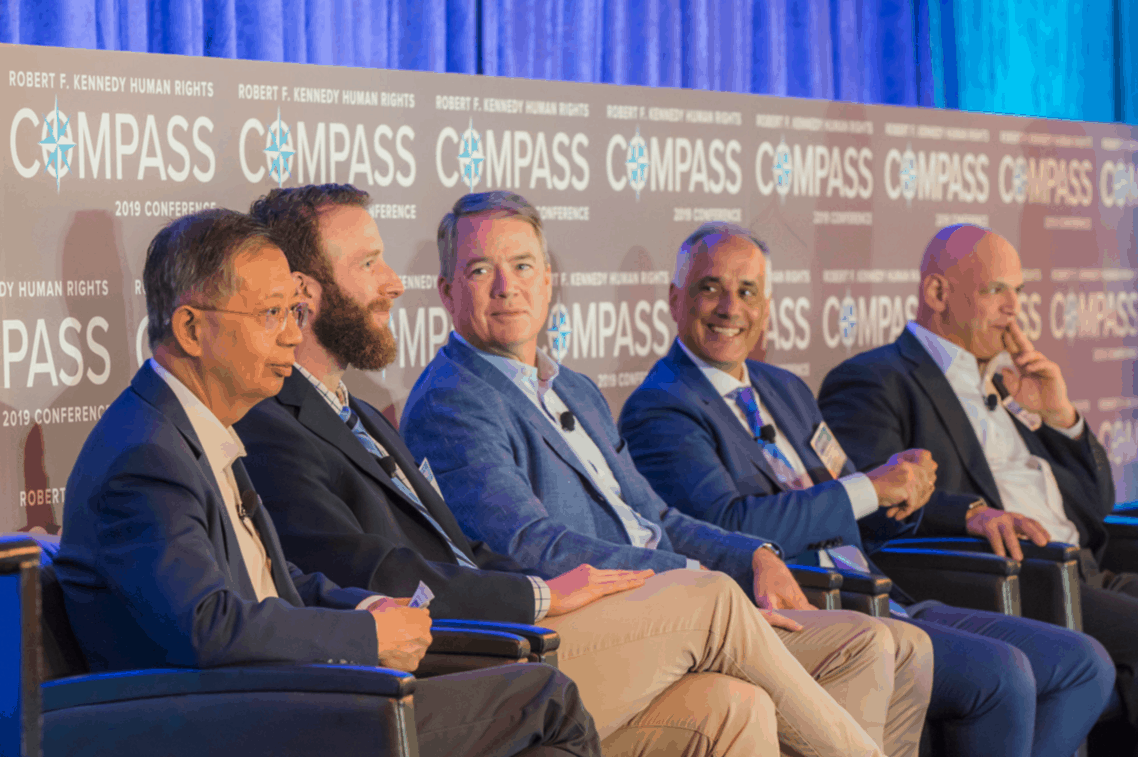

Institutional investors at the Robert F Kennedy Human Rights Compass Investor Conference in Hyannis Port were excited about the prospect of investing in the decades to come given the progress in frameworks around ESG investing.
Former CIO of CalPERS and now vice chairman and head of strategic partners at Morgan Stanley Investment Management, Ted Eliopoulos, said the crystallisation of the taxonomy, or organisational structure, to invest via ESG considerations was an important development in investment in the past decades.
“The trillions of dollars now moving to ESG, the nomenclature around integration, and more capital thinking about impact points is an enormous and powerful change for good. I’m looking forward to the next decade and decades to come,” he said.
“From an institutional investor perspective, the organisation, taxonomy and landscape around how to think about these risks and returns in a multi-asset investment is now an organisational concept that can really drive the measurement and reporting around financial impact as well as the social impact of these forces. The $35 trillion moving towards this type of taxonomy and framework is stunning to me.”
Similarly, Andrew Collins, director of ESG investing at the San Francisco Employees’ Retirement System talked about the evolution of divestment according to moral or ethical terms to a more robust ESG framework that considers how environmental, social and governance factors influence the risk return spectrum, and how fiduciaries can’t ignore ESG in how they invest.
“Since 1988, we have had a social investment procedure that governs our program, and five years ago we updated that to be an ESG policy and guidelines. The naming convention is one indication about how thinking has evolved. Back then the guidelines and actions we took were divesting of sectors where there were moral or political objections such as tobacco or firearms manufacturers. In the last five years we have an ESG policy and procedure framed from the context of how E, S, G influence the risk return spectrum and how as long term fiduciaries we can’t ignore ESG in how we make decisions,” he said. “Our journey reflects the evolution of the whole space where people talk about the shift from exclusions to more integrated inclusion of factors.”
Both investors talked about the importance of data and the evolution of the reports they received from external asset managers, such as from private equity manager TPG and its rise fund.
“A lot of people have trouble with the data, but it’s great that so many smart minds are a tackling this problem,” said San Francisco’s Collins.
“The iterative process works and is so important to prove impact is being created and creating a lens to look forward and unpack other opportunities. The more asset owners ask for this reporting the more they will deliver on it.”
Investors are discovering their collective power in asking questions of their external managers when it comes to ESG reporting, and Collins said he is now seeing trustees ask managers why they don’t have impact or ESG reporting.
“We are also trying to measure these things ourselves. We are now seeing same platforms we use to measure performance and risk, integrate ESG into their systems and so we are able to report on these things in concert with one another.”
Collins said when his fund looks across the spectrum of ESG risks, climate rises to the top.
“We developed a six point climate strategy to understand those risks, minimise them and tap into opportunities created by the climate transition. We spent a lot of time saying how can we put in place a thoughtful strategy to manage these risks.”
One of the steps is to be more vocal in how it engages with companies and regulators to talk about climate risk and risk management structures.
It has “ramped up” its shareholder activism individually and through the Climate Action 100 group, which was actually started by CalPERS which on analysis of its portfolio found that 50 per cent of carbon emissions were coming from 100 companies.
That list of companies expanded to 150 systemic carbon emitters which investors collectively are engaging with to reduce emissions. It has been a very effective way of mobilising the investor community to get effective action from companies with around $33 trillion of investor money signed up the Climate Action 100 group.
Eliopoulos said that “rainbow washing” was at the heart of the concern for institutional investors and asset managers truly focused on driving these impacts that also achieves a financial impact.
“An investor community coming together on an orthodox set of methodologies is a really important step in how we invest in the next decade or so.”








Leave a Comment
You must be logged in to post a comment.
Login