
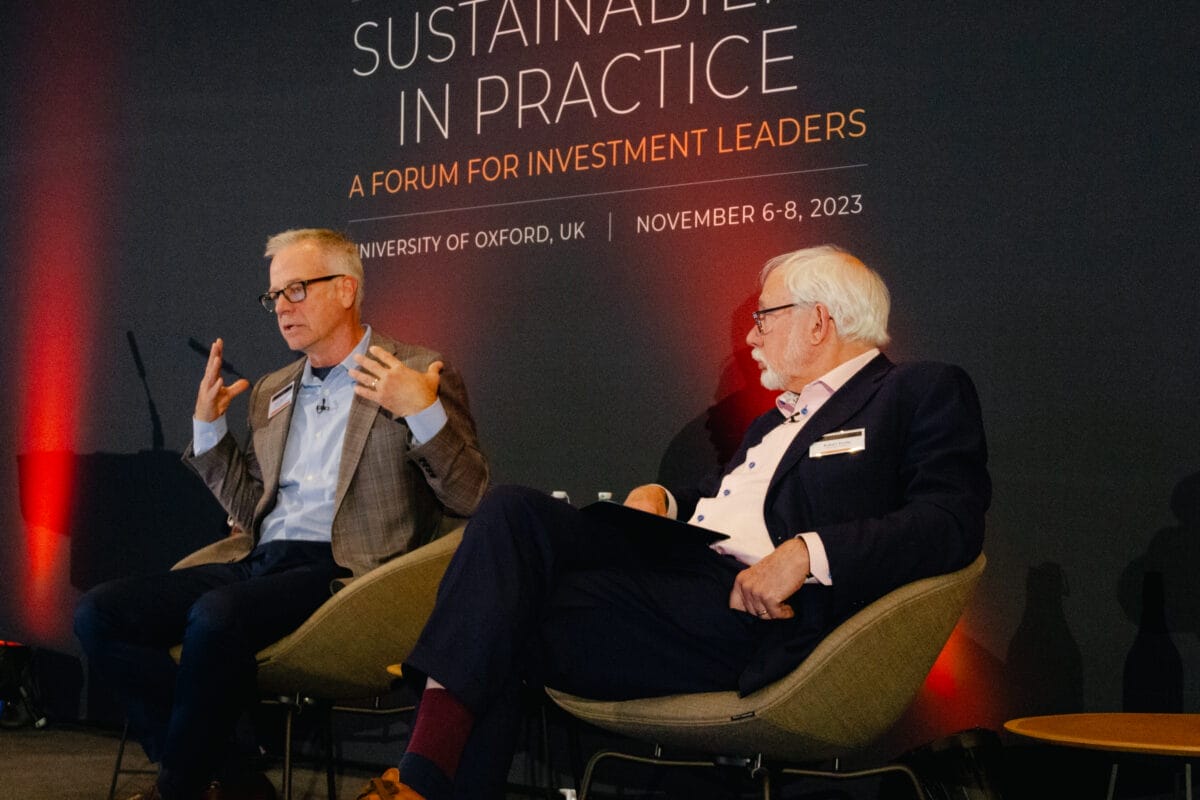

CIOs need to fight back against the politicisation of ESG in the United States by adopting sound governance principles and not allowing their funds to be “pinned down to one side of the [political] spectrum,” according to John Skjervem, the chief investment officer at Utah Retirement Systems.
Expressing disappointment with how sustainability has evolved in public funds, Skjervem said the issue had been “captured by the elected officials and the political class and has strayed terribly from its original intent,” which was to “put an empirical framework around externalities.”
“I went to college in the early 80s and you know, you study microeconomics and you get to the part where the factory is dumping pollution in the river and the professor shrugs his or her shoulders and says: ‘Oh, well, it’s an externality,’” Skjervem said. “And so I felt like one of the greatest things that’s happened in my lifetime as we have evolved as a society is to say: ‘Hey, we’re not going to tolerate externalities anymore.’”
But after around 2016, ESG “became very narrative based” and lost its empirical foundations, he said.
He was speaking at the Sustainability in Practice conference held by Top1000funds.com at the University of Oxford, in a panel session chaired by Robert Eccles, visiting professor of management practice, Saïd Business School, University of Oxford.
Skjervem, a lifelong surfer, skier, and lover of nature, said the popular view of liberals towards ESG “largely comes down to vilifying big oil or vilifying fossil fuels…and there is no appreciation for the fact that it has to be a transition.”
Well-intending people are thus ignorant of the complexity of the transition that needs to take place, and think that by divesting, the problem is solved. Environmental officials elected on a two-year election cycle are misaligned with CIOs like him with “a 40-year horizon”. This leads to misguided campaigns that hamper efforts to deal with critical issues like climate change, he said.
For example, expanding the power grid in the United States is one of the biggest impediments to decarbonisation, he said, as the legal environment is onerous and punitive.
Environmentalists had cheered after defeating the 17-year Northern Pass high-voltage transmission line project to bring hydro-electric power from Quebec to the north-east, “even after the developer agreed to bury something like 60% of the transmission lines,” he said. “And so the north-east now will burn more coal.”
There are numerous examples of this kind, he said.
Utah Retirement Systems takes a “both, and” approach, he said, never getting “pinned down to one side of the spectrum or the other.”
“We are capitalizing on the exodus of private equity in oil and gas and we are coming in right behind that and doing direct deals with oil and gas operators,” Skjervem said. “We are doing full spectrum of renewables and we are, to my knowledge, at least the United States, the only plan that has made direct active investments in what I call emerging energy: fusion, fission, hydrogen.”
The fund does not have any investments in coal, he said.
Arguing climate change and sustainability are seperate issues, Skjervem also said “net zero is a waste of time” as most of the world’s population is not in the developed world and aspire for the same lifestyle as rich countries.
“So 1.6 billion people [in developed countries] have created this problem over the last hundred years,” Skjervem said. “I just find it just infuriatingly sanctimonious that we’re going to spend our time and energy on net zero targets when it doesn’t matter, because the only thing that matters is developing clean energy technologies so that those 5.2 billion people don’t do what we did.”
ENDS








Leave a Comment
You must be logged in to post a comment.
Login