
Politicisation, poor governance to blame for backlash against ESG

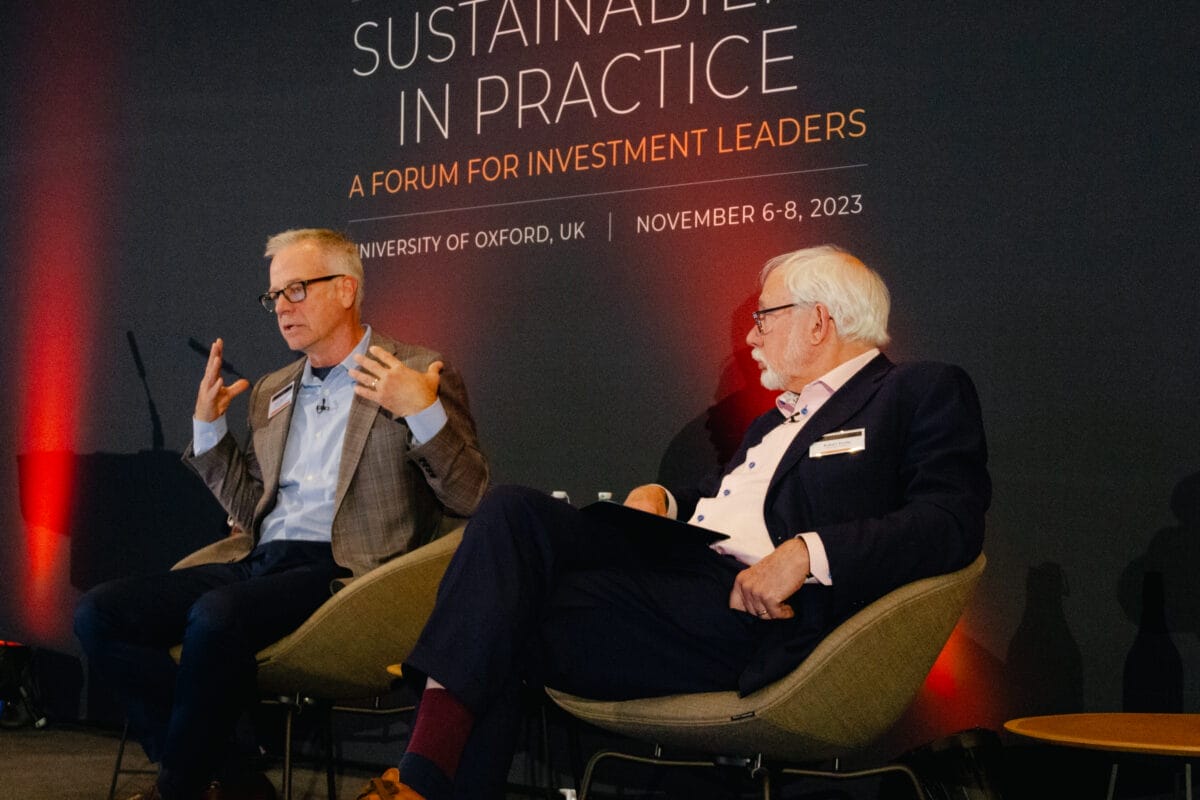
John Skjervem (L) and Robert Eccles

CIOs need to fight back against the politicisation of ESG in the United States by adopting sound governance principles and not allowing their funds to be “pinned down to one side of the [political] spectrum,” according to John Skjervem, the chief investment officer at Utah Retirement Systems. 

Expressing disappointment with how sustainability has evolved in public funds, Skjervem said the issue had been “captured by the elected officials and the political class and has strayed terribly from its original intent,” which was to “put an empirical framework around externalities.”

“I went to college in the early 80s and you know, you study microeconomics and you get to the part where the factory is dumping pollution in the river and the professor shrugs his or her shoulders and says: ‘Oh, well, it’s an externality,’” Skjervem said. “And so I felt like one of the greatest things that’s happened in my lifetime as we have evolved as a society is to say: ‘Hey, we’re not going to tolerate externalities anymore.’”

But after around 2016, ESG “became very narrative based” and lost its empirical foundations, he said.

He was speaking at the Sustainability in Practice conference held by Top1000funds.com at the University of Oxford, in a panel session chaired by Robert Eccles, visiting professor of management practice, Saïd Business School, University of Oxford.

Skjervem, a lifelong surfer, skier, and lover of nature, said the popular view of liberals towards ESG “largely comes down to vilifying big oil or vilifying fossil fuels…and there is no appreciation for the fact that it has to be a transition.”

Sponsored Content

Well-intending people are thus ignorant of the complexity of the transition that needs to take place, and think that by divesting, the problem is solved. Environmental officials elected on a two-year election cycle are misaligned with CIOs like him with “a 40-year horizon”. This leads to misguided campaigns that hamper efforts to deal with critical issues like climate change, he said.

For example, expanding the power grid in the United States is one of the biggest impediments to decarbonisation, he said, as the legal environment is onerous and punitive. 

Environmentalists had cheered after defeating the 17-year Northern Pass high-voltage transmission line project to bring hydro-electric power from Quebec to the north-east, “even after the developer agreed to bury something like 60% of the transmission lines,” he said. “And so the north-east now will burn more coal.”

There are numerous examples of this kind, he said.

Utah Retirement Systems takes a “both, and” approach, he said, never getting “pinned down to one side of the spectrum or the other.”

“We are capitalizing on the exodus of private equity in oil and gas and we are coming in right behind that and doing direct deals with oil and gas operators,” Skjervem said. “We are doing full spectrum of renewables and we are, to my knowledge, at least the United States, the only plan that has made direct active investments in what I call emerging energy: fusion, fission, hydrogen.”

The fund does not have any investments in coal, he said.

Arguing climate change and sustainability are seperate issues, Skjervem also said “net zero is a waste of time” as most of the world’s population is not in the developed world and aspire for the same lifestyle as rich countries.

“So 1.6 billion people [in developed countries] have created this problem over the last hundred years,” Skjervem said. “I just find it just infuriatingly sanctimonious that we’re going to spend our time and energy on net zero targets when it doesn’t matter, because the only thing that matters is developing clean energy technologies so that those 5.2 billion people don’t do what we did.”

ENDS

Leave a Comment

The ‘space economy’ is a legal and literal vacuum for investors

The ‘space economy’ is a legal and literal vacuum for investors

The looming SpaceX IPO has put the spotlight firmly on the so-called ‘space economy’, but asset owners have been urged to exercise caution about investing in a sector that still resembles the wild west, with no legal or governance framework to protect capital. That’s not to say money will not be made, but it might not be in the areas investors first expect.

Sort content by

Investors head back to EM as US tech capex bill mounts

US tech mega caps are grappling with surging capital expenditure, casting doubt on whether the premium attached to these stocks in the AI super cycle has become detached from fundamentals. Investors are now turning their attention to emerging markets equities where they have the opportunity to buy into the AI hype at a much lower price.

China tech rivalry is ‘existential’ for the US – and diversification

Decades of US economic and financial supremacy have made diversification away from it a drag on returns for many investors, but the forces that have underpinned that supremacy may now be coming to an end.

AustralianSuper built scale – now its new CIO needs to make it work

The $295 billion AustralianSuper has spent two decades building scale, but Shaun Manuell's task as the fund's new chief investment officer is to ensure Australia's largest pension fund can operate effectively with it. As short-term performance pressure mounts on the fund and its assets set to hit A$1 trillion ($718 billion) by 2035, the local equities boss-turned-CIO will see his legacy defined by whether he can transform AustralianSuper from a domestic giant to a global leader.

Why Asian equities’ growth will outlast the AI-driven semiconductor cycle

In the latest episode of the Fiduciary Investors Series, Liao spoke with Top1000funds.com Asia Pacific correspondent Darcy Song on why the convergence of innovation, demographics and improving shareholder returns makes Asian equities an increasingly compelling diversification trade for asset owners navigating a geopolitically fractured world.

How CPP is evolving risk management for a faster, more interconnected world

In an environment where multiple risks are emerging and their effects are compounding on the portfolio, CPP Investments' chief risk officer Priti Singh says the $572 billion fund is rethinking risk management from the ground up, shifting from reaction to preparation and embedding risk thinking earlier in investment decisions. She speaks to Amanda White about the fund's risk approach.

Pension funds confront the question of who owns AI

As the use of AI within asset owners evolves, organisations are grappling with the governance question of where the strategy and accountability sit. Darcy Song looks at the treatment of AI organisationally within a number of high-profile funds, including OTPP, AustralianSuper, CPP and Norges Bank.



