
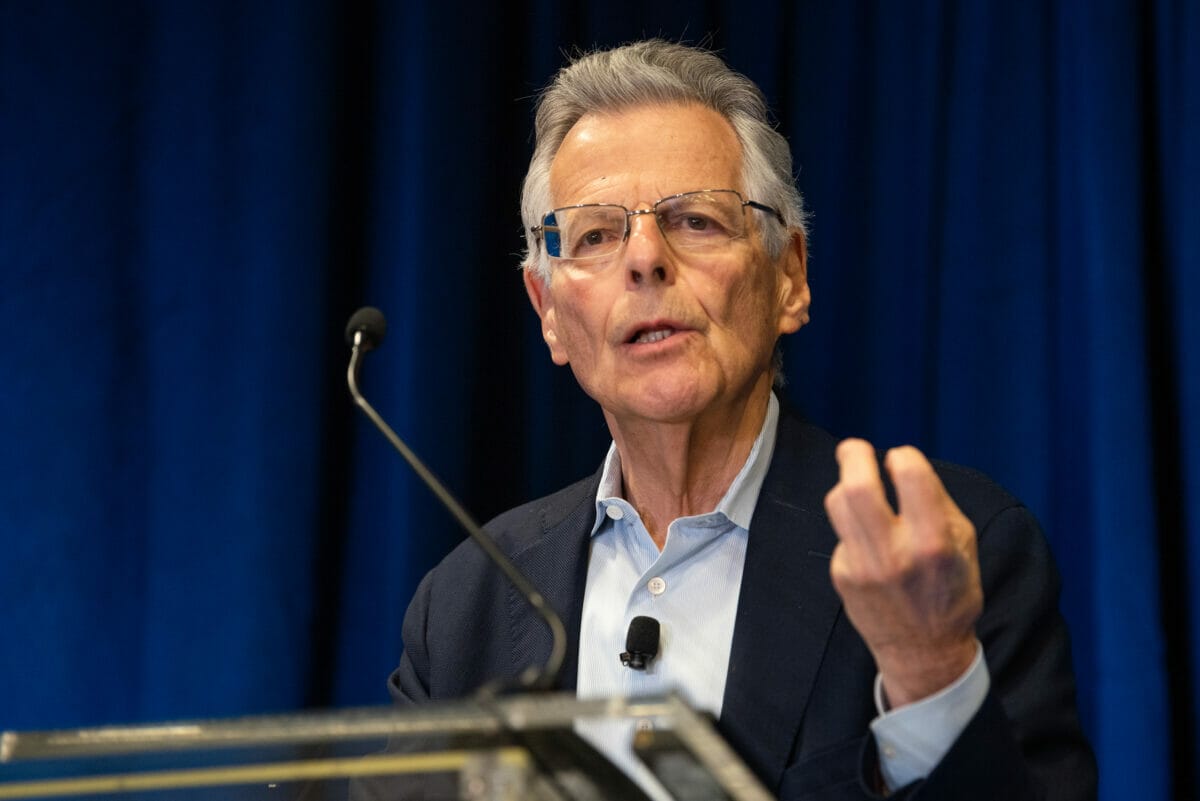

Nobel Prize-winning economist Myron Scholes told the Fiduciary Investors Symposium at Stanford University that the focus of asset owners needs to shift from measuring risk to managing it, to avoid the downside while capturing the upside and allowing compounding to do its thing.
Asset owners need to move away from merely measuring risk to adopt a mindset of actively managing risk across different time periods and across different market conditions, the Fiduciary Investors Symposium at Stanford University has heard.
When investors talk about risk they often mean volatility, but volatility is not a sensible measure of risk, according to Nobel prize-winning economist Myron Scholes.
“We use volatility as a measure of risk. But volatility is a crazy measure of risk,” Sholes said.
“If I tell you we have upside volatility, [that] everything is going to be good but it’s going to be very volatile on the [upside], you want that, or no? Sure you want that – everyone wants upside vol; it’s downside volatility we don’t want. In life, you don’t want to miss the upside.”
Scholes, whose Nobel prize was awarded for his work jointly developing the Black Scholes model for pricing options, told the Fiduciary Investors Symposium that actively managing risk even over short time periods is critical because just as short-term returns compound to long-term returns, so does risk over short timeframes compound to long-term risk.
And diversification is not an adequate way to control risk, Scholes added, even though diversification frequently is referred to as the only free lunch in finance.
“The only reason it’s free is because when you need it, it ain’t there,” Scholes said. “You know, basically, at times of shock, everything moves together, right?”
The key, Scholes said, was to manage downside risk while benefitting from the upside, to support compounding. Scholes said he was keen to move the discussion on risk away from means and averages and measuring everything relative to benchmarks.
“That’s what I want to do – let’s move away from the relative components or averages and thinking about averages to think about compound return only,” he said.
“How are we going to get better measures of compound return? What is the risk of compound return – you know, downside risk, upside risk. How you get a better compound return experience?
“And the problem with compound return is it takes a long time to see that convexity, to see the ability with a convexity that we’ve grown in our portfolio and had a better experience for our pension holder.
“So moving the idea away from thinking about risk as second-order to first-order and primary, and averages or returns are second order. That’s the way I think we can increase the value of our portfolio.”
Scholes said the focus needs to shift to how to better measure compounding.
“Can we do bootstrapping?” he said. “Can we look over time, three-year, five-year returns and bootstrap them to figure out what the risks are of these various strategies we have and think about what’s happening there, to enhance our portfolio experience?
“People talk about long term: ‘Oh, we have risk over the long term’. But risk over the long term is not the correct measure. Risk on the short term, risk every period, compounds to being long-term risk, and all those things are very important.”
Wilshire managing director of client solutions Ali Kazemi said that for the better part of the past decade and a half, institutional investors have enhanced their ability to measure risk.
“That’s been very additive to the portfolio construction process,” he said.
“I think the next phase is continued expansion of the ability to evaluate liquidity in your portfolio, and to be able to pay your benefits, but also adhere to the level of risk that you want to always be maintaining via the strategic asset allocation.
“So whether it’s using leverage, whether it’s using overlays, being able to pay benefits, but also maintain a level of volatility that on a risk-adjusted basis is going to get you to that discount rate return that you need to achieve is, I think, that the next phase. We’re starting to see investors use more sophisticated tools and develop internally in some cases to better evaluate their liquidity.”
Head of investment risk for BCIMC, Samir Ben Tekaya, said that moving from measurement to management of risk is key, fundamental questions to ask first are: “What do we mean by risk, and what do we have in our portfolio?” he said.
“I can give the example of a typical pension, particularly Canadian, we have good allocation to private [assets]. And having the private there, yes, I think it changed the priority. What are the priorities? The market risk that we need to assess [or] is it maybe liquidity, as we have heard in [an earlier] panel, and we need to have this cushion there. And by having this cushion, that can help us to withstand a market downturn.
“So I think it depends on the context.
“However, from a top-down perspective, portfolio construction, if you have private assets, it’s going to be more complex, to assess the vol and to optimize this vol, let’s say; and this is something that we need to just be mindful of.”








Leave a Comment
You must be logged in to post a comment.
Login