
Looking backwards is a poor way to assess Asia’s future

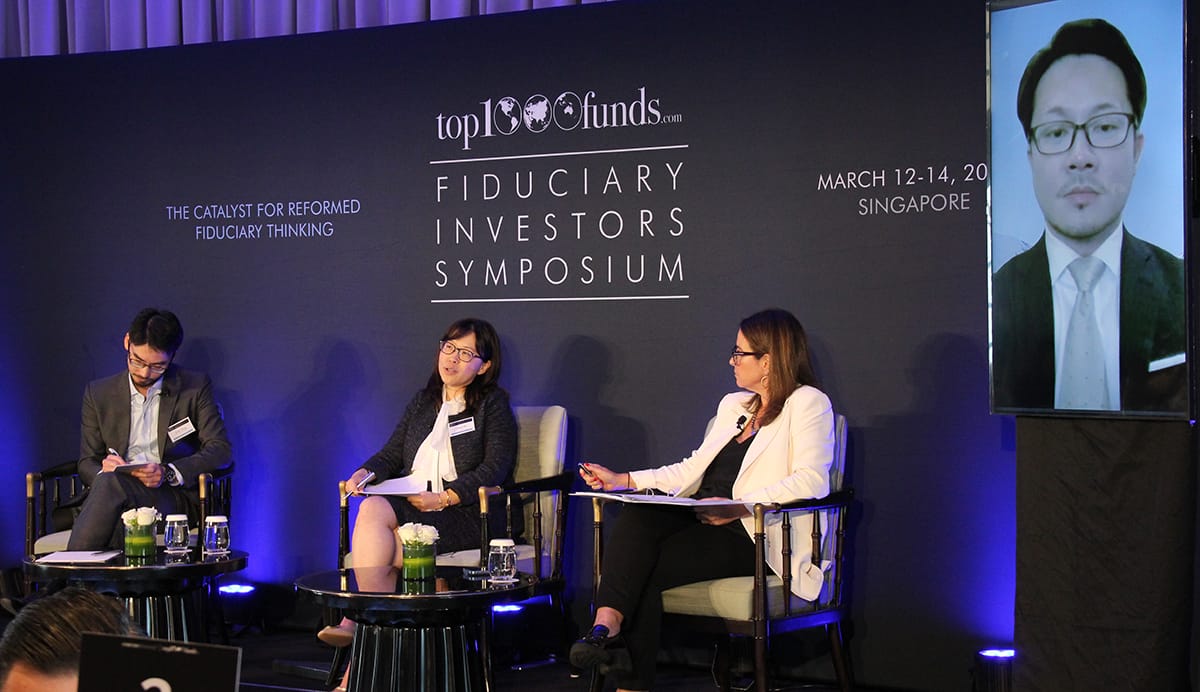
L-R: Andy Wong; Grace Qiu; Top1000funds.com's Amanda White; Kevin Bong (on screen)

The specific drivers of growth for Asian economies means a traditional view of asset allocation is not necessarily the best way to approach investing in the region, the 2024 Top100funds.com Fiduciary Investors Symposium in Singapore has heard.

GIC senior vice president, total portfolio policy and allocation, Grace Qiu told the symposium that the backward-looking nature of benchmarks means that they may not necessarily be the best guides when assessing the potential of developing markets or regions.

Qiu said investors on the ground can often make better decisions.

“Benchmarks may be the best simple and transparent rule-based solution you can come up with in a single asset class. But in a total portfolio context, some of these important decisions can be made by ourselves.”

“As investors, we know the investment objective, the time horizon, and the risk tolerance. So, we should potentially take those decisions in-house, and make the right allocation accordingly.”

Qiu said that in emerging markets “the benchmark may potentially be even worse than…in developed markets”.

Sponsored Content

“Because [the benchmarks] are backward-looking, they’re not really reflective of the true [reason] why we allocate or invest in emerging markets,” she said.

“For us, making more granular decisions on not just the asset class, but also regional allocation, in a consistent manner across the total portfolio is an important task for asset allocation.”

Pictet Asset Management senior investment manager, multi asset Andy Wong agreed that asset allocations based on benchmarks are by definition backward-looking.

“Your variance, covariance matrices [are] mostly backward-looking,” Wong said. “Also, it is quite arbitrarily confined. People say the US economy is doing well, you should buy S&P 500. Actually, half of the revenue is from overseas.”

Wong said he has “a strong view that the semiconductor is the foundation of modern technology”, and being located close to supply chains for major manufacturers provides a useful perspective.

“Understanding some of the bottlenecks, understanding some of where the new technology is going to will help us think about where the world actually globally will be heading next,” Wong said.

Wong said investors shouldn’t use today’s use-case – which might be reflected in current benchmarks – to try to assess the investment potential of technology.

“When Apple was at $200 billion market cap, people were saying that even if every phone in the world is an Apple phone, they were overvalued. At $2.6 trillion today, quite clearly, it’s more than just a phone call machine; it is connectivity, it’s ecosystem, it’s productivity, it’s GPS, iPod, everything in one. All of these things we couldn’t imagine from before.”

Wong said asset allocation needs to be “a little bit more nuanced”.

“You need to look at fundamental drivers,” he said. “If you want to understand risk, you need to understand equities. If you want to understand equities, you need to understand US equities, which is 70 per cent of the market now.

“And then you need to understand Magnificent Seven, you need to understand AI, you need to understand semiconductor. So, from our perspective, themes and ideas are an integral part of asset allocation.”

Senior managing director, chief investment strategist and head of Singapore, AIMCo (Singapore) Kevin Bong said that from a portfolio construction perspective “diversification benefits; differing sector compositions; different stages in the economic and market development cycle; differing political, economic, and policy cycles; they all mean that the investment markets will not be perfectly in sync with what is I think, typically a developed market-heavy portfolio, and most of us have”.

“You could argue that some of it is an unfortunate side effect of slowing or a reversal of globalisation,” Bong said.“But I suppose if the markets give you lemons, you make a lemonade portfolio.”

Bong said that it is “admittedly more aspirational than a reality, but there is always alpha potential in new markets”.

“One could argue that active management opportunities are attractive across the Asia Pacific region, in part because the markets are not as efficient for the most part, but also because there’s meaningful dispersion in the region,” Bong said.

“All of that sums up to a picture where, especially for where we’re starting from Asia is an attractive opportunity.”

Qiu said asset allocation “needs to adapt to the new environment, to the new regime; and under the new environment asset allocation we believe at least, should be more flexible, more deliberate, and more granular.

“What is the next frontier? What is the newest area of innovation in asset allocation that we can think of to actually bring our portfolio to the next step?

“Those activities lie in some of the maybe more traditionally called bottom-up or more granular type of activities that doesn’t necessarily fall into traditional asset allocation mandate or asset allocation job description.”

Leave a Comment

How the Future Fund built a TPA culture that scales

How the Future Fund built a TPA culture that scales

The total portfolio approach has allowed Australia’s sovereign wealth fund to capture the themes that will power markets and economies for decades to come, said director of thought leadership Craig Thorburn – but that doesn’t mean it’s not hard to scale.

Sort content by

How long-term investors should think about stock-bond correlations

Asset owners that are long-term investors should be wary of the conventional model of assessing the stock-bond correlation that is based on several “implicit assumptions”, the Fiduciary Investors Symposium has heard. Instead, the question investors should be asking is: are bonds a hedge or a risk?

AI already driving ‘biggest transformation in the economy we’ve ever seen’

The economic impact of AI can be better measured if every job is broken down into its component tasks, and the impact on each of those tasks is valued. The Fiduciary Investors Symposium heard that on this basis, we’re seeing the biggest economic transformation ever.

Long-duration storage, digitisation key to cracking the energy transition

Packing more energy into smaller batteries is one crucial technological development to help achieving the energy transition within the necessary timeframes, the Fiduciary Investors Symposium has heard, and there are enormous economic opportunities ahead as industry races to unlock solutions.

Winds of change blowing through private credit markets

The influx of capital and interest into the private credit market has spawned new managers and offerings, but asset owners are increasingly alert to the fact that not every one of them is built equal, and even tiny losses during the credit cycle can eat significantly into long-term returns.

Changing geopolitical risks are getting harder to manage – but here’s how

The changing nature of geopolitical risks has made them harder to manage, even though the adversaries to an American-led world order have remained nearly the same over the decades. The Fiduciary Investors Symposium heard a key difference is that everything that happens everywhere is now interconnected.

Macro risks, opportunities prompt rethink of portfolios

Investment heads at large global funds are cutting down on risk, making higher allocations to equities and shifting focus to absolute returns as they reorganise portfolios to future-proof against global macro risks on the horizon, and to take advantage of potential opportunities, the Fiduciary Investors Symposium has heard.

Previous



