
ESG data not fit for purpose

A cohort of ESG experts argued that the current data and research available for investors is lacking. Elsewhere they urged investors to engage with corporate boards to encourage change.

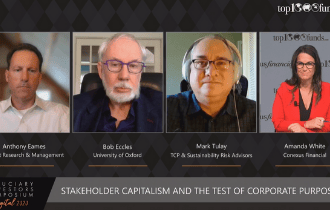
Much of the current ESG research and data is not fit for purpose because it doesn’t integrate big data or the sentiment analysis that really gages what companies are doing rather than saying. Following an in-depth study into corporate purpose that assessed 800 publicly traded companies on their response to the pandemic and inequality crisis, Mark Tulay, founder and chief executive of the Test of Corporate Purpose (TCP) initiative and chief executive of Sustainability Risk Advisors, said that investors urgently need new models to help them assess and integrate ESG risk.

Speaking at FIS Digital 2020, Tulay outlined how the TCP initiative, which partnered with ESG data providers Truvalue Labs and Morgan Stanley, explored the extent to which purposeful companies, including signatories to last year’s Business Roundtable pledge to re-define corporate purpose away from shareholder primacy, performed during the pandemic.

“We did something that would be impossible with traditional ESG research. We need a new model to integrate ESG and I hope more investors push the frontier in encouraging this,” Tulay told delegates.

Alongside ratings agencies producing conflicting corporate data, an “alphabet soup” of organisations and NGOs produce different guidelines, said fellow panellist and co-chair of the TCP initiative Robert Eccles, visiting professor of management practice at Oxford University’s Saïd Business School and a leader in how companies and investors can create sustainable strategies.

Although these organizations have developed standards and are increasingly working together, he flagged investor confusion. Imagine how impossible financial analysis would be without accounting standards, he said.

Sponsored Content

“This is the situation ESG is in today.” Calling for a global body and “basic plumbing” to enable investors to integrate ESG and facilitate corporate reporting, he espoused the urgency to get behind a sustainability standard board.

Alongside the stark absence of informative data guiding ESG investment, the initiative had another key take-home – companies that performed well on ESG metrics also performed better through the crisis. However, companies that have a declared purpose to represent all their stakeholders (rather than just their shareholders) did not necessarily perform well through the crisis.

Purpose

Eccles urged investors to do more to encourage portfolio companies to adopt purpose. He said purpose should be integrated at board level and that investors should hold their fund managers accountable for pushing companies on the subject.

“Tell your portfolio companies you want a company-specific statement of purpose signed by the board,” he urged.

Fellow panellist Anthony Eames, vice president and director of responsible investment strategy at Calvert Research and Management, a wholly owned subsidiary of Eaton Vance Management, noted that more companies are rising to the challenge of stakeholder capitalism. He also said that companies’ navigation of the pandemic will have a lasting impact on their brand and reputation.

“Different corporate responses have shortened or lengthened the impact of pandemic,” he said, citing paid leave, nurturing key supplier relationships and cutting back on executive compensation as drivers of success.

Eames also reflected on the challenges inherent in current ESG data but noted important milestones around disclosure and measuring financial materiality. He urged asset managers to adopt an evolved approach that keeps up with learnings.

“We are developing as investors, finding new ways to assess companies’ performance,” he said. It led him to reference a new Corporate Resilience KPI the manager now uses to measure the governance strength of a company as a consequence of the pandemic based on its financial capacity to execute strategy in a crisis.

“This COVID KPI is under the governance pillar and underpins the strategy and competence of the management team of a company,” he said.

Next, the conversation turned to the extent to which investors are engaging with corporate boards. Eames said it was incumbent on managers, and should be written into the mandate, to communicate with client investors on how they are monitoring and engaging with investee company boards. “We are seeing more progress on the engagement front,” he said.

As for Calvert’s own progress in the area, he cited a recent initiative to measure diversity levels in investee companies, many of which don’t disclose workplace diversity. The manager contacted the companies and argued the business case for diversity, triggering some change. “It is encouraging, but we need to keep after it,” he said. “We are gaining more information to make better decisions and helping these companies with their agenda.”

Tulay concluded that corporate laggards needed to be called out, while investors should also highlight corporate success stories. “If companies are underperforming, we should shine a light, while those doing well should be recognised,” he said.

Leave a Comment

The twin forces rewriting the rules of investing

The twin forces rewriting the rules of investing

Portfolios built for the old world will be severely tested as emerging forces rewrite the rules of investing. The Fiduciary Investors Symposium heard that geopolitical and macroeconomic upheaval, together with the disruption wrought by AI, should force asset owners to rethink the structure and composition of portfolios.

Sort content by

GIC, OPTrust on how TPA reshapes allocation process, accountability

Long-time practitioners of the total portfolio approach said one of its greatest advantages is that the investment team can make significant asset allocation at its discretion, as interest towards adopting the framework picks up among asset owners to handle more complex decision-making. At FIS Singapore, GIC and OPTrust unpack the governance and risk culture to enable it.

Why game theory falls short in AI-driven trading market

The rise of artificial intelligence-driven trading has raised questions about the possibility of algorithmic investors crowding into many of the same ideas and amplifying stress during times of volatility. Nanyang Technological University computer science professor Bo An explores the question at FIS Singapore.

Why active management matters in emerging markets

The emerging markets are a great way to access the AI thematic without buying into expensive US large caps, but their nuances demand local active management if investors want to unlock their rewards.

Asian private credit shines as US, European covenants weaken

As covenants in US and European private credit become weakened from an increasing flow of lending capital, asset allocators and managers are eyeing Asia as the next frontier due to its relatively untapped yet sizable market. At FIS Singapore, investors unpacked the region's complexity premium and why a local approach is essential.

Why China thinks it will lead the next industrial revolution

While China was mainly a beneficiary rather than a participant of previous industrial revolutions, it now believes it can lead the next one, and the US will have to work hard to catch up to its extraordinary capacity and speed for development.

APAC equities moves from tactical to structural buys

The outperformance of APAC equities in 2025 has reignited interest among asset owners in allocating towards the region, but Franklin Templeton's investment strategist Christy Tan argues the investment case for APAC has shifted from a tactical to a structural buy. She unpacks the reasoning in conversation with Top1000funds.com Asia Pacific correspondent Darcy Song.

Previous



