

Escalating diplomatic “disillusionment” surrounding the US-China relationship has made investors think twice about exposure to the world’s second-largest economy. Geopolitics expert Professor Stephen Kotkin said China, and other emerging markets, may still be attractive to asset owners, as long as they understand the complexities of domestic Chinese politics – and ensure they are paid a hefty risk premium.
Tensions between the US and China have escalated significantly after the Trump Administration introduced new tariffs and China’s zero-COVID policy heavily disrupted trade and travel between the world’s two largest economies. They have continued to clash since over Taiwan, human rights, microchips and rare earths.
Stephen Kotkin, a geopolitics expert at Stanford University’s Hoover Institution, said officials in Washington DC and Beijing are “disillusioned” about the relationship after decades of efforts to transform China into a liberal, open society have fallen flat.
And they’re not the only ones. Institutional investors, many of whom had been beneficiaries or champions of what Kotkin called the “Pygmalion” approach to engagement with China – a reference to the classical Roman poem in which a sculptor creates a statue of his idealised version of womanhood – are also now feeling disillusioned as the Chinese market is submitted to rising state intervention and a reversal of once-lucrative partnerships with the global financial system.
Some investors call this dynamic “geopolitical risk”. But Kotkin said it should more accurately be seen as simply a re-pricing of the inherent risk attached to investing in the developing world – a risk he says some have clearly underestimated.
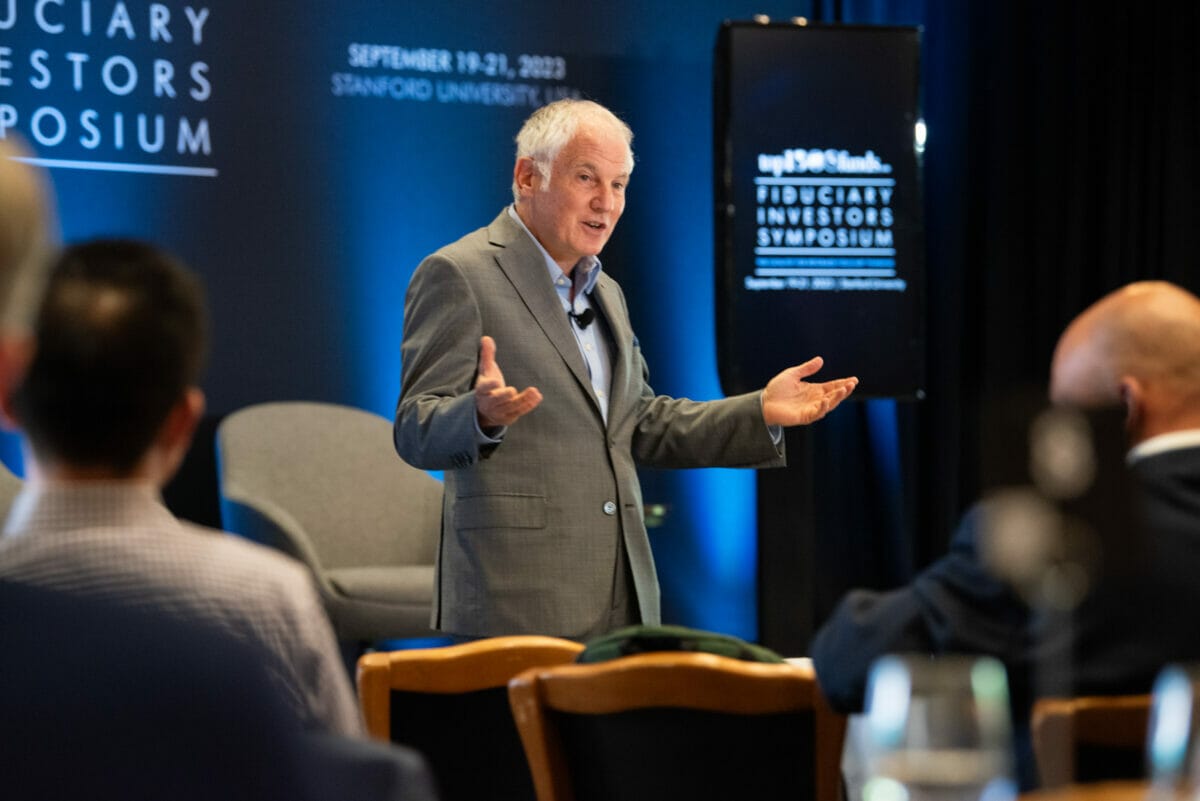
“What many people are calling geopolitical risk is just investing in places where the governance is not the same as in your home country, where rule of law is not the same (if it exists at all) and, where transparency is lacking [or] opacity is extreme,” Kotkin told the Fiduciary Investors Symposium held at Stanford last month.
“And for some reason, it was considered normal practice, to invest in those places, and to assume a great deal of risk for which you didn’t get rewarded. But you did do it. And it was known as emerging markets. This never seemed to me a properly understood idea.”
The thesis that emerging markets could yield similar or better returns to developed world markets – without sufficient attention being paid to inferior governance or institutional structures of these countries – was flawed, Kotkin said.
“You were not getting a sufficient premium in my view,” Kotkin told delegates, speaking rhetorically to the broader institutional investor community. “And you maybe were not aware of the scale of the risks that you were undertaking. And now it’s become more obvious and we’re having the repricing.
“Investing in places beyond North America, Europe, Japan, Australia, we’re not advising against that – we don’t give advice on investment. But it’s just how you price those investments previously, but especially going forward.”
Cold war the best of bad options
Notwithstanding the disillusionment felt by diplomats and analysts, Kotkin said geopolitical tensions between world powers was not new and that investors should be realistic that a cold war scenario between the US and China has not only commenced – but is preferable to the alternative scenarios.
“People are against cold war, they say that would be terrible if we went into a cold war with China … [but] you only have a handful of options in geopolitical competition … What are the other options that you would prefer? How about hot war? Would you prefer hot war? I would not prefer hot war. That would be maximal geopolitical risk. I want to avoid hot war,” he said, adding that nobody wins a war given the losses on all sides.
That leaves two options, Kotkin said: appeasement, which he described as “capitulation” and dismissed as “not a good idea” and the “Pygmalion” option favoured by former US Trade Representative Bob Zoellick. Attempting to reform China through engagement and co-operation was well-intentioned but “not going to work”.
“I study geopolitical competition and history, and cold war to me looks like a really good option, because it’s better than all the other options that I know from history,” he said. “So, just learn how to compete, keep it from becoming hot war, don’t capitulate and don’t have illusions about Pygmalion. This is not rocket science.”
He said some analysts and historians had ignored that during the Cold War between the US and Soviet Union there was a “tremendous amount of scientific cooperation”. The standoff was not based on miscommunication or misunderstanding, but a fundamental clash of strategic interests and values which cannot be reconciled. Cold war is the most feasible way to mitigate that tension without escalating to catastrophic conflict, he said.
At the same time, he said China’s success in lifting around 700 million people out of poverty had been built on the back of access to the US economy and consumer. He said there may yet be opportunity for investors in the Chinese market.
But as well as ensuring they are generating sufficient risk premia, he added they face another challenge.
“From an investment point of view, your problem is … understanding Chinese domestic politics. If you’ve made investments there, or if you’ve made investments that are influenced by China, because they’re elsewhere in Asia, or they’re in Germany, or wherever, there are second-order effects from … Chinese domestic politics. Good luck with that proposition. I think it’s possible, but it’s not simple.”








Leave a Comment
You must be logged in to post a comment.
Login