

Investing in Asia poses an ESG dilemma that investment in other regions throws up less frequently, namely, that most manufacturing companies there derive the energy needed to run their operations from high carbon-emitting sources, principally coal.
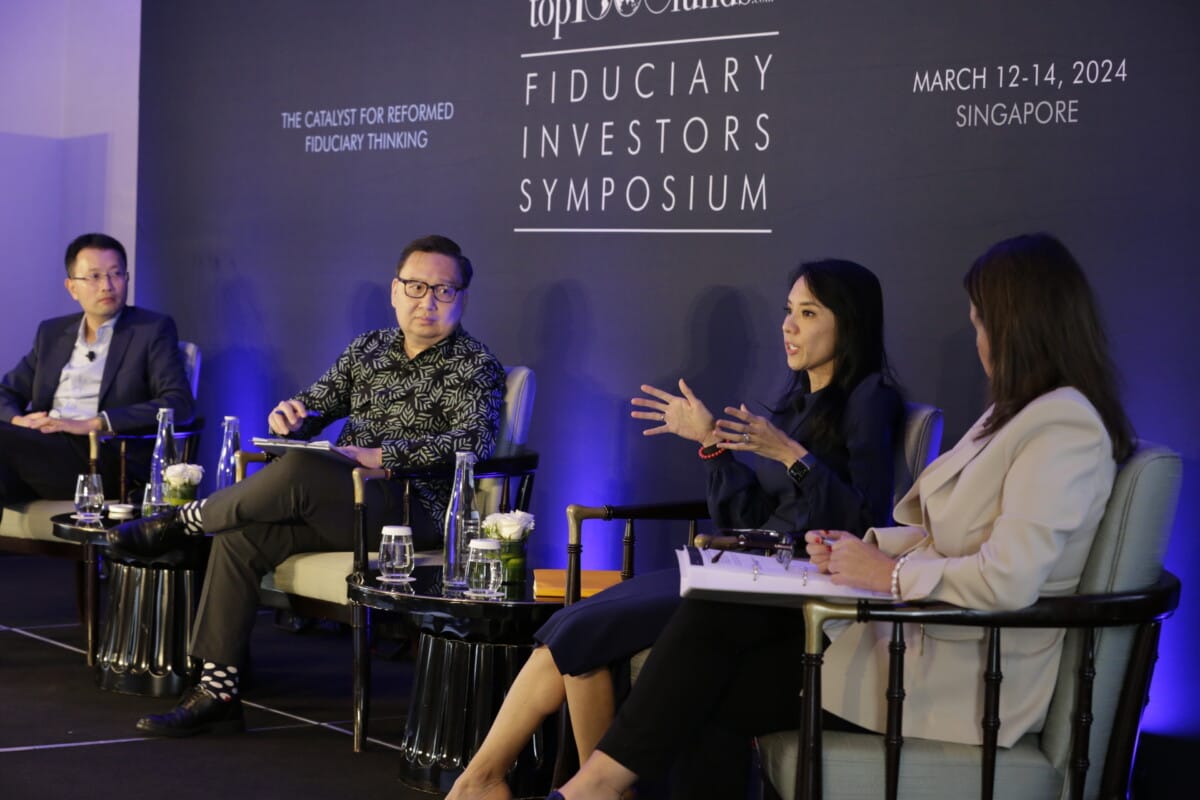
This inconvenient truth was just one of the challenges posed for investors in the region, outlined during the Fiduciary Investors Symposium in Singapore last week.
Khazanah Nasional head of strategy and asset allocation Wai Seng Wong said the $27 billion Malaysian sovereign wealth fund has always had a home bias, “and home, in this case, is not just Malaysia, but a preference and a comfort with China and India and everything else around us”.
But this home bias presents challenges for the fund’s ESG and sustainable investment aspirations.
“When we speak of the…manufacturing sector, the biggest elephant in the room is a source of energy, actually, in this region. It’s mainly coal,” Wong said.
“And no matter what you do, the moment you allocate to southeast Asia, or Asia, your ESG scores will pretty much go sideways.
“That’s the reality of the region.”
“Our challenge in the portfolio is we are very heavy emitters. We have an energy utility company. We have airlines, we have airports, we have construction. And all of that is really the focus for us, in terms of decarbonisation, and transitioning away.
Wong said fund applies a two-prong strategy to managing the issues.
“One, you go ahead of the curve, take a look at reducing your portfolio emission through investing in green energy, investing in anything that reduces your emission,” he said.
“Or, the other approach is go with the flow, the world will decarbonize on its own, chill, relax, let’s just go with it, because the West is doing that so we just buy those stocks,” he said.
“It really depends on your ambition, but also depends on your targets, and also what’s inherent in our portfolio.”
Wong said the find doesn’t take an either-or approach to its portfolio, it does both.
“On infrastructure, and renewable energy and all of that, we take the more proactive approach to decarbonize the portfolio,” he said.
“But on the other side – where we perhaps have less control and perhaps the market’s more mature, and [where] I say we can relax a bit more – will be out PE funds, will be our developed markets portfolio where, just by virtue of the fact that we go for quality, we will decarbonise and we don’t really have to focus so much.
“So really, it’s about choosing our battles.”
Temasek director of macro strategy MK Tang said Temasek works closely with its portfolio companies to understand their aspirations and actions on sustainability; and internally, it factors in a carbon price of $50 a tonne when assessing potential investments.
“We expect that to go up to $US100 [a tonne] by 2030,” Tang said.
“And then one other thing, very important that we do is essentially try to think about sustainability in a holistic kind of way,” Tang said.
“What that means is that we do not just invest in green companies. There are a lot of non-green companies out there. We also evaluate companies in terms of the vision, in terms of their plans, in terms of the clarity of being a less significant emitter of carbon going forward. We evaluate those companies in those terms as well.”
Tang also said that while demographic trends are well established, the impact of those trends has shifted over time. Two decades ago, the Baby boomers were ageing from youngsters to 56 years old.
“But now, going forward, the aging that we’re talking about is slightly different, because those people are aging into retirement,” he said.
“In that case, they have to dip a little bit in the nest egg; they have to dis-save. What that means at the macro level is really that potentially we can see an inflection, pretty significant changes in the consumption and savings dynamics going forward.
“And that could potentially add to a lot of other structural factors that…actually could push up structural inflationary pressure going forward. What that means, and what that brings is higher structural real interest rates.”
Tang said that as an asset owner “high real interest rates are really great”.
“The challenge, obviously, is that for companies that are less proven, they have less cash flow. The valuations and also the financing opportunities could face a lot of headwinds when real interest rates are high.”
Tang said that for long-term investors “that’s really a key”.
“What we try to do, of course, [is] manage technical risks, but we also try to ride out short-term storms,” he said.
“It’s exactly in things like this where a lot of green companies that actually are not proven to be successful companies yet in terms of commercial returns, we stay very focused on the longer-term prospect, on the longer-term returns, as well as impact.”
Brunei Investment Agency acting chief investment officer Su Tengah said the home bias issue the agency faced was quite different – it has invested since inception without a home bias because there wasn’t a home market to be biased towards.
But expanding its portfolio to cover other markets and widening its asset allocation has presented some other challenges.
“Our reserves were mostly invested in developed countries,” Tengah said. Initially investing mostly in public markets, it has since expanded to encompass other asset classes.
“Ten years into the establishment of BIA, our predecessors then started amassing a big real estate portfolio all around the world,” Tengah said.
“The big push for alternatives in BIA really didn’t happen until recently, not until the post-QE era.”
Tengah said the agency is now expanding into other geographies and asset classes but its size – while its assets are not publicly disclosed, BIA has a relatively small investment team – means it must be selective about how it grows.
“Everyone has a different context,” Tengah said.
“Upon reflecting, I realized ours was more a structure issue. We had a very small team. People didn’t really specialise, so we could only at any one point in time focus our efforts on one thing.
“And so actually in building out Asia, or in building out VC, we were always cognisant that we had to be sequential, because we couldn’t be in all places all at once.”
“We just had to be sequential and start where we thought we could first be more effective and evolve the exposure towards our asset allocation.”
Tengah said BIA looked at “things that we didn’t have a lot of in the portfolio, and these were technology investments so we also started building out our venture program”.
“And then, as an extension to that, we also pivoted to growth and growth infrastructure,” she said.
“We would funnel pipelines for our growth investments through our venture managers, and then also growth as a thematic, growth and growth infrastructure. There’s just a huge need for it, especially in this region, whether that’s digital or for decarbonisation efforts, so more investments going into that.”
Tengah said BIA also started down the ESG path.
“We didn’t really have proper frameworks, but we just wanted to start,” she said.
“And I think bottom-up that theme is clearly coming out of each and every one of our portfolio managers’ ideas and investment books.”
Tengah said that even though investing in China can be challenging in, “the preface of investing in China for us has changed”.
“Now, opportunities have opened up and investors do need to embrace Asia, in its diversity and its entirety,” she said.
Tengah said there are opportunities emerging in Japan, even if it remains relatively expensive; and in southeast Asia and Korea “maybe opportunistically”.








Leave a Comment
You must be logged in to post a comment.
Login