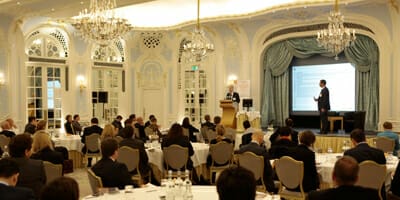

Opportunity Australia – 2011

High profile members of Australia’s financial services sector, senior political figures and offshore managers met last month in New York and London to discuss the risks and opportunities involved in entering Australia’s fast growing investment market.

Australia’s ambassador to the United States, Kim Beazley, was at  key note speaker in New York and other speakers at the Opportunity Australia series included representatives from Australia’s $79 billion sovereign wealth fund, senior investment staff from major superannuation funds and executives from the country’s leading legal, banking and financial services companies.


Sponsored Content

[vslider name=”OppAusNY”]


[vslider name=”OppAusLondon”]

Leave a Comment

Impact investing’s case for scale

Impact investing’s case for scale

Impact investing has come a long way in the past two decades, going from a niche strategy to a $1.5 trillion industry, but there are still challenges for it to reach institutional scale due to the lack of products and insufficient evidence of outperformance in some parts of the market.

Sort content by

Oxford Professor urges urgent European reform

The University of Oxford’s distinguished Professor of Economics David Vines predicted the ongoing crisis in Europe will turn into a “train wreck with implications for investors” unless governments undertake significant reforms. He urges for large write downs of the sovereign debt of southern European countries, a loosening of austerity in those countries and a significant

Fiduciary investor think tank London – delegate profile

Return to event coverage DELEGATES Jonathan Anayi, director, investment solutions, Winton Capital Ciarán Barr, investment director, RPMI Railpen Keith Carne, first bursar, Kings College, Cambridge Sarah Carter, executive director, Newton Centre for Endowment Asset Management, Cambridge University Nick Cavalla, chief investment officer, Cambridge University David Chambers, director of the Centre for Endowment Asset Management at

Concerns over private equity leave pension funds wary

Institutional investors are clearly attracted to private equity, but remain wary of the sector for its perceived lack of transparency and ability to be measured, high fees and a sense that they cannot invest into the sector as truly equal partners. “It’s clear that now is a time with a lot of flux in private

All aboard the change express as Railpen leaves the station

At the end of a corporate review process that lasted eight months, involved 23 meetings of a steering committee and produced 60 working papers, the UK railways pension fund Railpen was left with 422 action items. “We’ve done 224 of them,” Chris Hitchen, Railpen chief executive, told the Fiduciary Investors Symposium (FIS) at Harvard University.

Using a ‘foreign language shield’ to improve investment decision making

Introducing a “foreign language shield” into a decision-making process is a proven way of making better decisions, according to Cass Sunstein, the Robert Walmsey University Professor at Harvard Law School. Sunstein, a former administrator of the White House Office of Information and Regulatory Affairs (OIRA), told the Fiduciary Investors Symposium (FIS) at Harvard University that

ESG factors take centre stage in the evolving world of the fiduciary

The modern responsibilities of the fiduciary investor extend beyond what are perceived as the “mainstream” investment issues to those related to environment, society and governance (ESG) factors. But there is a growing understanding among fiduciaries that ESG considerations are now equally important in discharging their obligations. David Wood, adjunct lecturer in public policy and director of the Initiative for Responsible

Previous



