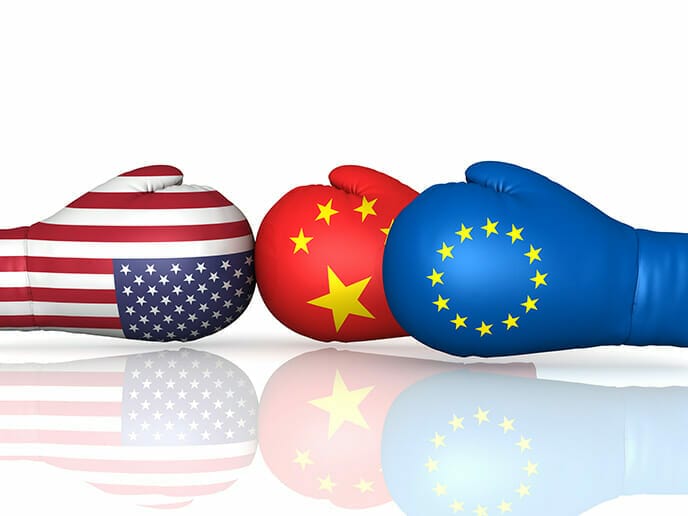

IFSWF marks rise of protectionism

Geopolitical issues, in particular the rise of protectionism, are a threat to the free flow of capital, a condition of investment extremely important to large global institutions, says Shahmar Movsumov, executive director of the $39 billion State Oil Fund of Azerbaijan.

In an interview at the International Forum of Sovereign Wealth Funds in Morocco, Movsumov, who was elected to the board of the IFSWF on Wednesday, said protectionism needed to be addressed.

At the forum, participants are celebrating 10 years since the creation of the Santiago Principles, which are credited with bringing transparency, accountability and a rule book on best practice to the sovereign wealth fund community, which represents about $10 trillion.

“When the principles were created 10 years ago, they were far-sighted and achieved a lot,” Movsumov said. “Today, there are new threats, protectionism is rising again…This might mean renewing the Santiago Principles, or maybe there are other ways we can impact that.

“The free flow of investment and capital is the most important thing for all of us, and protectionism is becoming a threat to that.”

The Oil Fund of Azerbaijan was one of the first member funds of the IFSWF to do a self-assessment of progress on the principles.

Sponsored Content

“This helped us see our gaps in relation to governance, accountability and disclosure and we made some minor adjustments,” Movsumov said. “For other SWFs, newcomers, it has been a rule book, an important set of best practices.

“They have also been important for the whole industry. [A decade] ago, SWFs were not well known players, and there were some misconceptions and concerns around their investments. This has disappeared. We are what we declare and thanks to the Santiago Principles and the IFSWF, we can show we are prudent, institutional investors without any hidden objectives.”The Oil Fund of Azerbaijan was established in 1999 with $270 million and has grown to about $39 billion.

Its policy portfolio is 60 per cent bonds, 25 per cent private and public equity, 10 per cent real estate and 5 per cent gold. The fund has dual purposes – the stabilisation of the economy and the needs of future generations. Due to the stabilisation objective, it currently has a lot of liquidity so, in reality, about 80 per cent of investments are in bonds, managed internally.

This year, the fund will contribute about $6.5 billion to the government’s budget and will receive about $10 billion from oil contracts. Azerbaijan is one of the fastest-growing economies in the world, due to its energy sector.

The executive director of the oil fund is appointed and dismissed by the president of the Republic of Azerbaijan.


For more on the Santiago Principles see:

SWFs could help global stability: forum

Abu Dhabi sovereign fund coughs up: first ever review published

Sovereign wealth funds look to risk[vc_images_carousel images=”25444,25443,25442,25441,25440,25439,25438,25437,25436,25435,25432″ img_size=”full” title=”Photos from IFSWF 2018″]

Leave a Comment

Impact investing’s case for scale

Impact investing’s case for scale

Impact investing has come a long way in the past two decades, going from a niche strategy to a $1.5 trillion industry, but there are still challenges for it to reach institutional scale due to the lack of products and insufficient evidence of outperformance in some parts of the market.

Sort content by

Investors wrestle with Europe’s demographic time bomb

Sharply declining populations in Europe, as well as countries like South Korea and Japan, have dramatic implications for economic growth and investment opportunities. Investors at FIS Oxford were warned that as depopulation occurs in certain areas, highly skilled workers will leave, creating a loss of services and fuelling political instability.

Investors face ‘economic paradigm vacuum’ post-neoliberalism 

The global economy is running in a “paradigm vacuum” as the classical theories of marginal change, equilibrium and rational markets are breaking down. Amid the void, University of Oxford professor Eric Beinhocker said investors must seek new economic tools that reflect how the world actually works.  

Opportunities and pitfalls for LPs using AI in private markets

Asset owners have a wide selection of artificial intelligence tools that product providers tout as enhancements to their unlisted investment process, but leading private markets academic Ludovic Phalippou said the reality is not that simple. Not only can AI make mistakes, it can also be tricked.

How investors are balancing the risks of investing in defence

As European countries increase defence spending, allocators are weighing up the risk and opportunity of allocating more to the sector. For some, investing in defence sits relatively comfortably with stakeholders but for others, investing "in things that kill people" remains a highly controversial conversation. 

Timothy Garton Ash: Reflections on the future of Europe

Celebrated academic Timothy Garton Ash reflects on the vital changes that Europe needs to achieve to thrive in its next evolution: success in Ukraine, its own defence industry, implementation of Draghi's recommendations, and a resolution to the cultural and social tensions gripping the continent – to name a few.

IMCO, USS and NBIM mull the risks of non-US dominant portfolios

The US has driven portfolio returns for decades, but investors are increasingly concerned that US-dominant portfolios are jeopardising precious diversification. USS, NBIM and IMCO share strategies to foster diversification including different currency exposures and investing in emerging markets.

Previous



