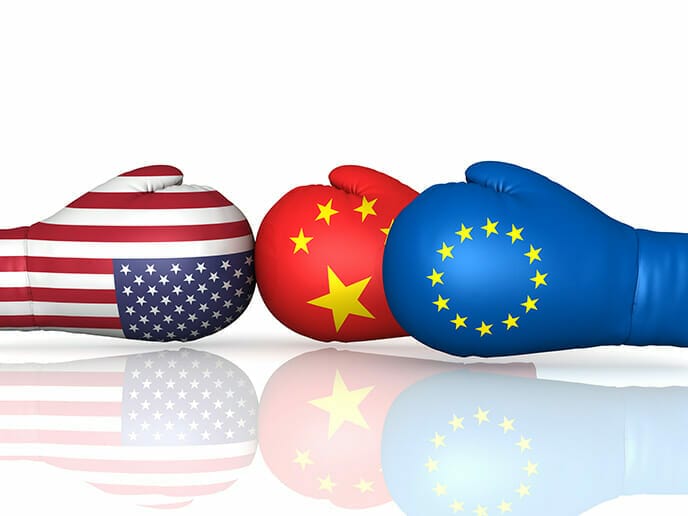
IFSWF marks rise of protectionism

Geopolitical issues, in particular the rise of protectionism, are a threat to the free flow of capital, a condition of investment extremely important to large global institutions, says Shahmar Movsumov, executive director of the $39 billion State Oil Fund of Azerbaijan.

In an interview at the International Forum of Sovereign Wealth Funds in Morocco, Movsumov, who was elected to the board of the IFSWF on Wednesday, said protectionism needed to be addressed.

At the forum, participants are celebrating 10 years since the creation of the Santiago Principles, which are credited with bringing transparency, accountability and a rule book on best practice to the sovereign wealth fund community, which represents about $10 trillion.

“When the principles were created 10 years ago, they were far-sighted and achieved a lot,” Movsumov said. “Today, there are new threats, protectionism is rising again…This might mean renewing the Santiago Principles, or maybe there are other ways we can impact that.

“The free flow of investment and capital is the most important thing for all of us, and protectionism is becoming a threat to that.”

The Oil Fund of Azerbaijan was one of the first member funds of the IFSWF to do a self-assessment of progress on the principles.

Sponsored Content

“This helped us see our gaps in relation to governance, accountability and disclosure and we made some minor adjustments,” Movsumov said. “For other SWFs, newcomers, it has been a rule book, an important set of best practices.

“They have also been important for the whole industry. [A decade] ago, SWFs were not well known players, and there were some misconceptions and concerns around their investments. This has disappeared. We are what we declare and thanks to the Santiago Principles and the IFSWF, we can show we are prudent, institutional investors without any hidden objectives.”The Oil Fund of Azerbaijan was established in 1999 with $270 million and has grown to about $39 billion.

Its policy portfolio is 60 per cent bonds, 25 per cent private and public equity, 10 per cent real estate and 5 per cent gold. The fund has dual purposes – the stabilisation of the economy and the needs of future generations. Due to the stabilisation objective, it currently has a lot of liquidity so, in reality, about 80 per cent of investments are in bonds, managed internally.

This year, the fund will contribute about $6.5 billion to the government’s budget and will receive about $10 billion from oil contracts. Azerbaijan is one of the fastest-growing economies in the world, due to its energy sector.

The executive director of the oil fund is appointed and dismissed by the president of the Republic of Azerbaijan.


For more on the Santiago Principles see:

SWFs could help global stability: forum

Abu Dhabi sovereign fund coughs up: first ever review published

Sovereign wealth funds look to risk[vc_images_carousel images=”25444,25443,25442,25441,25440,25439,25438,25437,25436,25435,25432″ img_size=”full” title=”Photos from IFSWF 2018″]


Leave a Comment

Impact investing’s case for scale

Impact investing’s case for scale

Impact investing has come a long way in the past two decades, going from a niche strategy to a $1.5 trillion industry, but there are still challenges for it to reach institutional scale due to the lack of products and insufficient evidence of outperformance in some parts of the market.

Sort content by

New Policy Concensus

We are now at a turning point, with Democrats controlling both legislative chambers and the presidency, and an emerging concensus among Democratic policy makers and their advisors that enables fiscal spending that is both significant in size and ambitious in scope. Later this year, we expect to see the first expansionary fiscal package centered around the pursuing long-term social, environmental, and competitiveness policy goals (following the more immediate COVID recovery package). In these Observations, we explore two key shifts in Democrats' thinking underlying these policy proposals, which we expect will be sustained well beyond this fiscal package.

Social Conditions Consideration

The ultimate goal of economic policy is simple and timeless - to ensure prosperity and maximise living standards. Broad macroeconomic measures such as GDP growth, the unemployment rate, and inflation had for decades been a good proxy of rising prosperity, so they have dominated economic policy making and are enshrined in most central bank mandates. But even before the COVID-19 crisis, it had become clear that traditional economic measures have increasingly diverged from social outcomes.

Secular Supply and Demand

Over the past two decades, China's secular rise dominated commodity markets, as its industrialization required a massive amount of raw materials to build up the country. As we consider the future, we see many reasons to be bullish on commodities tactically, but one of the most important secular factors will likely support industrial commodity demand for years to come: the shift in global economies away from fossil fuels and toward greener energy.

Diversity Impact Score

Throughout its history, the U.S. domestic Asset Management Industry, projected by PwC to grow to $71.2 trillion in assets under management by 20251, has exhibited an empirical lack of diversity with respect to gender and ethnicity within its ranks. Numerous studies have shown that Women and People of Color (“POC”) are underrepresented in the Industry, including a 2019 study commissioned by the Knight Foundation finding that Asset Management firms owned substantially or majority-owned by Women or POC managed only 1.3% of the Industry’s total assets under management.

Sustainability in the time of Covid-19

2020 underlined just how closely connected the world is. The pandemic broke out in a market in China but quickly spread to the rest of the world. The health crisis soon escalated into a serious economic crisis – a crisis of which we still do not know the full consequences of. Being able to act quickly and safely in a changing world is more important than ever. Many of PensionDanmark’s members and companies have endured periods of lockdown, and jobs have been lost as a consequence. The hotel and restaurant industry, the transport industry and the many employees at Denmark’s airports have been particularly hard hit. Many of the companies that were not shut down had to implement restrictions and other measures to protect themselves against COVID-19.

Asset Owner Technical Guide: Selection

The incorporation of ESG factors within the investment process has evolved from a nice-to-have to a necessity. Client demand has grown strongly, with 68% of the PRI’s asset owner signatory base addressing ESG considerations in their requests for proposals (RFPs). This means that many asset owners expect investment managers to include financially material ESG factors within their funds and investment strategies. In addition, policy makers around the world are introducing regulatory requirements for both investment managers and asset owners to disclose and report on responsible investment practices.

Previous



