
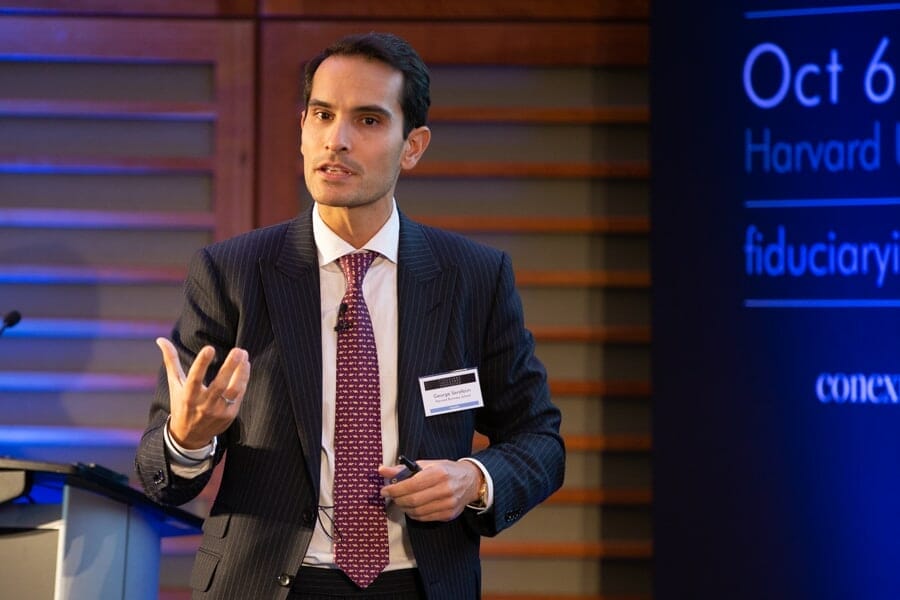

Investors should think much more about human capital and the role it plays in their investments, said George Serafeim, the Charles M. Williams Professor of Business Administration at Harvard Business School, speaking at the Fiduciary Investors Symposium at Harvard University.
It involves understanding how companies are implementing technology, how they are re-skilling and training their employees for the future, which groups of employees they are investing in, and how this impacts engagement. “We are misallocating resources and need to get much more active in asking the right questions to find the right answers. We need to understand who is being trained and why,” said Serafeim.
In reality, most companies are far behind solving key challenges in their human capital, he said. This means that they have stopped creating value, something that can’t be fixed by the “band aid” of monetary and fiscal solutions. He warned that the “system” is not working for employees because companies continue to treat them like an expense, rather than an asset. Active owners seeking to mitigate risk and drive growth need to engage with employers to help drive a change in corporate behaviour so that “companies stop spending money like some people are assets, and others are an expense.”
Outcomes not inputs
Serafeim said companies have long-recognised that building human capital drives progress. However, this is measured through the wrong lens of input and activity. Instead, success should be measured by outcomes. “Inputs and activity are the thing we do in the hope that something comes of it,” he explained. “If I go to the gym, it doesn’t mean I will definitely look good and be healthier. Inputs are a very different thing to outcomes.”
He noted that it is “much easier” to measure inputs and activity. From a monetary and policy perspective it is also much easier to be hold those responsible for inputs and activities accountable because they control them. “People are reluctant to be held accountable for the things they can’t control,” he said.
However, it is important to measure outcomes because this allows companies to provide the right incentives. He told delegates that investors should give credit to the allocator that is going to train and retrain people and create a work environment that is better from a human capital perspective. The challenge is the availability of data to allow accurate measurement of outcomes. Here, Serafeim has derived a human capital development metric that focuses on outcomes rather than inputs that shows with “reasonable accuracy” the human capital development metric for thousands of companies, providing exploratory evidence on its relationship with employee productivity.
Serafeim said that the impact of technology on the future of work is difficult to understand and forecast. He warned that technology would change the mix of skills, knowledge and capabilities needed to perform tasks. However, many occupations in the economy would be unaffected by technology, particularly those outside the corporate sector. He also noted that companies facing high levels of automation are also investing most in re-skilling employees. “In these industries, people are trying to build training, skills and knowledge to transition people to other types of jobs,” he said.
However, questions remain about what types of skills and re-training these companies are offering, and how productive it really is. Industries facing high levels of automation are also facing high turnover rates and challenges around retention. “It is about trying to understand which skills and knowledge are best value for money.” Here he noted that analysis of skills showed high demand for reasoning skills, yet this is not what many people learn in a corporate environment.








Leave a Comment
You must be logged in to post a comment.
Login