
Healthcare’s multiple opportunities

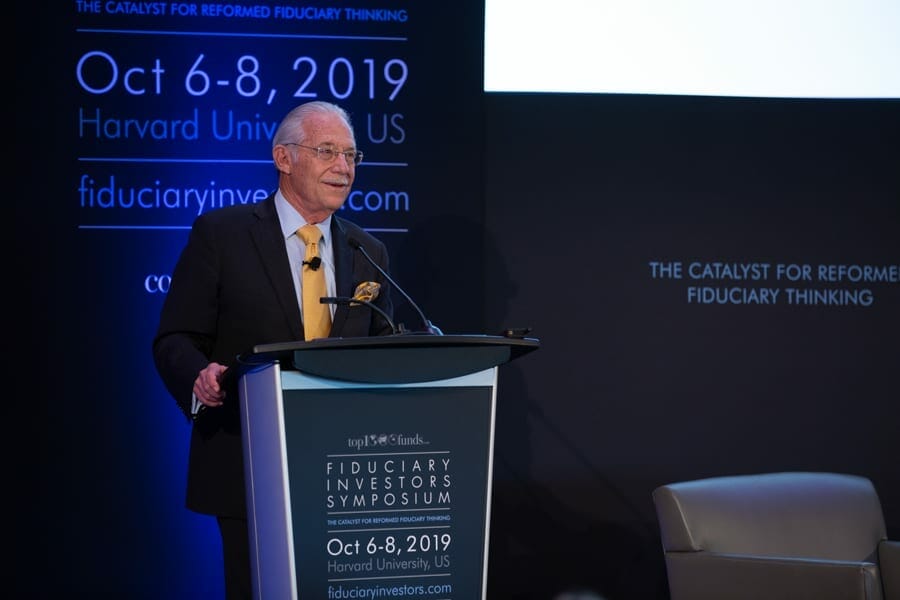
William Haseltine had a long career at Harvard Medical School where he was at the forefront of medical research and application. He educated a generation of doctors, designed the strategy to develop the first treatment for HIV/AIDS, and led the team that pioneered the development of new drugs based on information from the human genome. He addressed the Fiduciary Investors Symposium about important topics in medicine and health development including the role of technology and the intersection of medicine and ethics, and the importance of ensuring that quantum advancements in medical technology translate to improved health outcomes around the world.

Healthcare is one of the most exciting investment opportunities for asset owners, said William Haseltine, chair and president of ACCESS Health International, a nonprofit organisation he cofounded in 2007. Speaking to delegates at the Fiduciary Investors’ Symposium at Harvard University, and drawing on his extraordinary career in both science and business, he outlined the investment opportunities ahead. Healthcare provides opportunities in the short and long-term which range from high-tech to venture through to real estate. It is also continuously fuelled by rising income levels all over the world, he said.

Haseltine expressed his optimism in extending working lives, referencing his sister’s as well as his own, career. Age 78, she recently begun a ten-year post at the University of Texas, while he, at a similar age, is also “receiving a salary, writing lots of books, employed and employing people and still contributing to social security.”

Two areas of startling, transformative, progress include “our understanding of DNA and cells”, he said. Genomics is one area he has particularly focused, harnessing its power to diagnose illnesses where he notes the emergence of personalised medicine. New tools are allowing the sector to understand how genes change, determine DNA sequences leading to synthetic biology and biological manufacturing.

“Just now we are beginning to get pay off in terms of new medicines,” he said.

Sponsored Content

Elsewhere the “greatest breakthroughs” are being made in cancer medicine, mostly around using our own immune systems to fight cancer. The first phase of cancer treatment focused on cutting the cancer out, next came chemotherapy where “we realised we could kill the cancer a little bit before we killed people.” Then came revolutions around specific drugs for specific cancers, but the challenge here is that cancer changes and adapts. Now new practices centre around immunology. The challenge here is getting our immune systems to fight cancer, but not to the extend we “end up fighting ourselves” and develop auto immune diseases.

“The side-effect of immune therapy is auto immunity. We need to know how to control it,” he said.

There are many other uses of cells, he said. Like taking skin cells and “turning them into the equivalent of a fertilised egg,” or developing special tissues from cells like pieces of brain and blood vessels. Though he said these pioneering methods take years to develop.

“Are we going to be able to use our cells to turn the genetic clock back to zero and replace worn parts? I’m sure we can do it, but it will take a long time.” He said there was a “lot more information” and complexity that goes into making our body than just DNA.

Elsewhere, miniaturisation is changing medicine, allowing experts to use materials and architect them at the same level of our bodies. Robotics are also transforming our ability to develop instruments that read our intentions with life-changing consequences for paralytics, or those suffering from epilepsy.

The structure and delivery of healthcare is also on the cusp of change. In the past we have built big hospitals; in the future we will need distributed healthcare. Rather than people travel to hospitals, medical care will be delivered in the community and home. This is being driven by changes in IT that allow doctors to “know what is going on in the centre and the periphery.” A distributed healthcare system will see out-patient centres in communities, plus education and prevention centres and home care, in a structure that is less costly and what he believes is the “only way” ahead.

It equates to a huge investment opportunity, as does the integration of social care and medicine.

“A lot of the care we need is social care; we don’t always need the doctor,” he said.

He also argued that under a new, distributed healthcare system the goal is for people to be healthy with an emphasis on prevention, whereby treatment is the final option. He also envisages new personalised healthcare whereby the system is constructed to “touch life personally” with tailored programs and personalised information systems.

Leave a Comment

Modern slavery needs investor action

Modern slavery needs investor action

Asset owners and managers can help solve modern slavery and invest to stem the suffering of the 40.3 million workers in the world trapped in some form of labour abuse.

Sort content by

Disruption in demographic trends

Demographic trends will have a profound impact on pension funds’ investment returns, argued Patrick Zweifel, chief economist at Pictet Asset Management speaking at the Fiduciary Investors’ Symposium at Harvard University. He said ageing populations mean retirement ages need to rise and will see pension funds increase risk to stretch for returns.

The dangers of MMT: A counter argument

Look no further than the economic travails of Italy and Japan to see the perils of Modern Monetary Theory, MMT, said Sonal Desai, CIO, fixed income at Franklin Templeton. Speaking at the Fiduciary Investors’ Symposium at Harvard University, she countered the arguments of Stephanie Kelton, a leading MMT scholar at Stony Brook University and senior economic advisor to presidential candidate, Senator Bernie Sanders who espoused the virtues of MMT in a previous session MMT: A solution to broken policy?

FIS Harvard 2019 podcasts

The Fiduciary Investors Symposium at Harvard University brought together more than 85 asset owners from 20 countries to discuss globalisation, human capital, inequality, longevity, technology, medicine and ethics, and the role of institutional capital in creating real change in the world. We were joined by many distinguished speakers and have put together a podcast series of our favourite sessions.

Threats to equity bond correlation

A full-blown trade war, and changes in monetary policy triggered by a loss of credibility in the Federal Reserve and other global policy institutions, could result in a return of the positive correlation between bonds and stocks, and investors need to be aware of the risk, warned Luis Viceira, George E. Bates Professor in the Finance Unit and Senior Associate Dean for Executive Education at Harvard Business School, at the Fiduciary Investors’ Symposium at Harvard University.

Inequality risk equal to climate change

Rebecca Henderson, the John and Natty McArthur University Professor at Harvard University who co-teaches Reimagining Capitalism at HBS, says inequality is equal to climate risk in its potential impact. She told delegates at the Fiduciary Investors Symposium at Harvard University when a system no longer generates freedom and prosperity it must be changed. Change is possible because we have the resources and technology to do it. A first move is decent jobs for people at the “bottom”.

We are going to live longer; prepare now

Understanding the economic implications of changing demographics is essential for investors, said Aubrey de Grey, a biomedical gerontologist speaking at the Fiduciary Investors' Symposium at Harvard University He said the technology exists today so that the ageing process can be combated and people will live much longer in the future than what they do today, so really “longevity is a side effect of health”. He urged investors to think about how people living longer will affect consumer behaviour and investee companies.