

The hype and near-hysteria around AI and its potential to revolutionise businesses and industries can be difficult to see past and presents asset owners with a difficult decision: to invest in new, rapidly evolving technology and run the risk of backing something that doesn’t work out in the long term; or wait and see, and run the risk of missing some stellar investment returns.
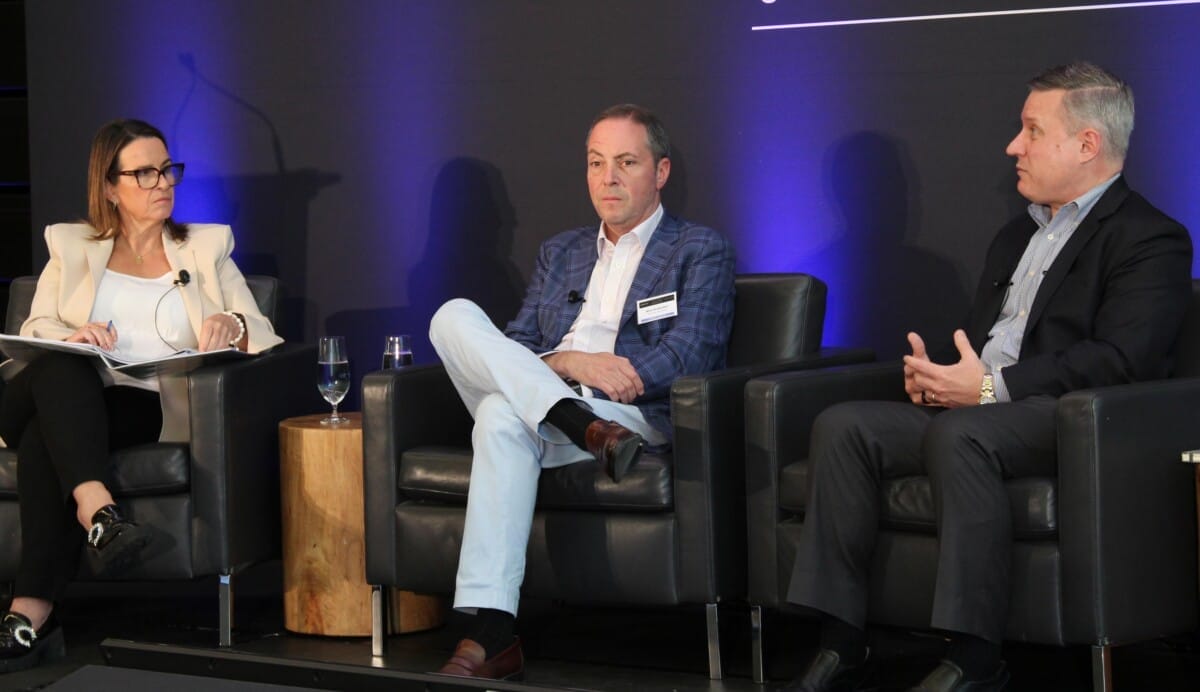
Identifying the specific impact of AI on businesses is vexing at a time when US companies are already “as profitable as they’ve ever been”, Employees Retirement System of Texas chief investment officer David Veal told the Fiduciary Investors Symposium in Toronto.
“That makes sense at some level,” Veal said.
“The question is, okay, does that mean revert, or is there another leg to this? That’s where this really starts to factor in that some of that thinking is, look, you can do new things or enhance margins even further, potentially. That’s great news for corporate America, which is generally good for the stock market.”
But there will also be industries and businesses that are negatively affected – the benefits of the technology will not be evenly distributed economy-wide, “and it’s worth thinking through what that looks like, as well”, Veal said.
Veal said ERS has an internal public equities team that has been considering these questions in depth for some time, and so far so good.
“We’ve owned Nvidia at size, we’ve gotten this trend right, which is one of the reasons our performance has been as good as it has been,” he said.
“But the question is, how do you sustain that? How do you stay on top of these trends?”
Impact on internal practices
Veal said he also worries about the impact on ERS’s internal business practices.
“A paper out of the University of Chicago last week talked about the fact that AI, Chat GPT, is actually better at predicting earnings than human analysts,” he said.
“Okay, how do you think about that? One of the other conclusions from that paper was the fact that Chat GPT plus a human analyst is actually better than either one individually. That’s something we can work with.”
From an investment perspective, seeking to capitalise on the potential of AI presents a series of risks, not least of which is concentration risk, because recent AI development, at least, is being driven by a very small number of very large organisations, such as Google, Microsoft and, of course Nvidia.
It also presents the downside risk of backing the wrong horses in the AI race. And it presents very clear and present career risk for investment professionals who consciously avoid AI opportunities, take a wait-and-see approach and miss the potentially enormous upside.
“The hardest part is, is where do you make your commitments?” Veal said.

“Do you change the way you commit capital? We don’t have a lot of exposure to venture capital, for example, [but] that’s been by design – we didn’t feel like we have the scale. But does that need to change? Is it too late to change? Something that we are really wrestling with is: have we missed the boat in some way?”
Jennison Associates managing director Nick Rubinstein told the symposium that AI is “at a seminal moment” from an investment perspective.
“AI essentially takes all of the [enabling technology] pieces that we’ve put into place, along with the predictive learning element, and enables us to essentially make predictions, streamline businesses, and potentially augment both top-line growth and cost efficiencies within organisations, as it democratises access to all of this data that we’ve created for decades so far,” Rubinstein said.
“And also it will add incredible amounts of efficiency to processes that previously were incredibly inefficient.”
Take-up will accelerate
The symposium heard earlier that initially the take-up of AI across businesses and industries has been limited, but it will accelerate exponentially as a wide range of use-cases are validated and results become tangible.
“So far, we’ve basically put the building blocks in place, and you’ve seen the growth, especially in companies like Nvidia and what we like to call the picks and shovels providers,” Rubinstein said.
“The cloud companies build the infrastructure, but then you need the applications to run on them. So the way we think about it is looking across industries. Where can these efficiencies be distributed?”
Rubinstein said there are practical applications of AI emerging across economies and often in some unexpected areas, such as agriculture where it builds on already existing automated practices.

“But now the next wave will be in the farming industry,” he said.
“How do you do predictive farming? How do you take inputs of weather patterns of past years? Which areas of your farm crops did better? How do you see those crops and embed all of that intelligence into an industry that used to be an incredibly manual process?”
Other industries such as healthcare, travel and customer service were candidates for AI-driven enhancements, Rubinstein said.
“There’s going to be a lot of diagnosis that goes on. We’re in the early days of measuring returns. And I think [Ajay Agrawal’s] example is very good, which is, can you get a 20 per cent productivity advancement in two years? If you can, you’ll probably make that investment regardless,” he said.
“But if you look over a longer-term framework, and suddenly the impact of that return multiplies and essentially goes geometric, then I think that will knock down the walls of mass adoption across industries.”
AI is even being applied to AI itself, Rubinstein said. Nvidia, has used the technology to cut its own product cycles.
“Product cycles that for Nvidia used to take two and a half years suddenly became two-year cycles,” he said.
“Within the past few years, that’s gone down to a year and that’s because they take the building blocks of what they had done for prior product cycles, applied them to go forward, and suddenly, their time to market was essentially cut by more than half.”







Leave a Comment
You must be logged in to post a comment.
Login