
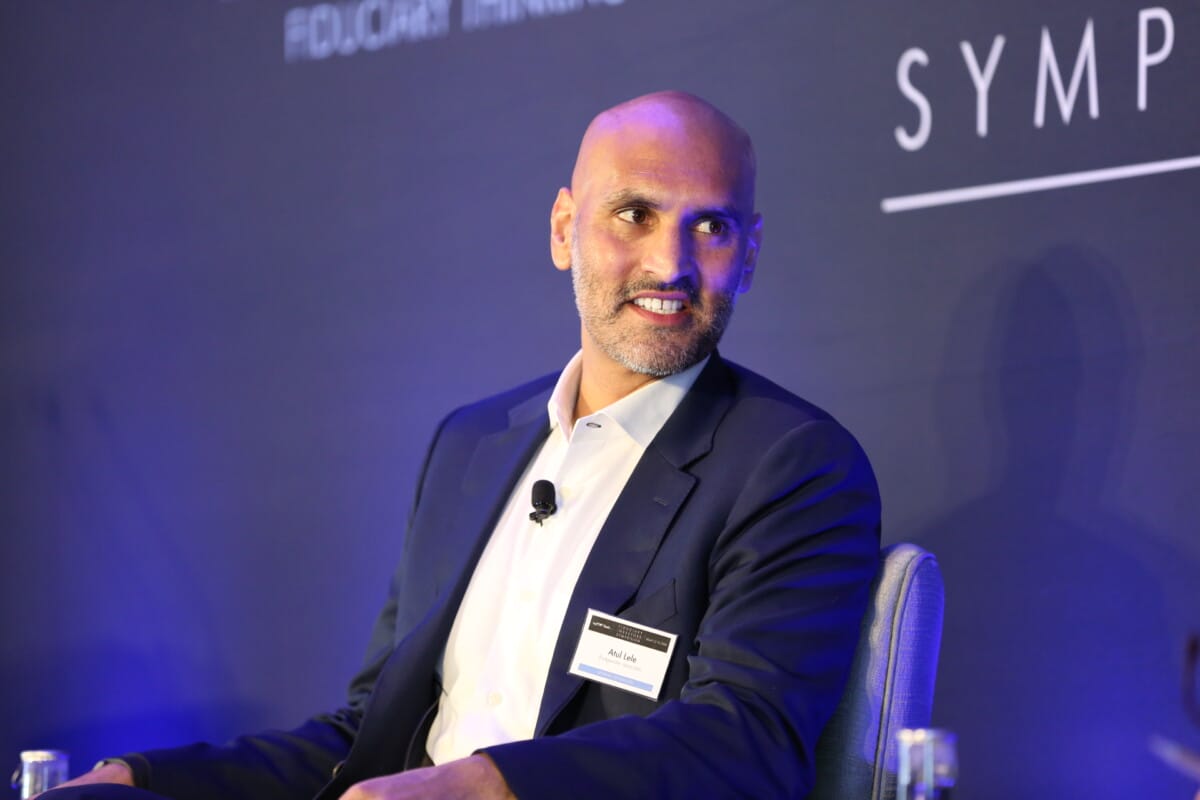

Bridgewater Associates has a house view that the world is moving into a period of macro-volatility and global conflict, following a half-century period of relative harmony and pro-growth market conditions. But despite the myriad geopolitical and environmental risks facing investors, Bridgewater senior portfolio strategist Atul Lele says it is investors’ unwillingness to break with the model portfolios of the past that presents the greatest threat to institutional portfolios.
Opening the Fiduciary Investors Symposium in Singapore earlier this month, Bridgewater Associates senior portfolio strategist Atul Lele argued investors had entered an “environment of great secular change”.
Echoing sentiments made by Bridgewater co-CIO Greg Jensen late last year, Lele argued that many of the pro-growth and disinflationary forces that had been advantageous to investment returns over the past half century were starting to subside, as deglobalisation is replaced by regionalisation and governments and labour unions regain strength after decades of deregulation.
Then, there are the additional and emerging challenges presented by climate change and artificial intelligence, he said.
“For the better part of 40 years you’ve seen secular disinflation as globalisation led to a decline in cost structures,” Lele said.
“As we fast forward to today, almost all of these secular disinflationary pressures are now fading – globalisation is turning to regionalisation, de-unionisation is returning to re-unionisation and income tax rates are rising across the OECD.”
But while these shifting macro conditions present financial – and in some cases, physical – risks to institutional portfolios, the greatest threat is posed by investors’ own unwillingness to respond to them, Lele argued.
He described the continued adherence to traditional 70:30 portfolios, in spite of the shifting macroeconomic reality, as the “biggest risk we see around the world”.
“When we look at the performance of most traditional 70:30 portfolios, they’ve just had their best decade ever. And most investors we see are still anchored to this portfolio or some variant of it. Yet today, the pro-corporate , pro-liquidity, pro-global harmony disinflationary winds that have been around for the past 50 years are now fading,” he said.
“When we look at all the drivers of portfolio outcomes – growth, inflation, policy, geopolitics, globalisation, the corporate environment, the energy backdrop, technology – all of these are shifting very, very rapidly.
“And so the question for investors is how to deal with it and that turns to the idea of portfolio resiliency. The answer isn’t just to dump equities, the answer is to think very seriously about how to make portfolios more resilient.”
Pulling the right lever
He urged the audience – which included 65 institutional asset owners from 15 countries – to determine their own definition of what portfolio resiliency meant to them. But he also offered Bridgewater’s definition that resilience refers to the ability to achieve target returns across the wide range of risky and shifting scenarios investors face.
Lele posited four specific elements of resiliency: narrowing the range of possible outcomes by mitigating risk; reducing the severity of tail-risk outcomes; reducing the likelihood of sustained periods of under-performance and raising the average return across different economic environments.
Given Bridgewater’s thesis that investors are facing an increasingly complex and fraught environment, Lele made the point that not all tail-risks can be mitigated. Institutional investors will therefore need to prioritise between vulnerabilities based on their objectives, values and those of their stakeholders.
“Then they need to pull levers,” he said. “Such as big portfolio shifts – moving out of equities to bonds for example, or shifting into infrastructure for inflation protection — or more tactical such as following trend-following strategies and tail risk hedging strategies and so on. It’s important investors think about the full range of levers available to them.”
Another key risk identified was benchmark allocations to Asian markets, which dramatically under-value the growing independence and importance of Asia in the global economy. He said investors should consider an “intentional shift” to Asian markets, revealing that Bridgewater’s portfolio allocation was in the realm of 15 to 20 per cent.
“Geographic diversification is absolutely top of mind for us,” Lele said. “Most investors are disproportionately invested in US and Europe.
“[Asian exposure is] hugely diversifying to portfolios …[and] hugely supportive of sharp ratios.”








Leave a Comment
You must be logged in to post a comment.
Login